
December 29, 2025
10 Key Benefits of Standard Operating Procedures for Scalable Growth in 2025

Unlock efficiency and consistency. Discover the top 10 benefits of standard operating procedures for faster onboarding, reduced errors, and scalable growth.
In a fast-paced business environment, 'tribal knowledge' and inconsistent workflows are silent growth killers. They create bottlenecks, frustrate new hires, and lead to unreliable outcomes for clients and customers. Many teams believe creating Standard Operating Procedures (SOPs) is a bureaucratic chore, but what if it was the single most impactful investment in your company's efficiency and scalability? This isn't just about documenting what you do; it's about creating a repeatable blueprint for success that anyone can follow.
This guide moves beyond the abstract to explore the concrete, measurable benefits of standard operating procedures. We'll break down 10 critical advantages, from slashing onboarding time to boosting customer satisfaction, and provide actionable steps to implement them immediately. You'll learn how to transform your operations with practical examples tailored for agencies, support teams, and HR departments.
By the end, you will understand how to:
Establish unwavering consistency across all projects and teams.
Accelerate new hire training and reduce ramp-up time.
Retain critical process knowledge, even when team members leave.
Measure performance and drive data-backed improvements.
Forget seeing SOPs as rigid rules. Instead, view them as the foundational framework for building a more consistent, efficient, and scalable organization ready for any challenge. Let's dive into the advantages that will unlock your team's full potential.
1. Improved Consistency Across Teams and Clients
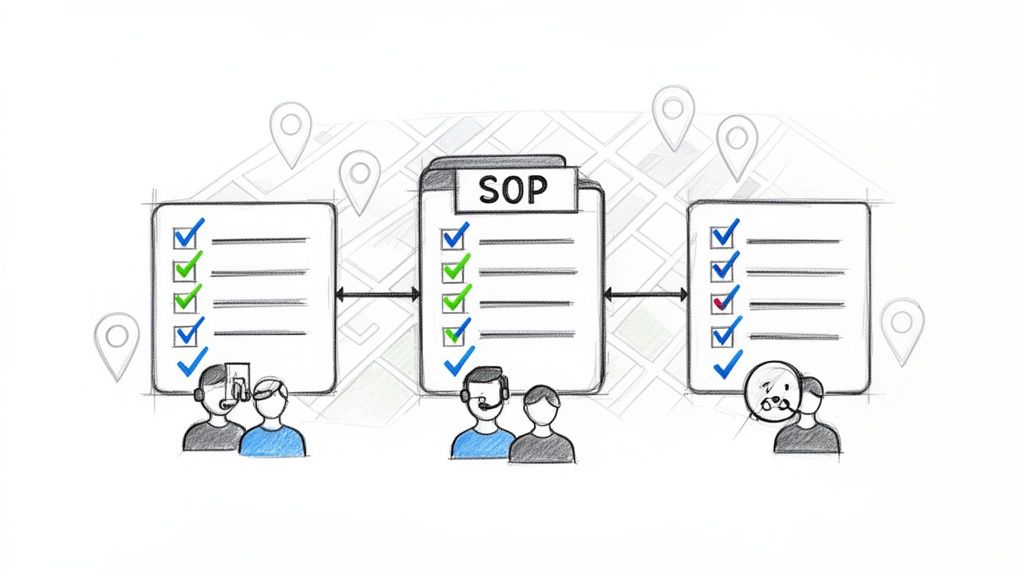
One of the most immediate benefits of standard operating procedures is the dramatic improvement in consistency across your organization. When every team member follows a clearly documented process, the variability in execution and outcomes disappears. This creates a reliable, high-quality experience for both internal stakeholders and external clients, regardless of who performs the task or where they are located.
This uniformity is crucial for maintaining brand standards and service quality. For agencies, it means every client onboarding is just as thorough as the last. For support teams, it guarantees every customer ticket is resolved with the same level of care and precision.
Why Consistency Matters
Inconsistent processes lead to unpredictable results, which can damage client trust and create internal friction. When an agency delivers a stellar project for one client but a mediocre one for another due to process gaps, its reputation suffers. SOPs act as the quality control mechanism that ensures every deliverable meets a predefined standard. This reliability becomes a core part of your value proposition.
How to Implement for Consistency
Start with high-frequency tasks: Identify and document the processes your teams perform most often, such as weekly client reporting or new employee onboarding.
Use visual aids: Incorporate screenshots, video snippets, and visual callouts in your SOPs to clarify complex steps and leave no room for misinterpretation.
Establish a central repository: Use a tool like Build a Guide to house all your SOPs in one accessible location, ensuring no one is working from an outdated version.
Iterate, don't replace: When a process evolves, update the existing SOP rather than creating an entirely new one. This maintains a single source of truth and avoids confusion.
2. Dramatically Reduced Onboarding Time
One of the most significant benefits of standard operating procedures is their power to accelerate the onboarding process for new employees, clients, and customers. Instead of relying on time-consuming, one-on-one training, new team members can use self-service guides to learn processes independently. This frees up senior staff from repetitive training tasks and empowers new hires to become productive faster.
This self-directed learning is critical for scaling teams. For distributed companies, it means remote employees can onboard asynchronously without scheduling conflicts. For agencies, it allows client kickoffs to focus on strategy instead of basic setup, creating a more professional first impression and getting to high-value work sooner.

Why Faster Onboarding Matters
Slow, unstructured onboarding leads to disengaged new hires and frustrated clients. It creates a bottleneck where growth is limited by the training capacity of your existing team. SOPs break this dependency by turning institutional knowledge into a scalable asset. A SaaS company can use customer-facing guides to reduce setup-related support tickets by over 40%, while an HR department can ensure every new employee has a consistent and comprehensive Day One experience.
How to Implement for Faster Onboarding
Record real workflows: Create SOPs by recording a team member performing the task. This captures authentic steps and nuances that are often missed in theoretical documentation.
Create role-specific guides: Develop separate SOPs for different roles or experience levels. A "quick start" guide is perfect for an expert user, while a detailed version is better for a novice.
Analyze engagement: Use analytics to see where new users get stuck or drop off in a guide. This data provides a clear roadmap for improving confusing sections.
Incorporate video: Embed short video tutorials within your SOPs to demonstrate complex steps visually, catering to different learning styles.
3. Enhanced Knowledge Preservation and Reduced Tribal Knowledge
A significant long-term benefit of standard operating procedures is their power to capture and preserve institutional knowledge. Without documentation, critical processes often become "tribal knowledge," existing only in the minds of a few experienced team members. This creates a massive operational risk; when a key employee leaves, their expertise walks out the door with them, leaving the team to scramble.
SOPs solve this by systematically converting individual know-how into a shared, accessible asset. This is vital for operations teams with complex workflows and agencies aiming to maintain consistent client engagement strategies even as staff changes. By documenting procedures, you build a resilient institutional memory that outlasts any single team member.

Why Knowledge Preservation Matters
Tribal knowledge is a silent business killer. It creates bottlenecks, as teams become overly reliant on a single person for answers. It also makes your organization fragile, as employee turnover can erase years of process refinement and learning overnight. By documenting core processes, you democratize expertise and ensure business continuity is not dependent on individual memory. This transforms valuable experience from a liability into a scalable asset.
How to Implement for Knowledge Preservation
Conduct exit interviews: Make knowledge transfer a formal part of the offboarding process. Use this time to have departing employees document their unique workflows and insights.
Explain the "why": Don't just list steps. Include the context and reasoning behind a process to preserve the strategic intent, helping future team members make better decisions.
Assign ownership: Assign a specific person or team to own and maintain each SOP. This ensures the documented knowledge remains accurate and up-to-date as processes evolve.
Use collaborative tools: Leverage platforms like Build a Guide where team members can contribute to and validate procedures, ensuring the captured knowledge is comprehensive. Learn more about how to record once and guide forever.
4. Decreased Support and Customer Service Costs
One of the most impactful financial benefits of standard operating procedures is a significant reduction in customer support costs. When comprehensive guides and procedures are made available to customers, they become empowered to resolve common issues independently. This self-service model drastically lowers the volume of incoming support tickets.
This shift allows your support team to move from handling repetitive, low-level inquiries to focusing on complex, high-value problems that truly require human expertise. For SaaS companies and product teams, this means fewer resources are spent on answering the same questions, leading to a more efficient and cost-effective support operation.
Why Cost Reduction Matters
High support ticket volume directly translates to increased operational costs, including staffing, software, and time. By creating clear, accessible SOPs for common customer issues, you deflect a large percentage of these inquiries. For instance, SaaS companies have seen support costs drop by 30-40% by implementing comprehensive customer-facing guides. This not only saves money but also improves customer satisfaction by providing instant answers.
How to Implement for Cost Reduction
Analyze ticket data: Review your support tickets to identify the most frequently asked questions. Prioritize creating detailed SOPs and guides for these recurring issues.
Create quick-reference guides: Develop short, easy-to-follow guides for the top 10 most common support problems. Make them highly visible in your help center or app.
Link guides in responses: When a ticket for a documented issue does come in, have support agents respond with a direct link to the relevant guide. This trains customers to look for answers first.
Use analytics for improvement: Track which guides are used most and where users might be struggling. Use this data to refine your documentation and make it even more effective.
5. Improved Compliance and Risk Management
One of the most critical benefits of standard operating procedures is their role in strengthening compliance and mitigating risk. When processes are clearly documented, they provide tangible evidence that your organization adheres to regulatory requirements, industry standards, and internal policies. This creates an auditable trail, demonstrating that your team follows approved guidelines and has been trained accordingly.
This documentation is non-negotiable in highly regulated sectors like finance, healthcare, and manufacturing. For a financial firm, SOPs for Know Your Customer (KYC) procedures are proof of anti-money laundering efforts. For agencies handling European client data, SOPs show a commitment to GDPR. In essence, SOPs transform abstract compliance rules into actionable, everyday tasks.
Why Compliance Matters
Failing to meet compliance standards can result in severe consequences, including hefty fines, legal action, and reputational damage. Without documented procedures, proving adherence during an audit becomes nearly impossible. SOPs act as your organization's first line of defense, proactively reducing legal and financial risk by embedding compliance directly into your operational fabric. They ensure that every action taken is deliberate, traceable, and defensible.
How to Implement for Compliance
Embed regulations directly: Reference specific legal statutes or industry standards (e.g., HIPAA, ISO 9001) within the relevant steps of your SOPs.
Use strict version control: Maintain a complete history of all SOP changes to provide a clear audit trail. This shows how processes have evolved to meet new requirements.
Document decision rationale: For complex compliance steps, include a brief explanation of why the procedure is structured a certain way to demonstrate intent.
Schedule regular reviews: Mandate periodic reviews of compliance-related SOPs with legal or quality assurance teams to ensure they remain current and effective.
6. Increased Productivity and Efficiency Gains
A significant benefit of standard operating procedures is the immediate boost in organizational productivity. When processes are clear and accessible, employees spend less time figuring out what to do next and more time executing high-value tasks. This eliminates decision-making delays and reduces the back-and-forth communication that consumes valuable work hours.
The result is a more efficient operational engine. Operations teams can reduce task completion times significantly, while marketing agencies can deliver client projects faster through standardized workflows. This efficiency gain isn't just about saving time; it's about reallocating that time to innovation, client service, and strategic growth initiatives.
Why Efficiency Matters
Inefficient processes create operational drag, leading to missed deadlines, bloated project budgets, and employee burnout. When a support agent has to ask a colleague how to handle a specific ticket type, both agents lose productive time. SOPs remove these bottlenecks, creating a streamlined path from task assignment to completion. This operational smoothness allows teams to handle higher volumes of work without sacrificing quality, directly impacting the bottom line.
How to Implement for Efficiency
Measure baseline task times: Before implementing an SOP, track how long a task currently takes. Measure again after the SOP is in use to quantify the productivity improvement.
Identify process bottlenecks: Use process mapping to visualize a workflow and pinpoint steps that cause delays. Design your SOP to eliminate or streamline these specific friction points.
Learn from your top performers: Document the methods used by your most efficient team members. Their shortcuts and best practices can become the new standard for everyone.
Build a feedback loop: Actively solicit feedback from the team members using the SOPs. Their on-the-ground insights are invaluable for continuous optimization and refinement.
7. Enhanced Scalability and Growth Enablement
One of the most powerful benefits of standard operating procedures is their ability to fuel sustainable growth. Well-documented processes enable you to scale operations without a proportional increase in leadership oversight or training costs. Instead of growth being bottlenecked by the capacity of senior team members, SOPs empower new hires to become productive almost immediately.
This scalability is a game-changer for ambitious organizations. For agencies, it means taking on a larger client portfolio without sacrificing quality. For SaaS companies, it allows for the rapid onboarding of thousands of new users through self-service guides, turning documented processes into a core component of the product experience itself.
Why Scalability Matters
Growth without a scalable foundation leads to chaos. Processes break, quality drops, and team burnout becomes inevitable. As you add more clients or employees, informal, "tribal knowledge" systems cannot keep up, leading to costly errors and missed opportunities. SOPs provide the essential framework that supports expansion, ensuring that your operational capacity grows in lockstep with your business ambitions. This prevents growth from becoming a liability and turns it into a strategic advantage.
How to Implement for Scalability
Design for future growth: When documenting a procedure, consider how it would function with double the team size or triple the workload. Build in checkpoints and automation triggers from the start.
Use modular templates: Create core SOP templates for common workflows, like client onboarding or project kickoffs. This allows teams to quickly customize and deploy procedures for new projects or markets.
Document before you scale: Don’t wait until you are overwhelmed to start documenting. Proactively create SOPs for key functions so they are ready to guide new team members during a growth spurt.
Build feedback loops: Implement a system for new hires to report on where SOPs are unclear or inefficient. This feedback is invaluable for identifying and fixing scaling challenges early.
8. Improved Customer Experience and Satisfaction
One of the most powerful, yet often overlooked, benefits of standard operating procedures is their direct impact on customer experience. When support teams follow standardized resolution workflows and clients receive consistent, high-quality deliverables, satisfaction and trust skyrocket. SOPs transform customer interactions from unpredictable gambles into reliable, positive experiences.
This is especially critical for SaaS companies and service-based agencies. For a software product, clear, customer-facing guides for onboarding or feature use can dramatically reduce support tickets and churn. For an agency, providing clients with professional documentation on project processes builds confidence and reinforces your value.
Why Customer Experience Matters
A single poor interaction can lose a customer forever. Inconsistent support, confusing product instructions, or unreliable service delivery directly erodes your customer base and harms retention. SOPs act as a quality guarantee for every customer-facing process, ensuring each interaction meets a high standard of care and efficiency. This consistency is what builds loyalty and turns customers into advocates. For a deeper look at how procedural clarity elevates client outcomes, explore this case study on improving Medicare patient satisfaction.
How to Implement for Customer Satisfaction
Create customer-facing guides: Document key product workflows, onboarding steps, or common troubleshooting solutions and share them directly with customers to empower self-service.
Design from the customer's perspective: Write guides using language your customers understand, not internal jargon. Focus on their goals and pain points.
Standardize support responses: Equip your support team with SOPs for handling common issues, ensuring fast, accurate, and consistent resolutions every time.
Gather feedback and iterate: Actively solicit customer feedback on your guides and support processes. Use analytics in a tool like Build a Guide to see where users get stuck and continuously refine your documentation.
9. Better Decision-Making and Quality Control
One of the most strategic benefits of standard operating procedures is the enhancement of both decision-making and quality control. SOPs provide a clear framework with predefined criteria, removing subjectivity and guesswork from critical operational choices. This ensures that decisions made by different team members are consistent and aligned with organizational standards.
This structured approach is invaluable in complex situations. For support teams, it means using documented escalation criteria to prioritize issues correctly every time. For HR departments, it ensures every hiring decision is based on the same standardized evaluation procedure, promoting fairness and quality. Quality control stops being an abstract goal and becomes a measurable, verifiable process based on documented standards.
Why Decision Frameworks Matter
Without a documented framework, decisions are often based on individual judgment or past experience, which can be inconsistent and unreliable. This variability introduces risk, especially in client-facing roles. When an agency uses a client service decision framework, it guarantees that every account manager handles difficult situations with the same strategic approach, protecting client relationships and ensuring consistent outcomes. SOPs turn reactive problem-solving into proactive, standardized execution.
How to Implement for Better Decisions
Document decision criteria: For key processes, clearly outline the "if-then" logic. For example, "If a customer bug report is classified as 'critical,' then escalate to the engineering lead within 30 minutes."
Create decision trees: Visualize complex scenarios with simple decision trees or flowcharts. This is especially effective for customer service escalations or project management approvals.
Define exception handling: No SOP can cover every possibility. Include a clear procedure for handling exceptions, specifying who to consult when a situation falls outside the standard process.
Build in feedback loops: Regularly review the outcomes of decisions made using your SOPs. Use this data to refine and improve the decision criteria over time, ensuring your processes evolve with your business.
10. Measurable Performance Metrics and Continuous Improvement
Standard operating procedures move process optimization from the realm of guesswork into data-driven decision-making. By pairing your SOPs with engagement analytics, you gain quantifiable data on how teams execute processes, where they get stuck, and which steps cause confusion. This creates a powerful feedback loop for continuous improvement.
This objective data is far more reliable than anecdotal feedback. Instead of assuming a process is inefficient, you can see exactly where bottlenecks occur. For example, analytics might reveal that support agents repeatedly pause or abandon a troubleshooting guide at a specific step, indicating that the instruction is unclear and needs immediate revision.
Why Data-Driven Improvement Matters
Without measurable metrics, improving your procedures is a subjective effort. You might "streamline" a process only to find it has no impact on efficiency or, even worse, creates new problems. Objective data allows you to pinpoint weaknesses with surgical precision, ensuring your optimization efforts are targeted and effective. This is one of the most powerful benefits of standard operating procedures when managed correctly.
For operations teams, this means identifying that a streamlined invoicing SOP reduces average completion time by 30%. For customer success managers, it means proving that clients who engage with onboarding guides have a 25% higher retention rate, directly tying process adherence to business outcomes.
How to Implement for Measurable Improvement
Establish baseline metrics: Before updating an SOP, measure its current performance, such as completion time, error rate, or user engagement.
Track engagement analytics: Use a platform like Build a Guide to monitor how users interact with each step, identifying drop-off points or areas of hesitation.
Correlate SOPs with KPIs: Connect guide completion rates with key business outcomes, like reduced support tickets or faster client onboarding, to demonstrate ROI.
Schedule regular reviews: Set aside time to analyze performance data and act on the insights. Learn more about how to keep SOPs up-to-date without a meeting.
10-Point SOP Benefits Comparison
Item | Implementation Complexity 🔄 | Resource & Maintenance Effort ⚡ | Expected Outcomes 📊 | Ideal Use Cases 💡 | Key Advantages ⭐ |
|---|---|---|---|---|---|
Improved Consistency Across Teams and Clients | Moderate — requires centralized docs, version control and templates | Moderate ongoing upkeep and role management | High uniformity and reduced quality variance ⭐⭐⭐⭐ | Agencies, distributed teams, multi-client environments | Fewer errors; simpler training; predictable delivery |
Dramatically Reduced Onboarding Time | Moderate — build interactive, visual guides and navigation | Moderate to high initial creation; low ongoing per-guide updates | Much faster time-to-productivity and fewer support requests ⭐⭐⭐⭐ | SaaS onboarding, customer success, rapid-hire teams | Faster onboarding; scalable self-service training |
Enhanced Knowledge Preservation and Reduced Tribal Knowledge | Moderate — capture tacit knowledge via interviews and co-editing | Continuous maintenance; ownership assignments needed | Strong preservation of institutional knowledge ⭐⭐⭐⭐ | Consulting, ops teams, distributed orgs with turnover | Protects expertise; improves continuity and replacement ramp |
Decreased Support and Customer Service Costs | Moderate — create self-service KB and troubleshooting flows | Moderate initial investment; analytics-driven updates | Lower ticket volume and operational costs ⭐⭐⭐⭐ | High-volume SaaS support, helpdesks, product teams | Reduced headcount needs; faster resolutions; measurable ROI |
Improved Compliance and Risk Management | High — require dated versioning, audit trails and training records | High ongoing maintenance to stay compliant | Clear auditability and lower regulatory risk ⭐⭐⭐⭐ | Healthcare, finance, legal, regulated agencies | Evidence for audits; reduced legal exposure |
Increased Productivity and Efficiency Gains | Moderate — document optimized workflows and checklists | Moderate maintenance; feedback loops for continuous improvement | Faster task completion and higher output per employee ⭐⭐⭐ | Operations, distributed teams, support agents | Less rework; fewer interruptions; better workload distribution |
Enhanced Scalability and Growth Enablement | Moderate to high — design repeatable templates and variants | High during scale-up; templates lower marginal cost thereafter | Ability to scale without proportional management increase ⭐⭐⭐⭐ | Agencies expanding clients, SaaS scaling users | Rapid expansion with maintained quality; lower oversight |
Improved Customer Experience and Satisfaction | Moderate — build branded, mobile-accessible, interactive guides | Moderate upkeep and customer feedback incorporation | Higher CSAT/NPS and improved adoption ⭐⭐⭐⭐ | Customer-facing SaaS, support teams, agencies | Better self-service UX; consistent customer journeys |
Better Decision-Making and Quality Control | Moderate — document decision trees, approval workflows | Moderate maintenance; stakeholder alignment required | More consistent, measurable decisions and fewer disputes ⭐⭐⭐ | Support escalation, HR, product approvals, agency delivery | Structured criteria; accountability; measurable QC |
Measurable Performance Metrics and Continuous Improvement | Moderate — implement analytics, dashboards and feedback loops | Ongoing analysis effort; privacy considerations | Data-driven optimization and measurable ROI ⭐⭐⭐⭐ | Ops, onboarding, support teams tracking process KPIs | Identifies bottlenecks; prioritizes improvements based on data |
From Theory to Action: Building Your SOP Flywheel
We've explored the extensive and interconnected benefits of standard operating procedures, moving far beyond the simple idea of a dusty binder on a shelf. From achieving unwavering consistency across client projects and support tickets to dramatically slashing onboarding time, SOPs are the structural backbone of any high-performing organization. They are the mechanism that transforms abstract goals into repeatable, measurable, and scalable actions.
The true power of SOPs lies not in any single benefit but in their combined, compounding impact. This creates a powerful operational flywheel. Consistent processes lead to fewer errors and higher-quality work, which improves the customer experience. Faster, more effective onboarding frees up your senior talent to focus on innovation and optimization rather than repetitive training. This, in turn, allows you to document and refine even more processes, fueling the cycle of continuous improvement.
Your Path from Documentation to Domination
The journey from chaotic, ad-hoc workflows to a streamlined, SOP-driven operation can seem daunting, but it starts with a single step. The key is to avoid the trap of trying to document everything at once. Instead, identify one high-impact, frequently performed task that is causing friction, and document it thoroughly.
Focus on creating a "single source of truth" for that process. This initial win will immediately demonstrate value and build the momentum needed to tackle the next process, and the next. Your goal is not to achieve perfection overnight but to build a living library of institutional knowledge that evolves with your business.
Key Takeaway: The ultimate benefit of standard operating procedures is converting your team's collective knowledge from a fragile liability trapped in individual minds into your most valuable, scalable, and defensible asset.
By embracing this incremental approach, you shift your organization's culture from one of reactive problem-solving to one of proactive system-building. You empower your team with the clarity and autonomy they need to excel, ensure compliance is baked into your daily operations, and lay a resilient foundation for future growth. The question is no longer if you should implement SOPs, but how quickly you can start capturing their transformative benefits.
Ready to stop documenting and start doing? Build a Guide transforms the tedious process of creating SOPs by turning your screen recordings into beautiful, interactive step-by-step guides in seconds. Stop wasting time on manual screenshots and text formatting, and start building your operational flywheel today at Build a Guide.