
February 1, 2026
Define institutional knowledge: Capture, share, and scale your team's expertise
Discover how to define institutional knowledge and turn it into a repeatable process: capture, share, and scale your team's expertise today.
Institutional knowledge is the collective wisdom, experience, and information that defines how your company really works. Think of it as your organization's unique 'secret sauce'—the unwritten rules, clever shortcuts, and deep-seated expertise that lets your team solve problems and create value without even thinking about it.
What Is Institutional Knowledge and Why It Matters
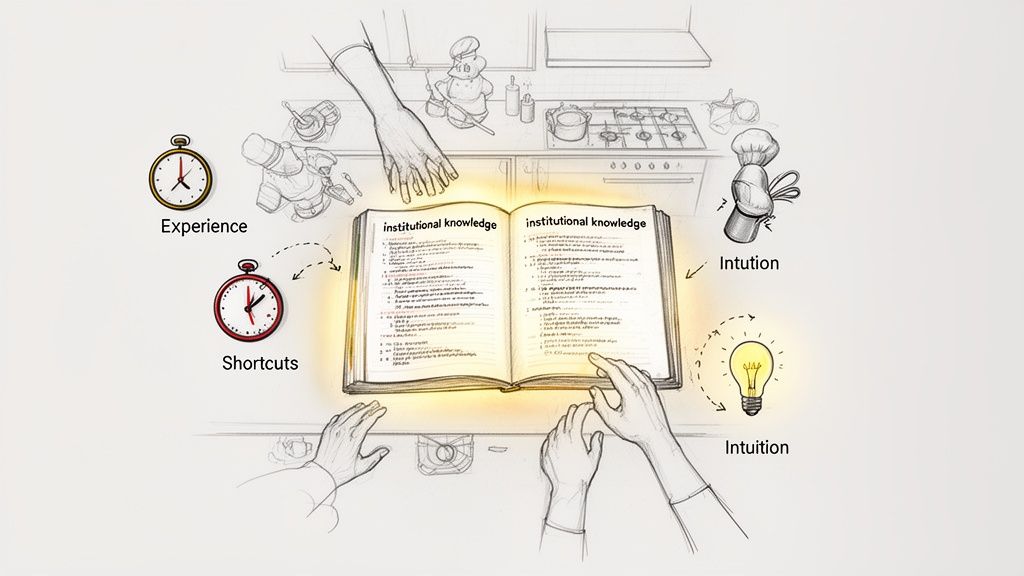
Imagine your company is a world-class chef's kitchen. The official recipe book—your standard operating procedures (SOPs) and policies—is essential. It gets everyone started.
But the real magic comes from the kitchen's institutional knowledge. It’s the head chef knowing exactly when the sauce is perfect just by its aroma. It’s the line cook who figured out a faster way to prep vegetables that isn't written down anywhere.
This collective expertise is built slowly, over time, through trial and error, shared experiences, and solving tough problems together. It's the sum of everything your team has learned, both from their wins and their mistakes. When you manage it well, this knowledge becomes a powerful competitive advantage.
The True Value of Collective Expertise
Harnessing this asset is about more than just avoiding common mistakes; it has a direct impact on your bottom line. Companies that get this right—effectively capturing and sharing institutional knowledge—see productivity improvements of up to 30%. Teams can build on proven methods instead of constantly starting from scratch.
This "secret sauce" is the engine that drives:
Greater Efficiency: Teams complete tasks faster and more accurately because they're following practices that have been tested in the real world.
Faster Onboarding: New hires get up to speed much quicker when they can tap into the accumulated wisdom of their colleagues from day one.
Consistent Quality: It ensures that every customer interaction and project deliverable meets a high standard, no matter who is doing the work.
Smarter Innovation: Understanding what has worked (and what hasn't) in the past provides a solid foundation for creative problem-solving and real growth.
Institutional knowledge is the living memory of your organization. It's the difference between a team that merely follows instructions and one that truly understands how to deliver exceptional results.
For a deeper dive into the overall framework, it's helpful to explore key knowledge management strategies. These provide the structure needed to turn scattered information into a reliable asset. And to put it into action, check out our guide on knowledge management best practices.
The High Cost of Letting Knowledge Walk Out the Door

We've all seen it happen. The senior project manager who’s been with the company for a decade finally puts in her notice. She’s the one who knows every client's history, the unwritten rules of stakeholder communication, and the weird technical quirks of every project.
Then, she’s gone.
Suddenly, her team is lost. Deadlines start slipping because no one understands her project management system. A key client gets frustrated because the new manager has no idea about a critical verbal agreement she had in place. The chaos isn't just stressful—it's expensive. It leads directly to rework, damaged client relationships, and lost revenue.
This scenario is a classic case of knowledge loss. It’s the silent threat that becomes painfully loud the moment your most experienced people walk out the door for the last time.
The Real Risks of Brain Drain
This "brain drain" isn't a rare disaster; it's a constant, everyday business reality. Recognizing what causes it is the first step toward stopping the bleeding.
The most obvious culprit is employee turnover. In 2023, the average turnover rate in major markets like the US and Europe was around 18-20%. This churn contributes to an estimated $1 trillion in annual losses worldwide, all because of the knowledge gaps left behind. For agencies and customer success teams, this is devastating. Unwritten client preferences and clever troubleshooting shortcuts vanish overnight. You can read more about the impact of institutional knowledge on business operations.
When an employee leaves, they don't just take their laptop. They take years of experience, relationships, and problem-solving shortcuts that are nearly impossible to replace without a system in place.
But turnover isn't the only risk. Other major factors include:
Retirement: Long-time employees are walking encyclopedias of company history, culture, and foundational processes. When they retire, that knowledge often goes with them.
Siloed Departments: When teams don’t talk, expertise gets trapped. One department might solve a problem that another team is still struggling with, wasting everyone’s time and energy.
Poor Documentation: Relying on memory isn't a strategy. Without clear, accessible guides, processes become inconsistent, and every new hire is forced to reinvent the wheel.
Each of these creates a vulnerability. For a support team, it might mean forgetting a veteran’s clever workaround for a legacy product. For a sales team, it could be losing the subtle negotiation tactics an experienced rep used to close huge deals. This isn't just an abstract problem—it's a direct threat to your stability and growth, measured in lost time, frustrated clients, and mistakes you keep making over and over again.
How to Capture and Preserve Your Team's Expertise
Knowing you might lose knowledge is one thing; preventing it is another. It takes a real strategy. Capturing your team's expertise means getting past the informal, word-of-mouth way of doing things and building a system that turns individual wisdom into a shared, lasting asset.
This isn’t about just one method. It’s a mix of proven habits and modern, scalable tools.
Traditional methods like mentorship programs and detailed exit interviews are great for passing on tacit knowledge. Pairing a seasoned expert with a newer employee is one of the best ways to transfer experience, nuance, and those gut feelings that define true mastery.
But these person-to-person methods are tough to scale. And they still leave you vulnerable if someone leaves unexpectedly. To really lock down that institutional knowledge, you need a living library of Standard Operating Procedures (SOPs)—the kind your team will actually use.
From Manual Documentation to Modern Workflows
Historically, creating SOPs was a chore. An expert did their work, and a manager tried to write down every step from memory, almost always missing critical details. The result was usually a dense, text-heavy document that became outdated the moment it was finished. No one ever looked at it.
Today, technology gives us a much better way.
One of the most powerful techniques is using screen recordings to capture complex digital workflows as they happen. Instead of trying to describe a process, you just record the expert doing it. Every click, menu, and decision is captured exactly as it happens.
This is a game-changer for documenting tasks like:
Client Onboarding: Recording the exact steps for setting up a new client in your project management software.
Software Configuration: Capturing the tricky process of configuring a SaaS tool for a specific team's needs.
Reporting and Analytics: Showing how to pull data from three different sources and build the weekly performance report.
Capturing a process on video cuts through all the noise. It’s no longer about interpreting written instructions; it's about seeing the correct workflow in action. It's one of the purest ways to define institutional knowledge in a way people can actually use.
Scaling Knowledge Capture with Automation
The real magic happens when you pair screen recording with AI-powered tools. Modern platforms can take a simple video and automatically turn it into a polished, step-by-step guide, complete with annotated screenshots and clear instructions.
This turns a dreaded documentation task into a simple, fast process that even the busiest teams can fit into their week.
This automated approach doesn't just save time—it creates better, more accurate guides. The AI catches every single action, making sure no small but crucial step gets forgotten. For teams trying to keep up, knowing how to find the right process documentation tools can be the difference between a culture of chaos and a culture of clarity.
Another smart approach involves training a chatbot on your own data, which can turn that hard-to-find tribal knowledge into an instant, searchable resource.
By embracing these methods, you build a system where expertise is constantly being captured, updated, and shared. You protect your company's most valuable asset and give your entire team what they need to do their best work. This creates a resilient foundation for growth, ensuring that critical knowledge stays with the company—long after any single person has moved on.
Turning Captured Knowledge Into Actionable Resources
Capturing your team’s expertise is a huge win, but it’s only half the battle. Raw information, like a disorganized pile of recipes, isn't very useful. To truly unlock its value, you have to turn that captured knowledge into a dynamic, centralized resource that actually empowers your team.
The goal is to create a living library—not a static archive that gathers digital dust. This means organizing information so it serves everyone. A new hire needs clear onboarding guides, while a senior team member might be looking for an advanced troubleshooting procedure. Both should be able to find what they need in seconds.
This process flow shows the modern, friction-free way to capture and share that expertise.
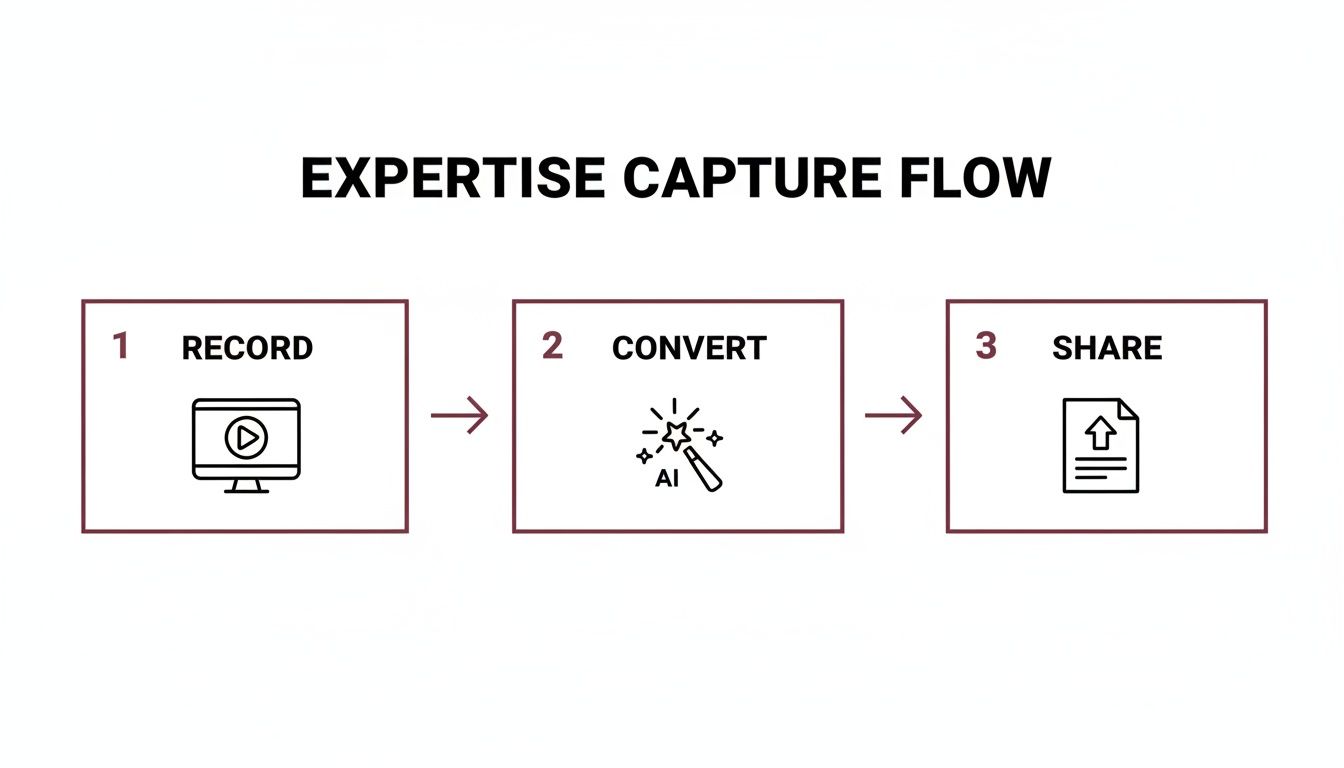
This workflow shows how easily screen recordings can be converted into shareable documents, turning a complex process into an accessible guide.
Building Your Central Knowledge Hub
A powerful knowledge hub serves as the single source of truth for your entire organization. It’s where your institutional knowledge lives, breathes, and evolves. Modern tools let you create branded, professional hubs where every SOP and guide is instantly accessible.
The key is to go beyond simple text documents. Effective resources use features that add context and clarity.
Rich-Text Editors: These let you add notes, checklists, and highlighted callouts to your guides, turning a simple procedure into a comprehensive lesson.
Real-Time Collaboration: The best knowledge isn't static. Tools that allow teammates to co-edit guides and leave comments ensure your documentation keeps pace with your business.
Intuitive Organization: A well-structured hub uses tags and folders to categorize information logically, so users can find answers fast—whether on desktop or mobile.
The Measurable Impact of Accessible Knowledge
Creating a centralized system has a direct, measurable impact on performance. When you successfully define institutional knowledge and make it easy to find, you streamline operations from top to bottom. This unique blend of experience and data underpins everything from IT system workflows to sales negotiation tactics.
Companies that implement centralized systems like knowledge bases report up to 35% faster decision-making. They also project 27% cost savings in operations by 2025.
These gains happen because teams stop wasting time hunting for information or asking the same questions repeatedly. Instead, they have immediate access to proven best practices. You can learn more about these operational efficiencies and how to build a knowledge base that drives real results.
The investment in organizing knowledge yields a clear and significant return by making your entire team more effective and self-sufficient.
Building a Culture That Champions Shared Knowledge
https://www.youtube.com/embed/byEDxj_R_R4g4
Even the best documentation tools are useless if nobody wants to use them. This brings us to the final—and most critical—piece of the puzzle: the human element. Turning what one person knows into an asset everyone can use is a team sport. It requires a culture where sharing knowledge isn't just encouraged, but celebrated.
This means you have to actively dismantle the roadblocks that keep experts from contributing. Many employees quietly fear that if they document everything they know, they’ll make themselves redundant. Others are just overwhelmed, believing they’re too busy with their "real work" to stop and build a guide.
The right culture reframes knowledge sharing as a core part of everyone's job, not some extra task. It’s about creating an environment where expertise is valued most when it’s shared and scaled.
Overcoming Resistance to Sharing
Getting people on board starts at the top. When leadership actively participates in and rewards knowledge sharing, it sends a powerful signal to the whole company. But you also have to address the fears and excuses head-on with practical solutions.
Here are a few strategies that actually work:
Reward the Contributors: Recognize and celebrate employees who take the time to document what they know. This could be public shout-outs, small bonuses, or making it a key factor in performance reviews. When people see it’s valued, they contribute.
Make it Effortless: Lower the barrier to entry. If creating a guide feels like a huge project, it won't happen. Using tools that turn a quick screen recording into a polished guide kills the "I don't have time" excuse. When it takes minutes instead of hours, people are far more likely to do it.
Show the "Why": Connect knowledge sharing to real team wins. When a new SOP helps the team hit a big deadline or solve a tough client issue, call it out. This shows everyone how their small contribution directly helps their colleagues succeed.
True institutional knowledge is built on a foundation of trust and psychological safety. Employees must feel confident that sharing their expertise will elevate both them and the team, rather than making them replaceable.
This shift in mindset pays off, big time. A study across 1,000 firms found that strong knowledge-sharing cultures directly correlate with 21% revenue growth. With mobile access, these living SOPs ensure your team has answers 24/7—which is vital for global teams where 90% of processes change every year. You can learn more about how this cultural shift impacts business outcomes.
Ultimately, preserving what your team knows isn't just about writing things down—it's about empowering every single person to be a teacher. This breaks down silos, fuels constant improvement, and turns your collective expertise into your most resilient competitive advantage.
Of course. Here is the rewritten section, following the style and tone of the provided examples.
Common Questions, Straight Answers
Even with the best intentions, a few questions always pop up when teams start getting serious about capturing how work actually gets done. Here are the most common ones.
Is This Different From "Tribal Knowledge"?
Yes, and the difference is critical.
Think of tribal knowledge as the risky, undocumented version of institutional knowledge. It's the stuff that lives in the heads of a few key people—the "tribe." When they leave, that knowledge walks out the door with them, leaving a huge gap.
The whole point of a knowledge management strategy is to turn that high-risk tribal knowledge into secure, accessible institutional knowledge. You're moving expertise from one person's brain into a system everyone can use. It’s the difference between a vulnerability and an asset.
I Run a Small Business. Where Do I Even Start?
Don't try to boil the ocean. If you try to document everything at once, you'll end up documenting nothing.
Instead, start small. Pick one single process that causes the most friction. Maybe it’s the workflow that trips up every new hire, or the one task that always generates a dozen questions in Slack.
Focus all your effort there first. Use a simple tool to record the process and create one high-quality, easy-to-follow guide. When you solve one real, painful problem, you’ll build the momentum—and the buy-in—you need to tackle the next one.
How Do We Keep Guides From Getting Outdated?
This is the mistake that kills most documentation efforts. People treat their knowledge base like a time capsule—written once and then forgotten.
To make it work, you have to treat it like a living library.
The key is active ownership. Assign specific processes to the people who actually do the work; they're the ones who know when something changes. Use tools that make it dead simple for anyone on the team to flag an outdated step or suggest an edit on the spot.
Finally, pay attention to which guides get used the most. Prioritize keeping those up-to-date. An accurate guide for a daily task is 100x more valuable than a perfect guide for something that happens once a year.
Ready to turn your team's expertise from risky tribal knowledge into a scalable, lasting asset? Build a Guide makes it effortless. Turn complex screen recordings into polished, step-by-step guides your team will actually use. Start building your living SOP library today at https://buildaguide.app.