
February 2, 2026
Difference Between a Policy and Procedure: A Practical Guide to Clarity
Explore the difference between a policy and procedure and learn how clear policies drive consistent operations and governance.
It’s a classic mix-up, but the difference between a policy and procedure is pretty straightforward once you see it in action. Policies are the rules of the road—the 'what' and 'why' that guide decisions. Procedures are the turn-by-turn directions—the specific actions you take to follow those rules.
Think of it this way: a policy is the map showing the destination, while a procedure is the GPS telling you exactly how to get there.
Why Distinguishing Policies From Procedures Is Mission-Critical
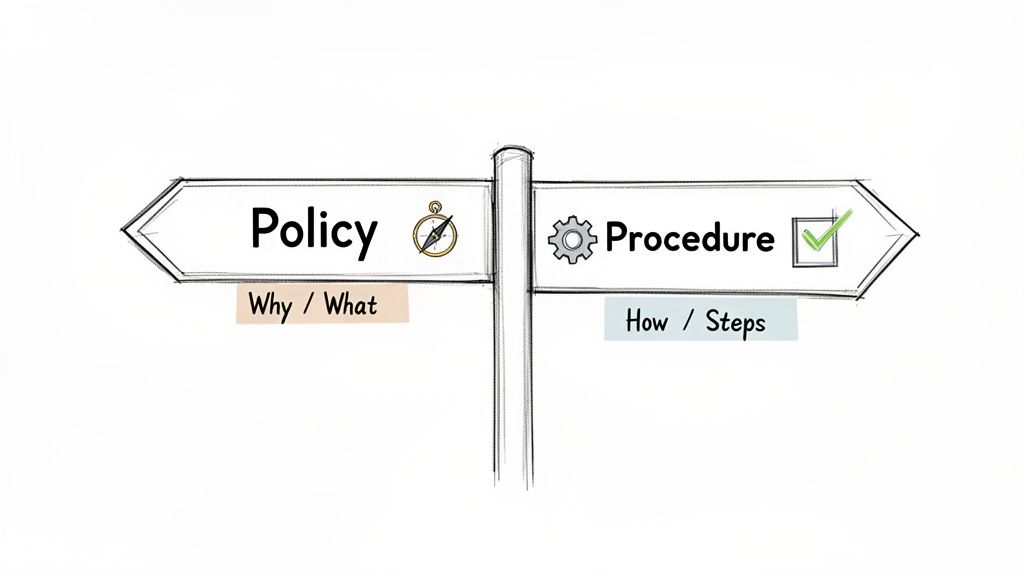
Confusing the two isn't just a grammar issue; it creates real friction. When policies get bogged down with step-by-step instructions or procedures lack a clear guiding principle, teams get stuck. Ambiguity leads to inconsistent work, compliance failures, and a whole lot of wasted time.
Getting this right is fundamental to scaling your operations. In fact, companies that nail this distinction have been shown to cut down on errors by as much as 30% a year. It’s the difference between telling your team what mountain to climb versus giving them a clear path to the summit.
The Role of Each in Your Organization
Policies and procedures play different, but equally important, roles. They work together, but they are not interchangeable.
Policies create the framework for decision-making. They’re broad statements reflecting your company’s values, goals, and legal duties. A strong policy gives employees the guardrails they need to use their own judgment effectively.
Procedures ensure consistency and quality. They take the guesswork out of a task by defining the one best way to do it, guaranteeing repeatable results every single time. This is absolutely essential for training, onboarding, and quality control.
A policy gives your team the ‘why,’ building a culture of smart, independent decision-making. A procedure gives them the ‘how,’ ensuring execution is consistent and correct across the board.
This separation is especially critical in fields like financial services, where strict regulatory compliance is non-negotiable. A bank’s anti-money laundering policy sets the overarching rules, but its customer verification procedure spells out the exact steps a teller must follow. One without the other is a recipe for disaster.
Policy vs Procedure at a Glance
For a quick summary, here’s a clear breakdown of the fundamental differences. This table should help clarify which document you need and when.
Attribute | Policy (The 'Why') | Procedure (The 'How') |
|---|---|---|
Purpose | To guide decisions and set expectations | To instruct actions and ensure consistency |
Scope | Broad and organization-wide | Narrow and task-specific |
Focus | Principles and desired outcomes | Specific steps and required inputs |
Flexibility | Allows for professional judgment | Prescriptive and requires strict adherence |
Ultimately, mastering this difference is what moves a team from disorganized to efficient. It's the foundation for building systems that scale and empowering your people with the clarity they need to do great work. You can explore more about the benefits of standard operating procedures in our detailed guide.
Defining Policies: Your Strategic North Star
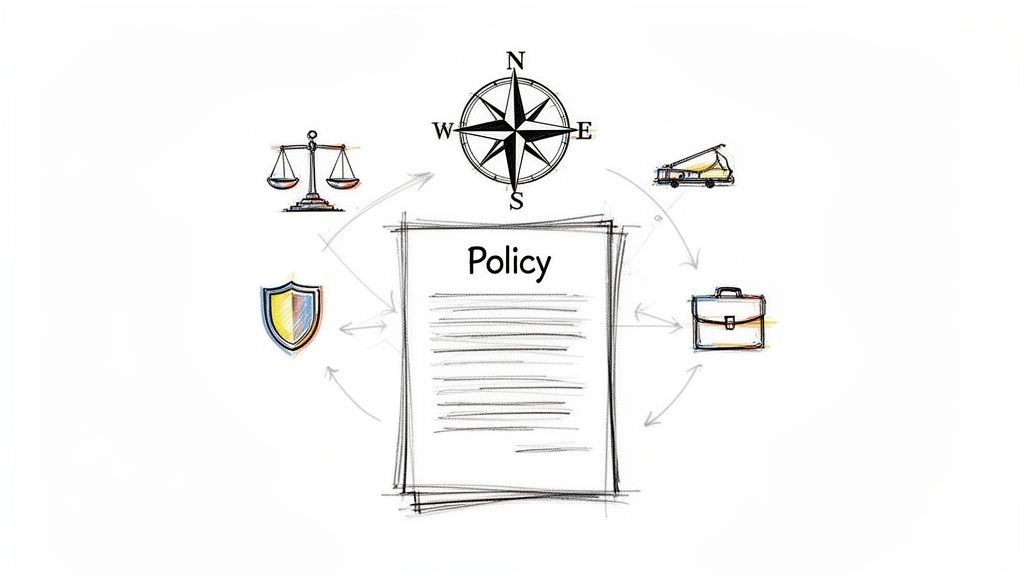
Think of a policy as your organization's compass. It's a high-level statement that answers the big questions: "What do we believe?" and "What are our rules of engagement?" Policies are intentionally broad, giving everyone a framework for making smart decisions.
Unlike a procedure that might change when you switch software, a good policy is built to last. It’s tied directly to your company's mission, legal duties, and core values. It's the constitution for a specific area of your business—it sets the law but doesn't detail every single action needed to follow it.
Core Characteristics of an Effective Policy
A strong policy isn't a hundred-page manual; it's a clear statement of intent. The best ones share a few key traits that make them incredibly powerful for managing risk and guiding the company.
Principle-Based: Policies are all about principles, not specific actions. A "Data Governance Policy" won't list software commands. Instead, it will state that all client data must be handled with the highest degree of confidentiality and integrity.
Broad in Scope: They apply to the entire organization or at least to major parts of it. An "Employee Code of Conduct" isn't just for one team; it sets expectations for everyone, from the CEO down to the newest intern.
Relatively Static: Policies shouldn't be changing every month. They're only updated when there's a major shift in strategy, regulations, or company values. This ensures the guidance people receive is consistent over time.
This structured approach is a cornerstone of good governance. In fact, our guide on knowledge management best practices explains how these high-level documents anchor your entire information system.
Who Creates and Owns Policies?
Because policies carry so much strategic and legal weight, they don’t come from just anywhere. Their creation is handled by senior leadership—the people with a bird's-eye view of the organization's goals and risks.
The key players usually include:
Executive Leadership (C-Suite): They make sure every policy aligns with the company's mission and strategic goals.
Legal and Compliance Teams: These experts check that the policy follows all relevant laws and industry standards, protecting the company from legal trouble.
Human Resources: For policies about people—like codes of conduct or remote work rules—HR's input on employee relations and culture is non-negotiable.
A policy doesn't just dictate rules; it empowers employees. By defining the boundaries of acceptable action, it gives team members the confidence to make smart, autonomous decisions that are consistently aligned with the organization's objectives.
This really gets to the heart of the difference between a policy and procedure. A policy gives people the freedom to operate within a safe and strategic framework.
For example, a "Customer Service Policy" might state that all customer issues should be resolved to the client's satisfaction. This empowers an agent to offer a creative solution, like a product discount, without needing a rigid, step-by-step script for every possible problem. It sets the destination and trusts the employee to find the best path to get there.
Defining Procedures: Your Tactical Blueprint
If a policy is the strategic "what" and "why," a procedure is the tactical "how." It’s the detailed, step-by-step instruction manual for a specific task. Procedures are what bring a high-level policy down to earth, making sure everyone executes a task the same way, every single time.
Where a policy provides guardrails for judgment, a procedure is designed to eliminate it. It dictates the single best way to get something done, creating a foundation for consistency, quality control, and training. Think of it less like a compass and more like a pre-flight checklist.
The Anatomy of a Powerful Procedure
Effective procedures are built for action and clarity. They leave no room for guesswork and are designed to be followed precisely, turning complex tasks into simple, manageable steps.
Specific and Focused: A procedure tackles one task and one task only. A broad "Data Governance Policy" might lead to a hyper-specific "Client Data Encryption Procedure," detailing the exact clicks and commands needed.
Action-Oriented: They use clear, commanding language—"Enter," "Click," "Verify." The goal isn't just to inform; it's to instruct, guiding someone through a workflow from start to finish.
Dynamic and Evolving: Procedures have to change as your tools and processes do. The minute your company switches accounting software, your procedure for submitting expense reports is officially out of date and needs a refresh.
This distinction isn't new. Modern procedures trace their roots back to Frederick Taylor's Scientific Management, which formalized detailed workflows to slash waste. Policies, on the other hand, often grew out of major governance needs, like the Sarbanes-Oxley Act, which mandated high-level controls after huge corporate scandals. If you're curious about the history, Workflawless has a great breakdown.
Ownership and Creation of Procedures
Unlike policies, which come down from senior leadership, the best procedures are built by the people closest to the work. This is the only way to guarantee they're both practical and accurate.
Key contributors usually include:
Line Managers: They have direct oversight of the workflows and can make sure procedures align with team goals and resources.
Subject-Matter Experts (SMEs): The employees who perform the task every day are the ultimate source of truth. Their input is non-negotiable for capturing the most efficient and correct steps.
For example, HR and leadership would create the "Employee Code of Conduct" policy. But the HR manager is the one who should develop the "New Hire Onboarding Checklist" procedure. This ensures the high-level principles of the policy are translated into concrete, actionable steps for the team on the ground.
Clear procedures are the engine of operational efficiency. They convert strategic intent into repeatable, measurable actions, forming the bedrock of quality control and scalable growth.
Ultimately, the difference between a policy and procedure is one of altitude. A policy sets the direction from 30,000 feet, while a procedure provides the on-the-ground instructions for the mission. To see how these instructions come together, check out our guide for creating a standard operating procedure template.
A Nuanced Look at Policies vs. Procedures
The definitions are a good starting point, but the real difference between a policy and a procedure comes alive when you put them side-by-side. Seeing how they function across your organization—from their purpose to who governs them—is what really matters.
Understanding this contrast is the key to building a documentation framework that’s both strong and actually useful. One document gives your team strategic direction, while the other ensures they can execute on it. They're two sides of the same coin, and you need both to run a tight ship.
Purpose: Guiding Judgment vs. Instructing Action
The most fundamental difference is their job. A policy is there to guide judgment and decision-making. It sets the boundaries and principles, empowering your team to think on their feet and act appropriately within those lines.
For instance, a "Remote Work Policy" establishes the company's official stance. It outlines who is eligible, what the core hours are, and the security expectations. It doesn't tell someone how to log into the VPN; it trusts them to make smart choices that align with the rules.
A procedure, on the other hand, exists to instruct a specific action. Its whole purpose is to kill ambiguity and make sure a task gets done the same way, every time. It’s all about compliance and consistency, not creative problem-solving.
Using the same example, a related procedure would be "Connecting to the Corporate VPN." This would be a step-by-step guide, complete with screenshots, that must be followed exactly.
Scope: Organizational vs. Task-Specific
Another huge differentiator is their scope. Policies are intentionally broad. They often apply to the entire company or at least to major departments, tackling big-picture issues that affect tons of people and processes.
Think about these examples:
An Information Security Policy covers every single person who touches company data, no matter their role.
A Code of Conduct Policy lays out universal standards for everyone from the CEO down to the interns.
An Equal Opportunity Employment Policy governs how hiring works across the whole company.
Procedures are the opposite—they're narrow and laser-focused on a single task or workflow. In fact, one broad policy might lead to dozens of specific procedures. That single Information Security Policy could link out to separate procedures for "Setting a Strong Password," "Reporting a Phishing Attempt," and "Requesting New Software." Each procedure tackles one tiny piece of the policy's big mandate.
Policies are wide and shallow, setting the rules of the game for everyone. Procedures are narrow and deep, providing the exact playbook for a single, specific action.
If you want a wider view of how these documents fit together, understanding how an integrated management system works can show how policies and procedures cooperate to keep an entire company compliant.
Flexibility: Discretion vs. Compliance
How much wiggle room each document allows is a critical distinction. Policies are built to allow for professional judgment within defined limits. They provide the guardrails but expect employees to navigate the road themselves.
A customer service policy might empower an agent to "take all reasonable steps to ensure customer satisfaction." This gives them the flexibility to offer a refund, a store credit, or a replacement based on their read of the situation. The policy trusts the agent's judgment.
Procedures demand the opposite: strict compliance. They are meant to be prescriptive, leaving little to no room for going off-script. A procedure for "Processing a Customer Refund" would detail the exact steps an agent must take, which fields to fill, and who to get approval from. Straying from the procedure isn't an option; it's mandatory.
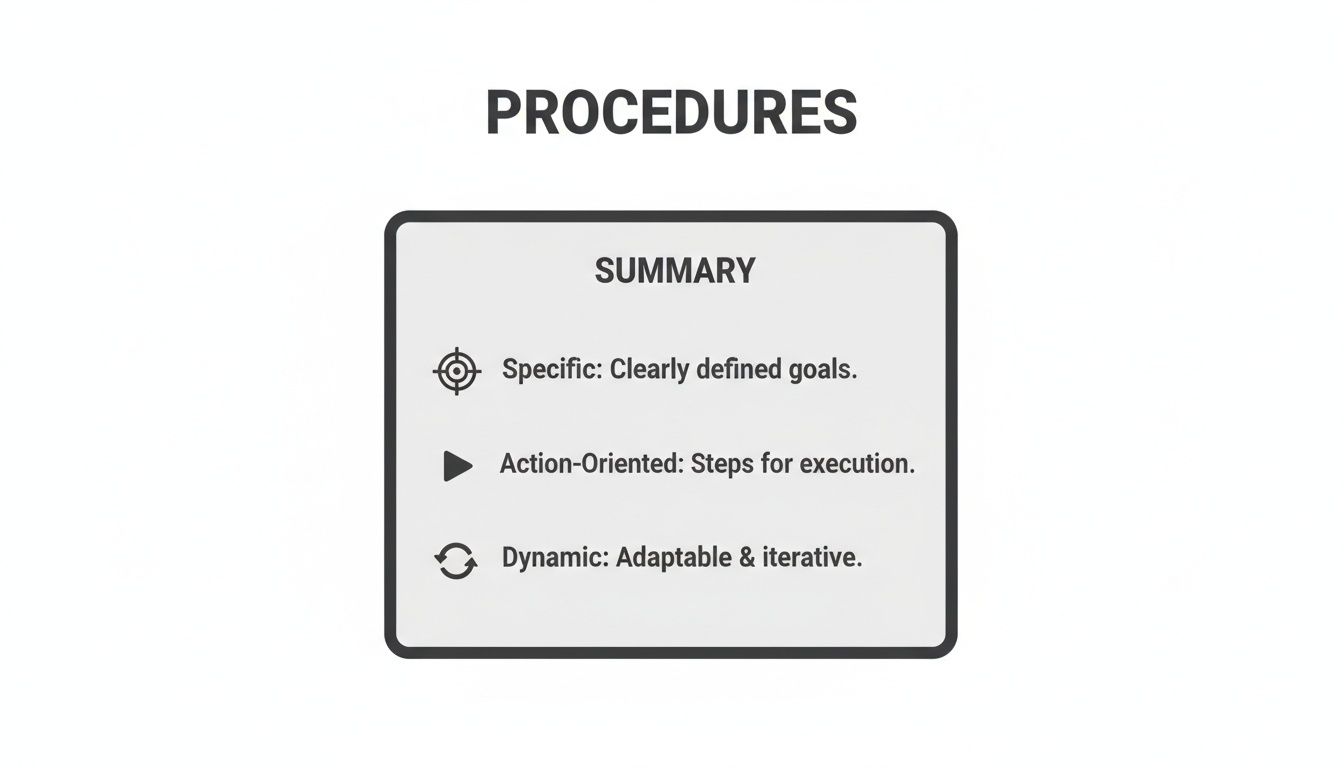
This graphic drives the point home: procedures are built for execution. They give teams a clear, unbending path to get a task done right, every single time.
In-Depth Breakdown: Policy vs. Procedure
To give you a powerful at-a-glance reference, this table breaks down the key differences between policies and procedures. Use this to gut-check your existing docs and plan out new ones.
Dimension | Policy | Procedure |
|---|---|---|
Primary Goal | Manage risk and ensure strategic alignment. | Ensure quality, consistency, and efficiency. |
Audience | Broad, often the entire organization. | Specific, targeted at teams or individuals doing a task. |
Level of Detail | High-level, focusing on principles and rules. | Granular, focusing on sequential steps and actions. |
Governing Body | Created and approved by senior leadership or legal. | Created by subject-matter experts and line managers. |
Frequency of Change | Infrequent; changes with strategy or regulations. | Frequent; changes with new tools or better processes. |
Format | Formal statements, principles, and rules. | Checklists, step-by-step instructions, and flowcharts. |
Accountability | Violations may lead to disciplinary action. | Failure to follow leads to process errors and correction. |
Ultimately, getting the difference between a policy and procedure right is about choosing the right tool for the job. Policies provide the stable, strategic foundation. Procedures offer the agile, tactical instructions needed to get work done day-to-day.
Translating High-Level Policy into Actionable Procedures
Knowing the difference between a policy and a procedure is a good start. The real work begins when you have to connect the two. This is where you turn high-level, strategic rules into the step-by-step guides your team can actually follow without getting lost.
A policy without a clear procedure is just a good intention. And a procedure without a guiding policy is just a list of steps that can easily drift away from what the business actually needs. The goal is to create a system where every action your team takes is a direct reflection of your company's core principles.
Let's walk through this with a common example: a company's "Travel and Expense Policy."
Deconstructing the Policy into Procedural Components
Imagine your company’s Travel and Expense Policy is built on a few core rules:
Employees must be fiscally responsible with company funds.
All travel needs to be pre-approved by a direct manager.
Expenses have to be submitted with valid receipts within 15 days of the trip ending.
Reimbursements will be processed within one billing cycle.
These are solid, high-level principles. The problem? They don't tell anyone how to do any of this. To make this policy work, you need to break it down into separate, task-specific procedures that answer the "how-to" questions.
From that one policy, you can immediately see the need for at least two different guides:
A Procedure for Booking Corporate Travel: This would cover the step-by-step process for getting travel approved before anything is booked, directly supporting the "pre-approval" rule.
A Procedure for Submitting an Expense Report: This guide would detail the exact steps for uploading receipts and getting reimbursed, making sure the "fiscally responsible" and "timely submission" rules are followed.
A well-structured policy basically acts as a table of contents for your procedures. Each rule in the policy should point to a specific, real-world workflow that needs to be documented.
This approach makes sure no part of the policy is left up to interpretation. Every "what" is tied directly to a "how," creating an unbroken chain from big-picture strategy to daily tasks.
Building an Actionable Procedure from a Policy Principle
Let’s build out the "Submitting an Expense Report" procedure. The policy principle behind it is: "Employees must be fiscally responsible and submit expenses with valid receipts within 15 days."
Here’s how you translate that into a clear, no-nonsense guide:
Access the Expense Platform: Open your browser and go to the company’s expense portal. Log in with your corporate credentials.
Create a New Report: Click the "New Expense Report" button. Name the report using this format: "[Trip Name] - [Your Name] - [End Date]."
Add Individual Expenses: For each expense, click "Add Line Item." Choose the right category (e.g., Meals, Lodging, Transportation).
Upload Receipts: Scan or take a clear photo of your receipt. Click "Upload Receipt" and attach the file for each line item. Note: Digital receipts from vendors are preferred.
Verify Information: Double-check that all amounts are correct and match the receipts. Add a short business justification in the "Notes" field for any expense over $75.
Submit for Approval: Once all expenses are in, click "Submit for Approval." Your report will automatically go to your direct manager.
This procedure is direct, linear, and leaves no room for confusion. It actively supports the policy by enforcing the rules (like mandatory receipts) and creating a standard workflow that keeps everyone on the same page.
Modern tools can even embed these policy rules right into the steps. This screenshot from the Build a Guide platform shows how teams create these kinds of interactive SOPs.
The interface is clean and lets you easily add steps, screenshots, and notes, turning a complex process into a simple guide. Using a platform like this helps you build a central hub where procedures are not just documented but are also easy to find, update, and follow.
For example, customer success teams at SaaS companies might have a policy about data privacy (like aligning with CCPA since 2020), but their procedures detail how to create guides in a tool like Build a Guide. In recent pilots, using AI-generated SOPs from this platform boosted completion rates by 42%. You can find more insights on how policies and procedures fit together at workflawless.com.
When you use the right tools to build out your procedures, you create a living documentation system where your strategy and day-to-day work are actually connected.
Of course. Here is the rewritten section, designed to sound completely human-written and natural, following the provided style guide.
Common Documentation Pitfalls and How to Avoid Them
Even with perfect definitions, it’s surprisingly easy to get documentation wrong. Teams often fall into the same traps, creating guides and policies that look good on paper but fail in practice. The result is confusion, non-compliance, and friction where there should be clarity.
One of the biggest mistakes is creating procedures in a vacuum. A procedure without a guiding policy is just a list of tasks without a purpose. It’s like having a map with no destination—the steps might be clear, but no one knows why they’re taking them. This leads to inconsistent work and makes it impossible to enforce standards.
Overly Prescriptive Policies
Another common pitfall is writing policies that act like procedures. When a high-level rule gets tangled up in step-by-step instructions, it becomes rigid, confusing, and a nightmare to update. Policies are supposed to set the "why" and "what," giving teams the principles they need to make smart decisions. They aren't meant to micromanage every click.
The fix is a clear document hierarchy.
Keep Policies High-Level: Focus them on rules, goals, and outcomes.
Link to Procedures: Add a "Related Documents" section in your policy that points directly to the procedures. This keeps the policy clean while showing people exactly where to find the "how."
This separation ensures policies remain stable, strategic documents, while the hands-on procedures can change as often as your tools and workflows do.
A policy that reads like a procedure is a sign of a broken documentation strategy. It constrains professional judgment and quickly becomes obsolete, creating more risk than it prevents.
Obsolete and Stale Documentation
This is probably the most dangerous pitfall: letting your documentation get old. An outdated procedure is worse than no procedure at all because it actively tells people to do the wrong thing. This is what happens when no one owns the document and there's no schedule for keeping it fresh.
Getting this right pays off. Mature documentation systems can deliver 300-500% returns by cutting down on errors. Policies are fairly stable, with data showing only a 12% annual change rate, but procedures need more frequent updates. If you want those returns, you have to maintain the docs. You can see the numbers for yourself in the full study on documentation ROI.
To stop your documentation from going stale, set up a simple governance plan.
Assign Ownership: Every document needs one person who is responsible for keeping it accurate.
Set a Review Cadence: Policies might get checked once a year. Critical procedures might need a review every quarter or anytime a tool changes.
Automate Reminders: Use a calendar or a project management tool to automatically ping the owner when it’s time for a review.
By sidestepping these common mistakes, you can build a living documentation system that actually works—one that drives clarity, ensures compliance, and helps your whole organization get better over time.
Even after you’ve got the basics down, a few common questions always pop up when it's time to put theory into practice. Getting these points straight is key to building a documentation system that’s actually useful.
It always comes back to one thing: Policies guide decisions. Procedures instruct actions. That single difference shapes everything, from how they’re written to how they're enforced.
Can a Single Document Be Both a Policy and a Procedure?
It's tempting to merge them, but don't. It's a classic mistake.
When you mix high-level rules with nitty-gritty steps, you end up with a document that’s a nightmare to read, a pain to update, and just plain confusing for your team. A policy should state the rules, then simply link out to the procedures that put those rules into action.
Separating them keeps things clean. When a tool or a workflow changes, you only have to touch the procedure. The overarching policy stays stable and intact.
How Often Should We Review Our Policies and Procedures?
This depends entirely on what the document is for. Policies are strategic—they don't change much. An annual or biennial review is usually fine, unless new laws or major business shifts happen.
Procedures, on the other hand, are tactical. Treat them like living documents. They need a check-up whenever a process, tool, or team structure changes. For some teams, that could be monthly or quarterly.
Think about the EU's GDPR enforcement. The organizations that navigated it best had flexible policies but rigid, meticulously updated procedures. That simple split helped them sidestep a huge number of potential fines.
Treating policies as your compass and procedures as your map is a proven way to boost consistency. In fact, data suggests this clarity can lead to productivity gains of 20-25%, especially in distributed teams. You can read more on how policies and procedures impact compliance over at complianceforge.com.
What Is the Difference Between a Procedure and a Guideline?
This is another critical distinction that trips people up.
A procedure is mandatory. Its steps are not optional—they must be followed exactly to get a consistent, compliant result. Think of it as a direct order.
A guideline, however, is advisory. It offers best practices, helpful tips, or general advice, but it doesn’t demand strict obedience. It’s a recommendation, not a rule. For example, a "Customer Refund Procedure" is mandatory, while "Guidelines for De-escalating Customer Complaints" would be advisory.
Ready to turn your complex processes into clear, actionable guides? With Build a Guide, you can record any workflow and automatically convert it into a polished, step-by-step SOP with screenshots and instructions. Stop letting knowledge get lost and start building a documentation library that drives consistency and growth. https://buildaguide.app