
February 26, 2026
The Ultimate Guide to SOP in Business for 2026

Unlock operational excellence with this guide to SOP in business. Learn to create clear procedures that boost efficiency, consistency, and growth.
A Standard Operating Procedure (SOP) is just a fancy name for a simple concept: a step-by-step guide on how to get something done right, every single time. Think of it as your company's official recipe for a key task. This isn't about guesswork; it's about giving anyone on the team the exact playbook to complete a job correctly and consistently.
What Is an SOP in Business and Why It Matters Now

Forget the dusty, three-ring binders of the past. A modern SOP in business isn't a static document collecting dust on a shelf. It's a living, breathing guide that turns your big-picture strategy into repeatable actions your team can take on the ground. It's the blueprint that lets your team operate with precision, whether they're in the same room or spread across the globe.
Too many growing companies run on "tribal knowledge"—that critical information stuck in the heads of a few key people. When that person goes on vacation, gets sick, or leaves, the process grinds to a halt. This leads to delays, mistakes, and unhappy customers. It’s a massive, unmanaged risk hiding in plain sight.
Moving Beyond Tribal Knowledge
SOPs are the antidote to tribal knowledge. They create a central, accessible source of truth for how work gets done. By formalizing the informal, you capture the "best way" to do things, making excellence the standard, not the exception.
This shift from relying on people to relying on systems is what separates businesses that can scale from those that can't. A well-built SOP in business makes sure that:
Consistency is a given: Every customer gets the same high-quality experience. Every report is formatted correctly. Every task is completed to the same high standard.
Onboarding gets faster: New hires can stop asking "what do I do next?" and start contributing much more quickly when they have clear instructions to follow.
Efficiency goes up: Your team wastes less time reinventing the wheel or hunting for answers, freeing them up to focus on work that actually matters.
An SOP isn't just a document; it's a commitment to operational excellence. It takes the guesswork out of daily tasks and sets a consistent standard, so whether someone has been at your company for two weeks or two years, they know exactly how to get things done.
Modern tools have completely changed the game. SOPs have evolved from long, boring text files into interactive guides that people actually want to use. Instead of dense paragraphs, today's best SOPs use screenshots, video clips, and checklists to make complex processes feel simple. You can learn more about creating these foundational documents in our complete guide to process documentation. This evolution makes SOPs a powerful engine for growth, not just another box to check.
The Real-World Benefits of SOPs
Let’s move past vague promises like “improved efficiency” and talk about what a strong SOP in business actually delivers. It’s about creating a standardized playbook for how things get done, which lays a foundation for consistent, excellent work and real growth. These benefits ripple through every corner of the company, from operations to customer support.
This isn't about micromanagement or control. It's about empowerment. When your team has a clear, reliable guide, they spend less time guessing or hunting for answers and more time creating value.
Guarantee Consistency and Quality Control
The first and most immediate win from an SOP is a uniform standard of quality. It makes sure that whether a customer talks to a brand-new hire or a ten-year veteran, they get the same great level of service every single time. An SOP for handling support tickets, for example, ensures every issue is logged, escalated, and solved with the same care.
This kind of consistency is what builds brand trust and keeps customers coming back. Without it, your service feels unpredictable, which just leads to confusion and frustration. SOPs turn quality from a happy accident into a daily, repeatable standard. The best way to achieve this is by implementing solid knowledge management best practices to streamline your team's workflow.
Accelerate Onboarding and Reduce Training Time
New hires often feel like they’re adrift, trying to piece together how things work from scattered conversations and outdated notes. A well-organized library of SOPs becomes their personal guide, slashing the time it takes for them to become productive, confident members of the team.
Instead of interrupting colleagues with the same questions over and over, they can pull up an SOP that walks them through a task step-by-step. This frees up your senior people and makes sure new employees learn the right way to do things from day one. You can see how this played out for one company in our TechGenius operations case study.
Enhance Scalability and Mitigate Risk
You can’t scale a business on chaos. As you grow, that undocumented "tribal knowledge" locked in a few key people's heads quickly becomes a bottleneck. It makes it nearly impossible to add new team members or expand into new markets without everything breaking down.
SOPs are the structural backbone for growth. They make your processes repeatable and easy to transfer, so you can expand your team with confidence, knowing that your standards won't slip.
SOPs are your business's insurance policy against inconsistency and human error. They ensure that even in high-stakes environments, critical tasks related to compliance and safety are performed correctly every single time, protecting both your customers and your company.
On top of that, SOPs are crucial for managing risk, especially if you're in a regulated industry. The ROI here is clear and quantifiable.
Let's look at the concrete impact SOPs have across different parts of a business. The table below breaks down the common problems that SOPs solve and the measurable improvements they drive.
Impact of SOPs Across Business Functions
Business Function | Key Challenge Without SOPs | Primary Benefit with SOPs | Example Metric Improved |
|---|---|---|---|
Operations | Inconsistent output, wasted resources, and difficulty scaling production. | Repeatable quality and streamlined workflows that reduce errors. | 30% reduction in incident resolution time for an IT firm. |
Customer Support | Variable service quality, long ticket resolution times, and poor customer satisfaction. | Consistent service delivery and faster problem-solving. | 25% improvement in first-call resolution rates. |
Sales | Inconsistent quoting, messy handoffs to project teams, and missed follow-ups. | Standardized sales process and smoother customer onboarding. | 15% increase in lead-to-close conversion rate. |
HR & Onboarding | New hires feel lost, training is slow, and key knowledge isn't transferred. | Faster ramp-up time and a structured learning path for new team members. | 50% reduction in time to full productivity for new hires. |
Compliance | High risk of errors, failed audits, and potential legal or financial penalties. | Reduced risk and auditable proof of adherence to standards. | 40% decrease in compliance issues for a pharmaceutical company. |
As you can see, the benefits aren't just theoretical. Documented procedures ensure that legal, safety, and quality standards are met consistently, safeguarding the business from costly errors and building a more resilient operation.
Anatomy of a High-Impact SOP Structure
What’s the difference between an SOP that people actually use and one that just collects digital dust? It’s all in the structure. A high-impact SOP isn’t just a wall of text; it's a practical blueprint built for clarity, action, and real-world use.
The best SOPs start with a clear title and a purpose that gets straight to the point. Instead of something vague like “Marketing Tasks,” make it specific: “How to Schedule a Weekly Social Media Post in Buffer.” Right away, your team knows exactly what the guide does and why they need it. No guesswork.
Next, you need to define the scope. Think of this as putting up guardrails. A good scope statement clearly says where the process begins, where it ends, and—just as importantly—what it does not cover. This simple step prevents confusion and stops tasks from bleeding into other workflows.
Core Components of an Effective SOP
With a solid foundation, you can get to the heart of the SOP: the step-by-step instructions. These need to be written with action in mind. Use simple, direct language and break complex tasks down into small, manageable chunks that anyone on the team can follow.
Here are the key elements that make it work:
Roles and Responsibilities: Spell out exactly who is responsible for each step. This builds in accountability and gets rid of the classic "I thought someone else was doing that" problem for good.
Visual Aids: This is a game-changer. Annotated screenshots, short GIFs, and quick video clips can turn a dense document into an engaging, easy-to-follow guide. Visuals show people exactly what to do, which is always better than just telling them.
Checklists and Resources: Make your SOP a one-stop shop. Include simple checklists for quality control and add links to any necessary tools or related documents.
For a deeper dive into organizing these elements, check out our article on effective SOP formatting standards that teams will actually follow.
An SOP is only as good as its usability. If a team member can’t quickly find what they need and follow the steps without getting confused, the document has failed. The goal is to make the right way the easy way.
Ultimately, the structure of your SOP in business is all about empowering your team to get things done consistently and correctly—without needing constant supervision. A well-structured SOP is a tool that builds confidence, ensures quality, and creates a more efficient, self-sufficient team. By focusing on clarity, visuals, and clear responsibilities, you create documentation that becomes an indispensable part of how you work.
How to Create Effective SOPs: A Modern Approach
Creating a Standard Operating Procedure (SOP) used to be a painful process. It meant hours spent staring at a blank document, trying to describe a complex workflow from memory. The result was often a clunky, inaccurate wall of text that nobody actually wanted to read.
Thankfully, there's a better way. The modern approach is built on a simple, powerful idea: show, don't just tell. Instead of writing from scratch, you start by recording the process exactly as it happens. This "recording-first" workflow is a game-changer for busy teams who need clarity without the bureaucratic drag.
Step 1: Identify a High-Impact Process
Before you hit record, take a minute to think. Don't try to document everything at once. Your goal is to find one repeatable process that has a real impact on your business.
Look for a task that causes frequent confusion, is critical for training new hires, or gets handed off between team members a lot.
Good candidates for your first SOP include things like:
Processing a customer refund.
Onboarding a new client in your project management tool.
Publishing the weekly blog post.
By choosing a process that solves a genuine, recurring pain point, your first SOP will deliver immediate value. That early win builds the momentum you need to keep going.
Step 2: Record the Workflow in Action
Once you've picked your process, just do it. Use a screen recorder to capture the entire workflow from start to finish. As you go, talk through your actions out loud, explaining why you're clicking here or typing that. This narration adds crucial context that a silent video or a simple checklist would completely miss.
This method is brilliant for two reasons. First, it captures every single click, typo, and detail, so you can't accidentally forget a critical step. Second, it's incredibly fast. A ten-minute process takes exactly ten minutes to record. No more guesswork.
Step 3: Use AI to Generate a Draft
Here’s where the magic really happens. Instead of manually transcribing your video and painstakingly taking screenshots, you can let an AI-powered tool do all the heavy lifting. Modern platforms can automatically turn your recording into a structured, step-by-step guide, complete with written instructions and perfectly cropped screenshots.
This step alone can slash the time it takes to create an SOP by over 80%. It turns what used to be a tedious, multi-hour task into a quick, automated action, freeing you up to focus on what really matters: refining the content.
Step 4: Refine and Add Context
The AI-generated draft is your starting point, not the finished product. Now it's time for you to add your human expertise. Go through the document and clarify any complex steps, add expert notes, insert checklists for quality control, or define key terms.
This is where you make the guide truly useful.
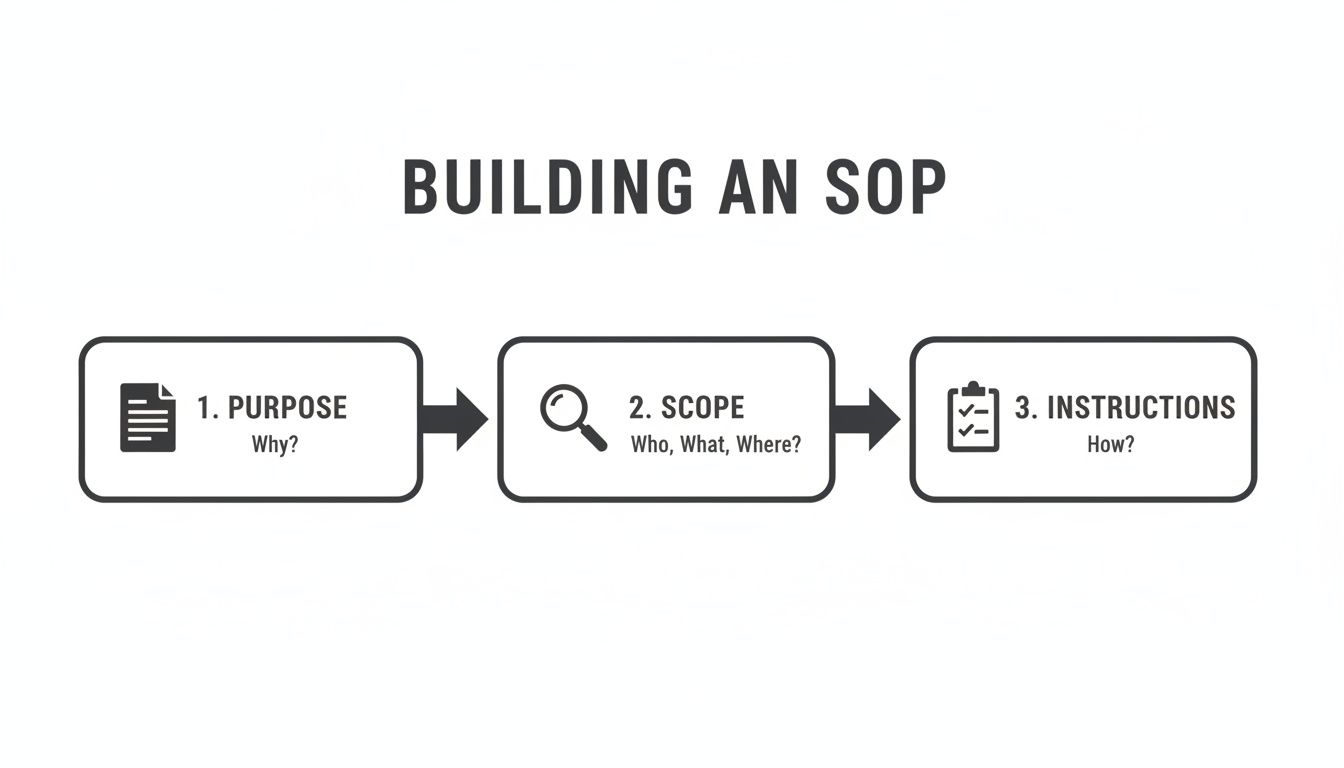
This simple flow—Purpose, Scope, Instructions—ensures every SOP is built on a solid foundation, making it clear, focused, and genuinely actionable for your team.
Step 5: Collaborate and Publish
Finally, share the draft with your team. The people who actually do this process every day are your best source of truth. They'll quickly spot any missing details or suggest clearer language. If you need a more detailed breakdown, there are comprehensive guides on how to create standard operating procedures that can help.
An SOP is a living document. The goal isn't to create a perfect, unchanging set of rules, but a useful guide that evolves with your business. Collaboration ensures it stays relevant and accurate.
Once you've incorporated their feedback, publish the SOP somewhere central and easy for everyone to find. This modern, recording-first approach takes the pain out of documentation, making a high-quality SOP in business an achievable goal for any team—not just professional writers.
Real-World SOP Examples for Different Teams
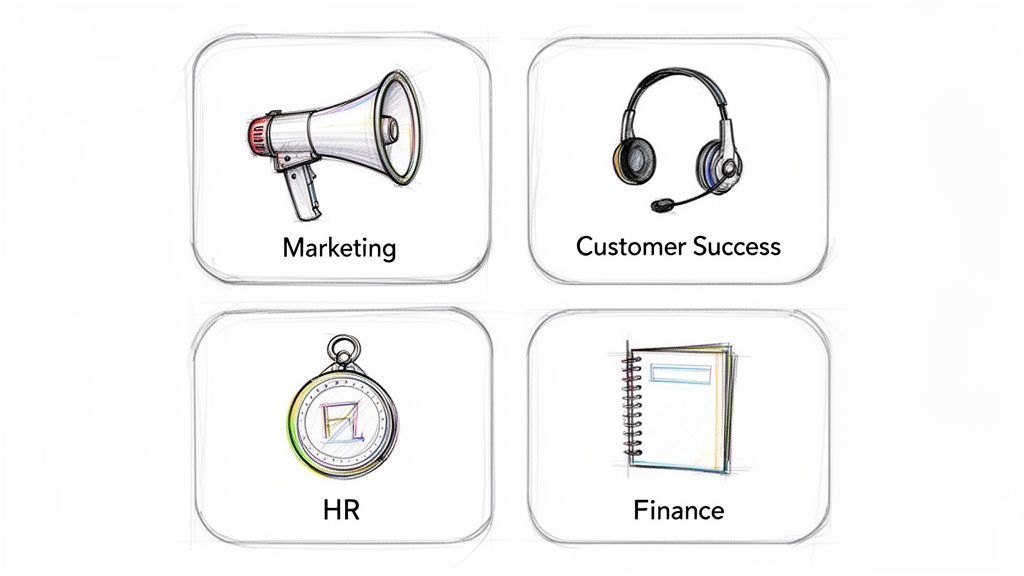
The real power of an SOP in business shows up when you move past the theory and look at how they solve everyday problems. These guides aren’t just for massive, factory-floor operations. They fix real, recurring headaches for teams of all sizes by turning messy guesswork into clear, repeatable actions.
Let's break down how a few different departments use SOPs to lock in their unique workflows, making sure everyone from marketing to HR is on the same page and delivering the same quality.
Marketing Agency Client Onboarding
For any marketing agency, the first few weeks with a new client set the tone for the entire relationship. A clunky, disorganized onboarding process can kill confidence fast, leading to missed deadlines and mismatched expectations right out of the gate.
An SOP for client onboarding fixes this by making a great first impression repeatable. It makes sure nothing critical gets skipped.
Step 1: Send the standard welcome kit and initial discovery questionnaire.
Step 2: Schedule the kickoff call using the pre-built agenda.
Step 3: Grant access to the project management tool and reporting dashboards.
Step 4: Set up the shared Slack channel and assign the primary point of contact.
This simple, structured flow guarantees every single client gets the same professional welcome, building trust from day one.
Customer Success Feature Walkthrough
When a SaaS company rolls out a powerful but complex new feature, the customer success team is on the front line. Without a clear game plan, every team member ends up explaining it a little differently. This leads to confused users and a wave of preventable support tickets.
An SOP for walking users through a new feature standardizes the whole conversation. This guide would probably include:
Key talking points to nail the feature's biggest benefits.
A pre-written email template to proactively reach out to high-value accounts.
Annotated screenshots and short GIFs showing users exactly where to click.
A quick checklist to make sure the feature is configured for each user's specific needs.
This turns what could be a confusing update into a smooth, valuable interaction that makes the customer feel successful.
HR Department New Hire Processing
Getting a new hire set up involves a ton of small-but-critical administrative tasks across a dozen different systems. An SOP here is non-negotiable, both for compliance and for creating a good first impression. It brings all the necessary steps together in one place, from paperwork to system access.
An SOP transforms onboarding from a chaotic scramble into a structured, welcoming experience. It ensures every new team member is set up for success, with the right tools, access, and information from their very first day.
This document would detail exactly how to handle payroll setup, benefits enrollment, IT equipment requests, and initial software logins. The need for this kind of structure is exploding. In fact, the global market for SOP management software was valued at USD 1,625.5 million in 2024 and is on track to nearly double by 2032, all driven by this push for operational consistency. You can dig into more of the data on this market growth at cognitivemarketresearch.com.
Each of these examples shows how a good SOP in business shifts a team from being reactive and putting out fires to being proactive and executing flawlessly every time.
Common Pitfalls to Avoid When Building Your SOPs
Knowing what to avoid when creating an SOP is just as important as knowing what to do. Even with the best intentions, a lot of documentation projects fail because they fall into the same predictable traps. If you can steer clear of these, your efforts will create lasting value instead of just collecting digital dust.
One of the biggest mistakes is making your SOPs too rigid. When a procedure is overly restrictive, it kills innovation and stops your team from adapting to new challenges. The goal isn't to put them in a cage; it's to provide clear guardrails that still allow for expert judgment when things get weird.
Another classic mistake is writing unclear or overly technical instructions. If an SOP is packed with jargon or assumes a high level of background knowledge, it’s basically useless to new hires or anyone from another department. Always write for the least experienced person who might have to do the task.
The Set It and Forget It Syndrome
But maybe the most damaging mistake of all is the “set it and forget it” mindset. A business is a living, breathing thing. Processes, tools, and strategies are always changing. An SOP that was perfect six months ago might be dangerously outdated today, leading to real errors and confusion.
An SOP is not a static document you file away. It's a living guide that has to be regularly reviewed, updated, and improved. If you don't maintain your SOPs, they become worse than useless—they become a source of misinformation.
To keep this from happening, you have to treat your SOPs as living documents. Here’s how:
Schedule Regular Reviews: Put a recurring event on the calendar—quarterly or semi-annually—to review and update your most important SOPs.
Assign Ownership: Make a specific person or role responsible for keeping each SOP current. Without accountability, it just won't happen.
Use Collaborative Tools: Work in cloud-based platforms that make it easy to edit, leave comments, and track different versions.
By getting ahead of these challenges, you can build a library of SOPs that your team actually trusts and uses. This is what turns your documentation from a one-time project into a reliable engine for consistency and growth.
The Questions We Hear Most Often
Even with the best plan, putting SOPs into practice always brings up a few questions. Let's tackle the ones that come up most often, so you can get ahead of them before they slow you down.
How Do You Get People to Actually Follow an SOP?
This is the big one. To get your team on board, you have to bring them into the process from the start. When people help build the SOP, they feel a sense of ownership, and the final guide actually reflects how the work gets done.
The other key is to make your SOPs impossible to ignore by weaving them directly into your team's day-to-day tools and workflows. Swap out those dry, text-heavy documents for something more engaging and visual. And most importantly, lead by example. When leadership consistently points to the SOP as the source of truth, everyone else will, too.
An SOP is only useful if it's used. The best way to guarantee adoption is to make your procedures so clear, accessible, and helpful that doing it the 'right way' becomes the easiest way.
What's the Real Difference Between a Process and an SOP?
It’s easy to mix these up, but the distinction is simple. Think of it this way: a process is the high-level "what" you're trying to do, like "onboard a new client." It’s the goal.
An SOP, on the other hand, is the super-detailed "how." It's the step-by-step instruction manual that spells out exactly who does what, when, and how to get that process done right—every single time.
How Often Should We Be Updating Our SOPs?
Your SOPs should be treated like living documents, not dusty files you set and forget. A good rhythm is to schedule a formal review every quarter or at least twice a year.
But here’s the most important rule: an SOP must be updated immediately whenever a tool, policy, or workflow changes. This is non-negotiable. It ensures your documentation always reflects how work is actually done today and remains a source of truth your team can trust.
Stop letting tribal knowledge slow you down. With Build a Guide, you can turn screen recordings into interactive, step-by-step SOPs your team will actually use. Start standardizing your processes and scaling your business today at https://buildaguide.app.