
March 1, 2026
What Is Procedural Knowledge and Why It Matters for Your Business
Learn what is procedural knowledge ('know-how') and how to document it to build powerful SOPs, streamline onboarding, and boost team performance.
Ever wonder how a seasoned barista pulls the perfect espresso shot without measuring? Or how a veteran software developer navigates a complex codebase almost by instinct? That's procedural knowledge in action. It’s the practical, “how-to” skill we rely on for everything from riding a bike to running a multi-step business process.
The Hidden Engine Driving Your Business
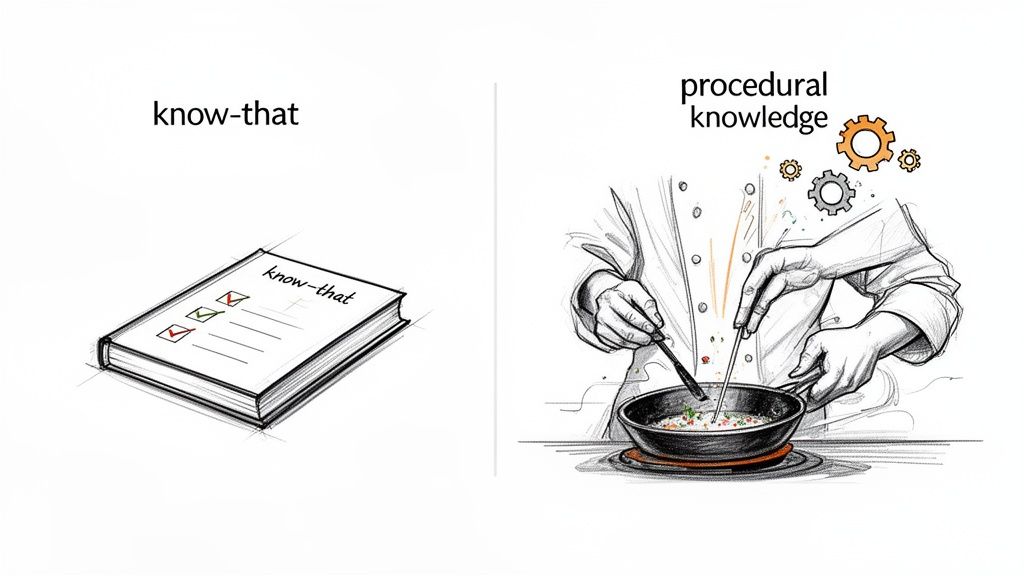
Procedural knowledge is simply knowing how to perform a task. It's the hands-on expertise you gain through practice, becoming so second nature that it’s often hard to explain. This makes it completely different from its counterpart, declarative knowledge, which is about knowing that something is a fact—like memorizing a company policy or a historical date.
Think of it like learning to drive. Reading the driver's manual gives you declarative knowledge. You know the speed limit and what a stop sign means. But only by actually getting behind the wheel do you build the procedural knowledge to merge onto a busy highway or parallel park.
The Value and Vulnerability of Know-How
In any organization, this 'know-how' is one of your most valuable assets. It's the secret sauce that lets your team work efficiently, solve problems creatively, and deliver consistent results. It’s the muscle memory of your business.
But because it’s often unwritten and lives inside your experts' heads, it's also incredibly vulnerable. When a seasoned employee leaves, their procedural knowledge often walks right out the door with them. This "tribal knowledge" drain forces teams to reinvent the wheel, leading to costly mistakes and a major drop in productivity. If this sounds familiar, you may find it helpful to learn more about how to define institutional knowledge and protect it.
This unwritten expertise is where the real operational magic happens. It’s not just about following steps; it’s the intuitive grasp of why those steps matter, which only comes from doing the work. Capturing it is the key to scaling excellence.
To really get it, it helps to see a direct comparison. While one type of knowledge gives you the 'what,' the other provides the crucial 'how.'
Procedural Knowledge vs Declarative Knowledge At A Glance
This table breaks down the core differences between knowing 'how' to do something and simply knowing 'that' something is a fact.
Characteristic | Procedural Knowledge (Know-How) | Declarative Knowledge (Know-That) |
|---|---|---|
Nature | Implicit and action-oriented | Explicit and fact-based |
Expression | Demonstrated through performance | Articulated through words and symbols |
Acquisition | Gained through practice and experience | Learned through reading or instruction |
Example | Knowing how to craft a compelling sales pitch | Knowing your product's feature list |
Storage | Stored as motor skills and habits | Stored as concepts and propositions |
As you can see, one is about doing, and the other is about knowing. Both are important, but only procedural knowledge gets the work done.
Beyond Following Steps to True Expertise
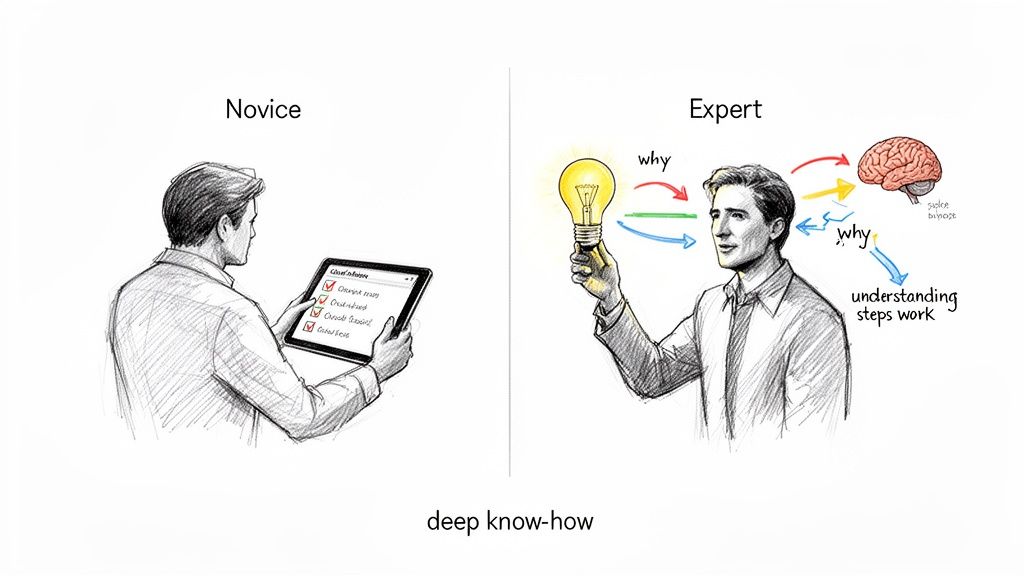
There's a huge difference between knowing the steps and having real expertise. It’s the gap between a novice who can follow a checklist and a seasoned pro who understands why each step matters. This is where people cross the line from just doing a task to truly mastering it.
Think about a junior support agent. Give them a Standard Operating Procedure (SOP) for a known software glitch, and they’ll follow it perfectly to resolve the ticket. That’s procedural knowledge in action—effective, but limited.
But what happens when a totally new, undocumented bug appears? The novice is stuck. Their script doesn't cover it. The expert, on the other hand, taps into a deeper understanding of how the software’s pieces fit together, letting them diagnose the root cause and find a fix on the spot.
That’s the difference. One person can replicate a process. The other can adapt and innovate.
The Two Levels of Procedural Skill
To build a truly capable team, you have to understand the two tiers of "how-to" knowledge. One is great for consistency, but the other is what fuels real problem-solving and growth.
Superficial Procedural Knowledge: This is just the ability to follow a sequence of steps to get a known result. It’s like following a recipe without knowing anything about the chemistry of cooking.
Deep Procedural Knowledge: This is where you understand the principles and context behind the steps. Someone with deep knowledge can tweak the process, adapt it to new challenges, or even reinvent it when necessary.
Moving from one to the other is a journey. It’s a lot like learning video editing from beginner to pro, where you start by mimicking tutorials but eventually internalize the logic, letting you develop your own style. That’s the gateway to becoming a true expert.
This isn’t a new concept. Cognitive psychologists have been studying this "know-how" since the 1970s to separate it from "know-that" (facts). The distinction between superficial and deep procedural skill is what enables the flexibility and good judgment every modern workplace needs. In fact, Deloitte found that companies focused on this deeper training saw a 24% increase in operational efficiency, with employees finishing tasks 37% faster without having to stop and recall instructions.
Why Deep Knowledge Creates Business Value
Building deep procedural knowledge isn't just an academic idea—it directly impacts your bottom line. When your team can think beyond the SOP, your whole operation becomes more resilient and efficient.
An expert doesn’t just know the path; they understand the terrain. This allows them to find new routes when the old ones are blocked, turning potential crises into opportunities for improvement.
This deeper expertise translates into some serious advantages:
Faster Problem-Solving: Experts don't need to escalate every weird issue. Their deep understanding lets them troubleshoot on their own, which means faster fixes and happier customers.
Increased Efficiency: Team members who get the "why" are the first to spot and suggest process improvements. They see the redundant steps and find ways to optimize workflows from the inside out.
Greater Adaptability: In a world where tools and customer needs are always changing, a team with deep knowledge can pivot fast. They can adopt new tech and methods without needing constant hand-holding.
Ultimately, when you invest in developing deep procedural skills, you aren't just training employees to follow directions. You're building a team of proactive problem-solvers who can drive innovation and keep you ahead of the curve.
How Procedural Knowledge Impacts Your Bottom Line
It’s one thing to talk about procedural knowledge in theory. It’s another thing entirely to see how it directly impacts your business. For ops managers, agency owners, and support leaders, mastering your company's 'how-to' knowledge isn't just an admin task—it's a direct lever you can pull to boost productivity, quality, and your bottom line.
When your processes are clear, documented, and repeatable, the whole business just runs better.
Think about an agency that onboards every new client manually. Each project manager has their own little system, which means steps get missed, timelines are all over the place, and costly mistakes lead to rework. But once you document that workflow, you create a single source of truth. Setup time shrinks, every client gets the same great experience, and satisfaction rates climb.
The Real-World ROI of Know-How
The financial and operational payoff of well-managed procedural knowledge is staggering. In high-stakes fields, it’s everything. Surgeons and pilots rely on ingrained procedures to perform flawlessly under pressure, where one wrong move could be catastrophic. For them, 'how-to' knowledge isn't optional; it's the core of their job.
That same principle applies directly to business. The performance gap between an employee who has mastered a process and one who's just starting out is massive. Studies show that experts consistently perform routine procedures 50-70% faster than novices.
In fact, a 2026 analysis of 5,000 firms found that teams with strong procedural skills boosted their daily output by 31%. For example, experienced doctors were able to interpret X-rays 2.5 times quicker, which let them treat 22% more patients in the same amount of time. The data is clear: know-how pays off.
By clearly defining and optimizing this knowledge, you can learn how to streamline business processes and unlock some serious gains in efficiency and profit.
Key Metrics Improved by Procedural Knowledge
The benefits aren't just theoretical—they show up directly in your key performance indicators (KPIs). When you successfully capture and share procedural knowledge, you create a positive ripple effect across the entire company.
When your team’s 'how-to' expertise is documented and accessible, you stop losing valuable time reinventing the wheel. This frees up your best people to focus on innovation and growth instead of constantly fighting fires.
The table below shows exactly which business metrics get a lift when procedural knowledge is handled well.
Business Area | KPI Improved | How Procedural Knowledge Helps |
|---|---|---|
Customer Support | First Contact Resolution (FCR) | Agents have clear, step-by-step guides for troubleshooting, letting them solve issues on the first try without escalating. |
Operations | Task Completion Time | Standardized workflows remove guesswork and hesitation. Employees can execute tasks faster and more consistently. |
Sales | Sales Cycle Length | A documented sales process ensures every lead is nurtured correctly, moving prospects through the funnel more efficiently. |
Human Resources | New Hire Time-to-Productivity | Onboarding checklists and procedural guides help new employees become fully effective in a fraction of the time. |
Ultimately, investing in capturing and sharing your team's procedural knowledge is one of the highest-return activities you can undertake. It cuts down on operational friction, empowers your people to do their best work, and builds a scalable foundation for growth.
How to Capture and Document Expert Know-how
So much of your company’s most valuable procedural knowledge isn’t in a manual. It's locked away in the minds of your top performers. This unwritten expertise, often called tribal knowledge, is the secret sauce behind their success. Capturing it is the first step to making that magic repeatable for your entire team.
Traditionally, companies have tried to pull this information out through slow, manual methods. These approaches are better than nothing, but they're often inefficient and completely miss the subtle details of complex digital workflows. It might sound crazy, but a staggering 90% of an organization's knowledge can be this unwritten, hard-to-explain type.
Getting that knowledge out of people's heads and into a system directly translates to business growth.
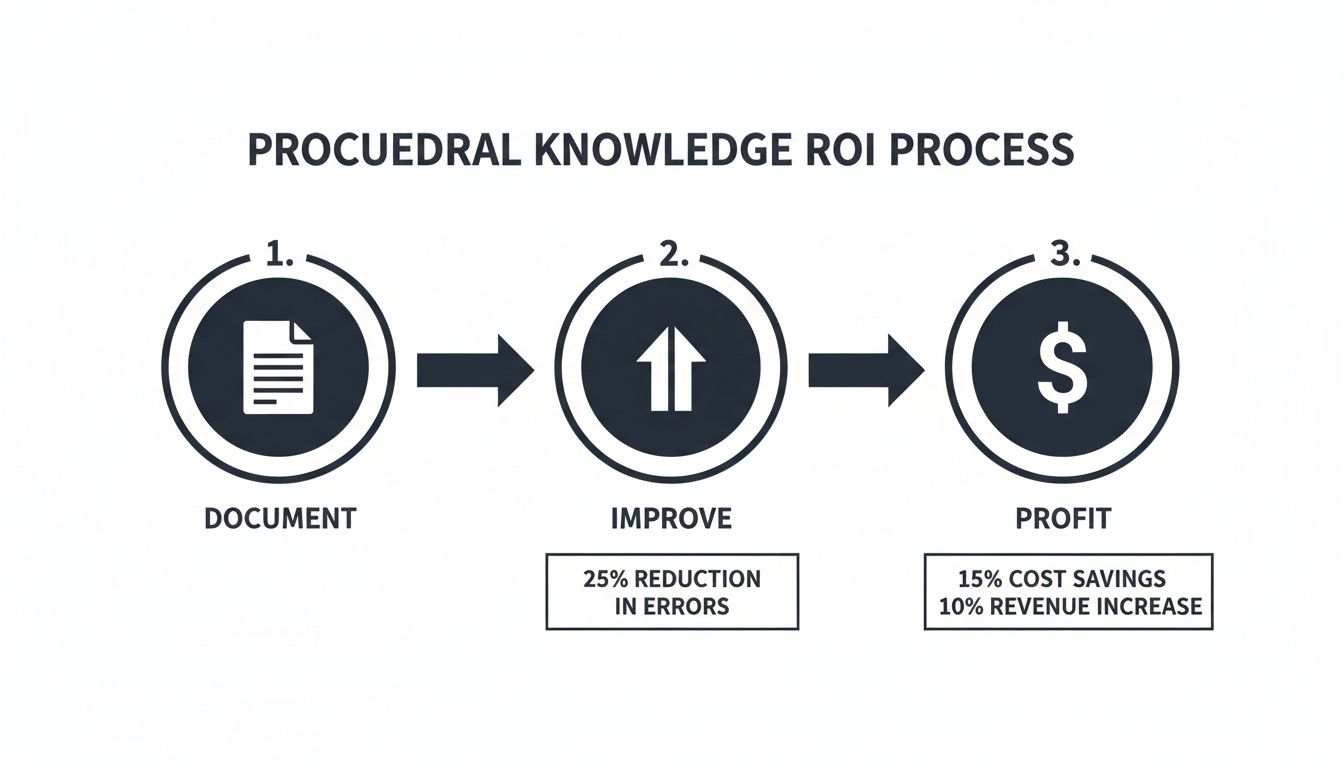
The process is simple: documenting what your experts know allows you to improve your processes, which in turn drives profitability.
Traditional Knowledge Capture Methods
For decades, businesses have relied on a few common strategies to document how their best people get things done. While these methods have good intentions, they are incredibly time-consuming for everyone involved.
Interviews and Q&A Sessions: This is the classic "sit down with an expert" approach. You ask them to explain their process, but the big problem is that experts often can't articulate every small step—so much of their procedural knowledge is automatic, like muscle memory.
Direct Observation (Shadowing): A manager or trainer literally watches the expert work and takes notes. It’s better than an interview, but it's still prone to human error. The observer might miss a critical detail or misinterpret why an action was taken.
Manual Screen Captures: The expert has to stop, take a screenshot, paste it into a document, and write a description for every single step. This is painfully tedious and almost never results in a guide that’s easy to follow.
These old-school methods put a huge burden on your experts, pulling them away from their real jobs to spend hours on documentation. Even worse, the final product is usually a static, clunky document that’s outdated the moment it's finished. For a deeper look into this problem, check out our guide on what is tribal knowledge and its impact.
A Modern Approach to Documenting Procedures
Thankfully, technology offers a far more efficient and accurate way to capture complex "how-to" knowledge, especially for tasks done on a computer. Instead of asking your expert to explain their work, you can just record them doing it.
This modern approach revolves around screen recording tools that capture a process as it happens. The expert performs their task as usual, while the tool records every click, keystroke, and screen change in the background. This completely eliminates the need for them to stop, take notes, or try to remember every detail later.
The goal is to capture expertise at the speed of work. Modern tools allow you to document a process in minutes, not hours, by turning an expert's natural actions into a ready-to-use guide.
Imagine an expert at a digital agency setting up a new client’s analytics dashboard. This is a multi-step process that jumps between several different platforms—a perfect example of complex procedural knowledge.
Here’s how the modern workflow unfolds:
Record the Process: The expert simply starts a screen recorder and performs the task just as they normally would. No need to slow down, narrate, or do anything unnatural.
AI-Powered Transcription: After the recording is done, specialized AI gets to work. It analyzes the video and automatically identifies each distinct action, like "Click on 'Create New Property'" or "Type in the client's domain name."
Automatic Guide Generation: The AI then instantly builds a step-by-step guide from those actions. It generates clear text instructions for each step and pairs them with annotated screenshots that highlight exactly where the expert clicked.
This automated method transforms what was once a complex, hours-long documentation task into a polished, visual guide in just minutes. It’s a game-changer for fast-moving SaaS companies, agencies, and remote teams that can't afford the bottleneck of manual documentation. By capturing procedural knowledge this way, you make expertise instantly transferable.
Turning Captured Knowledge Into Actionable SOPs
Capturing your expert’s workflow is a huge win. But a raw, auto-generated guide is just the starting point. The real value is unlocked when you transform that captured process into a polished, easy-to-follow Standard Operating Procedure (SOP) that anyone can use successfully. A simple recording of steps misses the crucial context that turns a good process into a great one.
This is where the real work begins. The goal isn't just to show what an expert did, but to explain why they did it. Adding this layer of insight is what separates a confusing checklist from an empowering guide that builds real confidence.
Polishing a raw guide means enriching it with the details only a human can provide. It's about going beyond the basic clicks and keystrokes to build a truly comprehensive resource.
From Raw Capture to Polished Playbook
Transforming an automated capture into a top-tier SOP involves several key enhancements. Think of it as adding the coach's notes to the game film—these additions provide the context, warnings, and extra details that prevent mistakes.
Key refinements include:
Adding Expert Notes: Insert callouts that explain the "why" behind a critical step. For example, “We use this specific setting because it prevents compatibility issues with our legacy software.”
Incorporating Checklists: For complex stages, a checklist ensures no small detail is overlooked. This is perfect for pre-launch quality checks or client onboarding tasks.
Embedding Links and Media: Add links to other relevant guides, policy documents, or even short video clips that offer a deeper dive into a specific part of the process.
This process turns a simple recording into a rich, multi-layered document. The raw capture provides the "how," and your edits provide the crucial "why," creating a complete picture.
A great SOP doesn't just list the steps; it anticipates the user's questions and answers them before they're even asked. This proactive approach to clarity is what ensures consistent execution and minimizes support requests.
On top of that, not everyone needs the same level of detail. A one-size-fits-all document is often a recipe for confusion.
Tailoring Guides for Different Audiences
The way you present a process should change based on who you're talking to. A new client being onboarded needs a simple, jargon-free walkthrough. An internal power user needs a more technical guide with advanced tips.
Consider these two scenarios:
A Guide for a New Client: This SOP should be clean and straightforward. Focus on the core steps, remove any internal-facing notes, and use clear, welcoming language. The goal is to make them feel capable and supported.
A Guide for an Internal Expert: This version can include more technical details, shortcuts, and troubleshooting advice. You can use shorthand and assume a higher level of base knowledge, focusing on efficiency and best practices.
Creating different versions of a core process ensures that every user gets exactly the information they need, without being overwhelmed by irrelevant details. This targeted approach dramatically increases the guide's effectiveness. To dig deeper into building these documents, check out our guide on how to create SOPs that your team will actually use.
Building a Living SOP Library
Finally, the most effective way to manage procedural knowledge is to treat your SOPs not as static documents, but as a living, evolving library. Processes change, software gets updated, and new best practices emerge. Your documentation needs to keep pace.
This is where collaborative editing is critical. By allowing team members to suggest edits, leave comments, and co-create guides, you empower the people closest to the work to keep it accurate. This solves the age-old problem of documentation becoming outdated and untrustworthy.
When your team collectively owns the SOP library, it becomes a reliable single source of truth that grows with your business.
Measuring the Success of Your New SOPs
Creating a clear Standard Operating Procedure (SOP) is a major accomplishment. But an SOP gathering dust in a folder doesn’t do anything for your bottom line. Its true value only comes when people use it—and when it demonstrably improves how they work.
You need a reliable way to see what’s working and what isn’t. Is the captured procedural knowledge actually making a difference in the real world?
Simply asking, "Did you read the guide?" isn't enough. Modern knowledge platforms like Build a Guide give you the data to see exactly how your team interacts with your documentation. This turns your SOPs from static assets into dynamic tools for continuous improvement.
Key Metrics to Track for SOP Success
To really know if your SOPs are effective, you have to look beyond simple view counts. The right metrics show you whether your team is truly engaging with the procedures you’ve documented—or just clicking away.
Here are the performance indicators that matter:
Guide Completion Rates: Are people making it all the way through the process? A high drop-off rate is a huge red flag. It might mean your guide is too long, a step is confusing, or something is just plain broken.
Time Spent on Specific Steps: Analytics can show you exactly where users are getting stuck. If someone spends an unusual amount of time on one part of the guide, that step probably needs more detail or a clearer explanation.
User Engagement: Are team members actually opening the guides when they perform a task? Tracking overall usage helps you understand which processes are most reliant on good documentation and which ones are being ignored.
These data points provide direct, unbiased feedback on the clarity and usability of your SOPs. They replace guesswork with concrete evidence, showing you exactly where to focus your improvement efforts.
Creating a Continuous Improvement Loop
The real power of analytics is in creating a feedback loop that consistently makes your operations better. This isn't a one-time fix; it's an ongoing cycle of refinement that keeps your procedural knowledge sharp and relevant.
Analytics reveal the "hotspots" in your process—the points of confusion where users slow down, make mistakes, or give up. These hotspots are your roadmap for improvement, telling you exactly where your SOP needs more clarity.
The workflow is straightforward but incredibly powerful:
Review the Analytics: Regularly check the data for your key SOPs. Look for guides with high drop-off rates, steps with long dwell times, or low overall completion.
Pinpoint Problem Areas: Dig into the data to identify the specific steps causing friction. Is the language unclear? Is a screenshot confusing? Did you forget a crucial detail?
Update with More Clarity: Edit the guide to fix the problem. You might add an expert note, break a complex step into smaller ones, or record a quick video to add more context.
Republish and Monitor: Push the updated version live and watch the analytics. You should see an improvement in your key metrics almost immediately, confirming your changes were successful.
This simple cycle turns your SOPs from static documents into living playbooks that get better over time. It’s how you prove the ROI of your knowledge management efforts and tangibly boost your team’s performance.
Frequently Asked Questions About Procedural Knowledge
As we've explored the world of "how-to" expertise, a few common questions always come up. Here are some straightforward answers to help you understand how procedural knowledge works in the real world.
Can Procedural Knowledge Be Taught in a Traditional Classroom Setting?
You can certainly introduce the basic concepts—the "know-that"—in a classroom, but you can't build true procedural knowledge there. Think of it like this: you can read a book about how to swim, but you only learn how to actually swim by getting in the pool.
Modern training gets this right by blending both worlds. It starts with the theory but quickly moves to hands-on practice, guided walkthroughs, and on-the-job application to build that crucial "know-how."
What Is the Biggest Risk of Not Documenting Procedural Knowledge?
The single greatest risk is knowledge loss. When a key employee walks out the door, their expertise often goes with them. This creates a sudden, massive gap in your operations.
Your team is left scrambling to reinvent processes, leading to inconsistent quality, costly mistakes, and frustrating delays.
This "brain drain" can cripple a growing business or distributed team by erasing critical expertise overnight. Proactively capturing procedural knowledge in a centralized, accessible library is the best way to ensure business continuity and support sustainable growth.
By documenting what your experts do, you turn individual know-how into a durable company asset.
How Often Should We Update Our Procedural Knowledge Documents?
Your Standard Operating Procedures (SOPs) should be living documents, not static files left to gather dust. They absolutely must be reviewed and updated whenever a process, software, or policy changes.
A good rule of thumb is to schedule quarterly reviews for your most critical operational guides. But an even better approach is to use a platform with built-in analytics, which acts as an early warning system.
For instance, if you see that people are consistently getting stuck or spending too much time on a specific step, that’s a clear signal that the guide needs an update. This data-driven approach helps you keep your procedural documentation clear, accurate, and actually useful for your team.
Ready to stop tribal knowledge from walking out the door? With Build a Guide, you can capture your team's expertise in minutes and turn it into polished, step-by-step guides that drive consistency and growth. Start building your living SOP library today at https://buildaguide.app.