
January 8, 2026
The Difference Between Policy and Procedure Explained
Understand the critical difference between policy and procedure with real-world examples. Learn how to create effective documentation that improves clarity.
It's a classic mix-up, but the difference between a policy and a procedure is pretty straightforward once you see it in action. Think of it this way: a policy sets the destination, telling you what to do and why. A procedure is the turn-by-turn GPS, explaining exactly how to get there.
Understanding the Core Distinction
A policy is the high-level rulebook. It’s your company’s official stance on an issue, designed to guide decision-making and ensure consistency with your overall goals. For instance, an "Acceptable Use Policy" for company equipment states that devices are for business purposes. It sets the boundary.
But that policy doesn't tell an employee how to request a new laptop. That's where the procedure comes in. The "New Laptop Request Procedure" would give them the exact, step-by-step instructions: fill out form X, get approval from Y, submit the ticket to Z. The policy is the rule; the procedure is the action plan to follow that rule.
Keeping these two separate is non-negotiable for a well-run organization. Policies give you a stable, strategic framework that reflects your company’s values and rarely changes. Procedures, on the other hand, are built to be flexible. They have to adapt as you get new software, change team structures, or find better ways to work.
When you blur the lines, you end up with messy, rigid documents that nobody wants to use because they’re too hard to follow and a nightmare to keep updated.
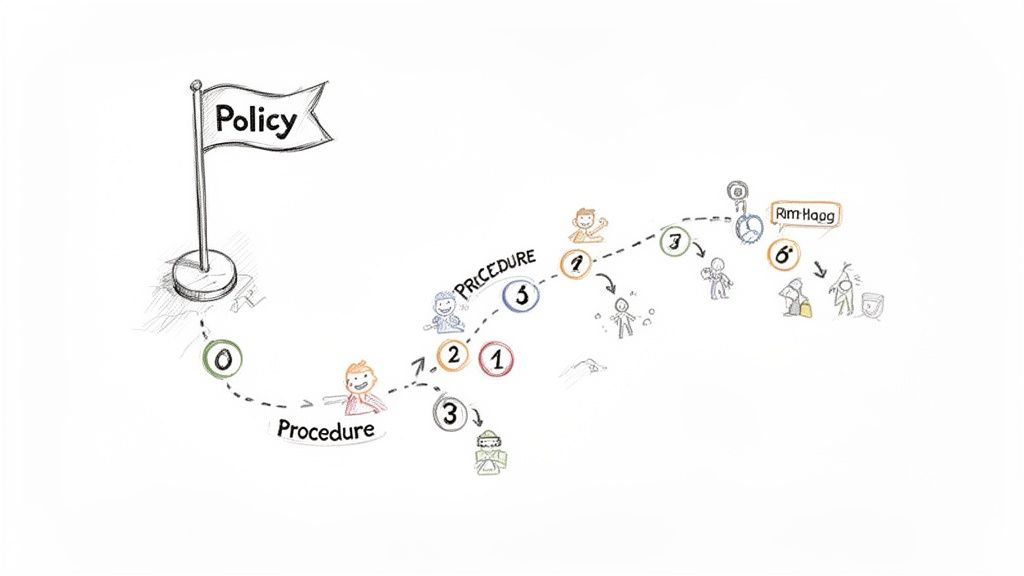
Policy vs Procedure At a Glance
For a quick reference, this table cuts straight to the core differences and shows how each one operates in the real world.
Attribute | Policy | Procedure |
|---|---|---|
Purpose | To guide decisions and set direction | To provide step-by-step instructions |
Focus | Defines the "what" and "why" | Explains the "how," "when," and "who" |
Scope | Broad and organization-wide | Narrow and task-specific |
Nature | Strategic and principle-based | Tactical and action-oriented |
Flexibility | General guidelines allowing judgment | Rigid steps with little deviation |
Audience | Leadership and all employees | Teams performing a specific task |
Mandatory? | Yes, compliance is required | Yes, following steps is required |
Ultimately, policies provide the guardrails, while procedures create the clear path forward. You can't have one without the other if you want consistent, scalable operations.
A Detailed Comparison of Policies and Procedures
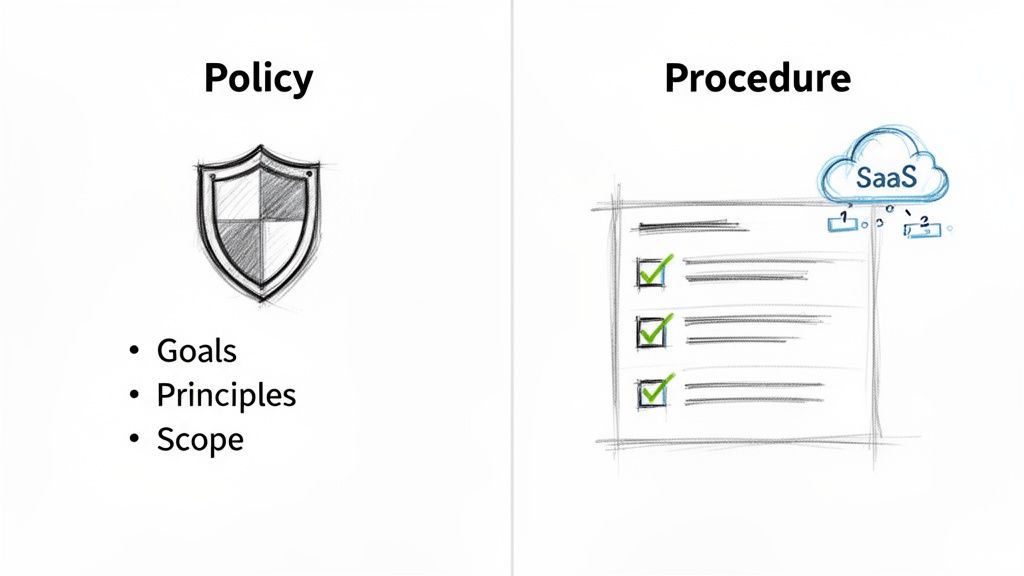
It’s easy to think the difference between a policy and a procedure is just semantics. But in practice, their relationship is far more nuanced, and getting it wrong has real consequences. To really get a handle on their distinct roles, you have to look at how they function across a few key operational areas. This is where you see how they work together to build a business that’s both stable and agile.
The distinction isn't just academic—it has a measurable impact on the bottom line. Policies are the high-level "what" and "why," usually set by leadership. Procedures are the ground-level "how" and "when" for getting specific tasks done. One operations study found that companies with clearly defined guidelines—where policies and procedures are explicitly separated—see around a 30% increase in operational efficiency over those running on informal knowledge. You can read more about this in these insights on operational documentation.
That efficiency boost comes from a simple source: clarity. When you untangle the big rules from the small steps, people know exactly what to do.
Strategic Purpose vs. Tactical Execution
A policy exists to give strategic direction. Think of it as a formal statement of principle that connects back to the company’s mission, values, and legal duties. Its whole job is to steer decision-making from the top down, making sure everyone is pulling in the same direction.
For instance, a SaaS company’s "Data Security Policy" isn't going to list software commands. It will state that all customer data must be encrypted at rest and in transit. That's a non-negotiable, strategic rule.
A procedure, on the other hand, is all about tactical execution. It’s the clear, actionable set of instructions for getting a specific task done in a way that complies with the policy. It’s the "how-to" guide that makes the strategic goal a reality. Following the security example, a procedure would lay out the exact steps an engineer needs to take to configure encryption on a new database server.
Key Differentiator: Policies set the destination (strategic), while procedures provide the turn-by-turn directions to get there (tactical). One is useless without the other.
Broad Scope vs. Narrow Focus
The scope of a policy is intentionally broad. It’s meant to apply across an entire department or even the whole company, and it’s written to stay relevant for a long time. A "Remote Work Policy" is a great example—it outlines general expectations for all remote staff on things like work hours, communication, and security.
A procedure, however, has a laser-sharp, narrow focus. It’s tied to a single task, a specific tool, or one workflow. A procedure that supports the remote work policy might be titled, "How to Request Reimbursement for Home Office Equipment." It would detail the exact steps for filling out a form in the company's expense software.
This difference is critical when it comes to keeping things up to date. Policies get reviewed periodically, maybe once a year. Procedures have to be updated the instant a tool or process changes.
Guiding Framework vs. Rigid Steps
Another place the difference becomes crystal clear is flexibility. A policy is a guiding framework that often leaves room for professional judgment. A marketing agency's "Client Communication Policy," for example, might require all client emails to be answered within one business day. It won't script the reply for you—it trusts you to handle the specifics.
A procedure, however, is designed to be rigid. It's prescriptive because its goal is consistency and quality control. The steps are meant to be followed precisely, every single time, by everyone.
Look at how these two work together:
Policy: A "Brand Voice Policy" that describes the desired tone as "professional, yet approachable and helpful."
Procedure: A "How to Publish a Blog Post" procedure with 15 mandatory steps, from running a grammar check in a specific tool to selecting the right category in the CMS.
One provides a principle; the other enforces a standardized process. This combination is what allows for both strategic alignment and flawless tactical execution, forming the backbone of any operation that’s built to scale.
Why This Distinction Matters for Your Business
Getting policies and procedures right isn't just a word game—it's a core business strategy. When the lines get fuzzy, you open the door to risk, inconsistency, and a whole lot of operational chaos.
But when you get the separation right? You build a framework that lets your business grow without breaking.
Well-defined policies are your first line of defense against legal and regulatory trouble. They set the official rules of the game, making sure your operations line up with the law and industry standards. Think of a data privacy policy. It’s not just a document; it’s a public commitment that shields your company from serious liability.
Procedures, on the other hand, make sure those high-level commitments actually happen day-to-day. They turn broad statements into simple, repeatable actions. This is where you get consistency, quality control, and a predictable customer experience. When everyone follows the same steps, mistakes go down and efficiency goes up.
Boosting Compliance and Reducing Errors
Policies and procedures need each other to work. A policy without a procedure is just an empty promise. A procedure without a policy is just a series of tasks without a purpose. The real magic happens when a clear procedure directly supports a high-level policy.
That connection is everything for compliance. Research shows that policies shape culture, while procedures drive execution. The companies that fail to connect them end up paying for it. In a global survey, risk leaders reported that companies without clear procedures tied to policies had compliance incidents at roughly 2x the rate of businesses with a mature documentation system.
A policy is your organization's "why," setting the standard for how to make decisions. A procedure is the "how," providing the exact steps that guarantee the standard is met every single time.
Creating a Foundation for Scalability
Ultimately, separating these two documents is fundamental to scaling your business. You can't rely on word-of-mouth and tribal knowledge forever. As the team grows, structured documentation is the only way to maintain quality without slowing down.
When you clearly define your strategic rules (policies) and your tactical workflows (procedures), you create a system that can grow with you.
This structured approach pays off in a few key ways:
Faster Onboarding: New hires get up to speed quickly because they can learn both the company’s principles and the exact steps to do their jobs.
Improved Consistency: Critical tasks get done the same way, every time, leading to high-quality, predictable results.
Enhanced Agility: You can update a procedure in minutes to reflect a new tool or a better workflow, all without having to rewrite the underlying policy.
By treating policies and procedures as distinct but connected tools, you build a powerful operational backbone for your company. This clarity doesn't just reduce risk—it empowers your team to execute flawlessly, paving the way for consistent, scalable success. You can see how this works in practice by exploring the benefits of standard operating procedures.
How to Write Effective Policies and Procedures
Great documentation turns big-picture goals into consistent, everyday actions. But writing a policy is a completely different game than drafting a procedure. Each requires a specific mindset to get right.
The simplest way to think about it is this: Policies set the rules. Procedures explain how to follow them.
A well-written policy is strategic, concise, and stays out of the weeds. Its job isn't to micromanage, but to establish principles, set clear boundaries, and explain the "what" and "why" behind a company rule. You’re building a framework for good decision-making, not a script for every possible action.
That means a policy needs to clearly state its purpose, define who it applies to, and assign high-level ownership. For example, a "Social Media Policy" won't list every banned word. Instead, it will state that all public content must align with company values and get a final check from the marketing team.
Crafting a Clear and Concise Policy
When you’re writing a policy, the goal is to create a stable, guiding principle that won’t need to change every month. To pull this off, your document should always have these four parts:
Policy Statement: One direct sentence that gets right to the point and summarizes the rule.
Purpose: A quick "why" behind the policy, usually tied to things like security, compliance, or core company values.
Scope: Who this applies to. Is it for everyone, just full-time employees, or a specific department?
Responsibilities: Who owns the policy? This is a high-level assignment, like, "The IT Department is responsible for enforcement."
Writing an Actionable Procedure
Writing a procedure, on the other hand, is all about the details. Here, you have to shift from abstract rules to concrete, step-by-step instructions. A procedure that leaves room for guessing has already failed. It exists to create a repeatable process that anyone—from a seasoned pro to a brand-new hire—can follow to get the exact same result.
This is where detail becomes non-negotiable. An effective procedure breaks a task down into a logical sequence of actions. And unlike a policy, which is mostly text, procedures thrive on visual aids like screenshots, checklists, and annotations. Modern tools make this easy, letting you capture a workflow automatically and turn it into a guide people can actually follow. If you want to see this in action, check out our post on how to create a step-by-step guide with visuals.
A policy is written to be understood; a procedure is written to be executed. The first guides thinking, while the second guides action. Without both, strategic intent rarely translates into flawless execution.
The best procedures are task-oriented and use simple, direct language. They anticipate where someone might get stuck and provide clear instructions for every stage. Think about a procedure for "Submitting an Expense Report." It should have numbered steps with screenshots for every single click in the software, leaving zero doubt about how to get it done right. This focus on visual, granular steps is what bridges the gap between a high-level rule and perfect execution.
Turning High-Level Policies Into Actionable SOPs
While policies set the direction and procedures outline the steps, a Standard Operating Procedure (SOP) is where the rubber truly meets the road. An SOP is the most granular, detailed version of a procedure, built to ensure a critical task is done the exact same way every single time. No exceptions.
Think of it as the final, polished output of your documentation. A policy gives you the "why," but a truly great SOP delivers a foolproof "how-to" guide that strips away all ambiguity. This is how high-level rules become consistent, repeatable actions that actually drive quality.
This flow from a broad rule to a detailed guide is a natural progression.
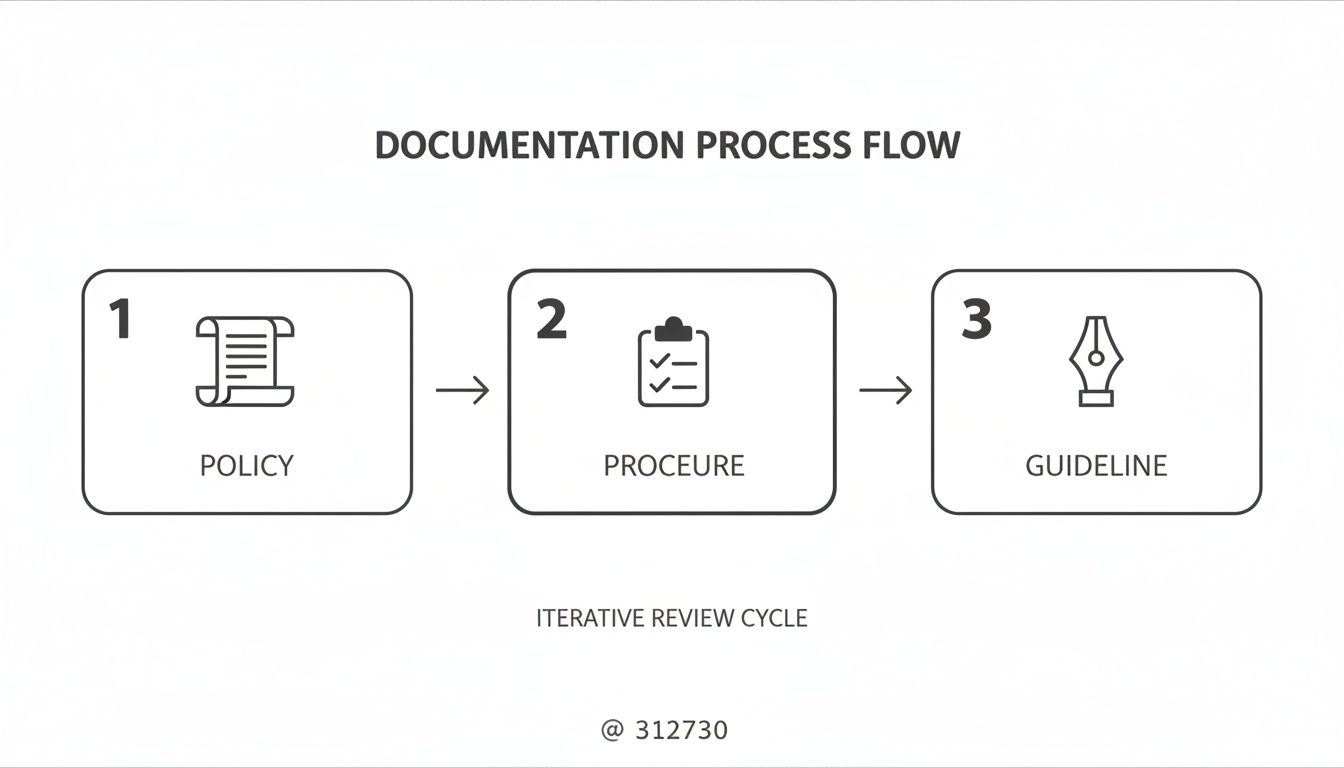
Effective documentation isn't a single document. It’s a connected system where abstract policies are translated all the way down into concrete, step-by-step SOPs.
The Anatomy of an Effective SOP
A good SOP takes the basic steps from a procedure and elevates them with rich detail. The goal is to make it so clear that anyone, regardless of their experience, can follow along without getting lost. It should answer every question before it’s even asked.
Let's say you have a policy that all customer support tickets must be resolved within 24 hours.
The SOP for this wouldn't just be a checklist. It would be a comprehensive visual guide. It would include annotated screenshots for every single click inside the helpdesk software, showing the team exactly how to log, escalate, and close a ticket to meet that SLA.
A great SOP usually includes:
A Clear Purpose: A short statement explaining what the SOP achieves and which policy it supports.
Specific Roles: Clearly defining who is responsible for each part of the task.
Step-by-Step Instructions: A numbered list detailing every action in a logical sequence.
Visual Aids: Screenshots, diagrams, or short clips to illustrate complex or confusing steps.
Required Tools: A list of all software, hardware, or materials needed to do the job.
Why SOPs Are Essential for Execution
Turning policies into actionable SOPs is fundamental for operational excellence. It's the only real mechanism that ensures your strategic goals aren't just empty statements collecting dust in a folder somewhere. It weaves them into the daily fabric of your team's work.
This process directly boosts team performance, cuts down on errors, and guarantees compliance across the board.
An SOP is the ultimate expression of a procedure. It transforms a simple checklist into a comprehensive, visual training tool that makes flawless execution the default, not the exception.
By documenting processes with this level of detail, you create a single source of truth that empowers everyone. For instance, a well-crafted SOP for client onboarding ensures every new customer gets the same high-quality experience, which directly supports a broader policy of customer centricity. When your team has clear, visual instructions, they can execute with confidence.
To get started, you can explore a complete standard operating procedure template that provides the structure you need. This structured approach helps transform those abstract policies into the consistent, repeatable actions that actually fuel business growth.
Still Have Questions? Let's Clear Things Up.
Even when the definitions seem clear, things can get fuzzy when you're actually trying to apply them. Let’s tackle a few of the most common questions that pop up.
Can One Document Be Both a Policy and a Procedure?
Not really, and you wouldn’t want it to be. Keeping them separate is what makes them work.
A policy needs to be a stable, high-level document. It sets the rules. A procedure, on the other hand, is a tactical, step-by-step guide that might change every time you update a piece of software. Mashing them together creates a messy, confusing document that’s a nightmare to update and even harder for your team to follow.
Think of it this way: a policy might reference several procedures, and every procedure should absolutely link back to the policy it supports. But they need to live in separate documents.
Who Is Supposed to Write These Things?
This is a classic "it depends on who knows what" situation.
Policies come from the top. Senior leadership or management are the ones who should be creating and approving them. They have the 30,000-foot view of the business, its goals, and its legal obligations. Policies are strategic, so they need to be handled at a strategic level.
Procedures, however, are built from the ground up. The best people to write a procedure are the ones who actually do the work every day. Your team leads, managers, or subject matter experts know the most efficient way to get something done. They live and breathe the process.
Key Takeaway: This division of labor is what makes both documents effective. Leadership provides the strategic "why" through policies, while the team on the ground provides the practical "how" through procedures.
How Often Do Policies and Procedures Need to Be Reviewed?
The review cycles for policies and procedures are completely different, and for good reason.
Policies are built to last. They’re the foundational rules of your organization, so you should only need to review them annually or when a major change happens—like new regulations or a shift in business strategy.
Procedures are far more dynamic. They need to be reviewed the moment a process changes. Did you just roll out a software update with a new UI? The procedure needs to be updated immediately with new screenshots and steps. This is where modern documentation tools really shine, letting you quickly edit a few steps instead of rewriting an entire manual.
Keeping your procedures fresh is what keeps them useful.
Ready to turn your high-level policies into actionable, easy-to-follow guides? Build a Guide helps you create clear, visual SOPs that your team will actually use. Stop letting tribal knowledge run your operations and start building a scalable system for success. Learn more and start your free trial today.