
February 17, 2026
10 Employee Onboarding Best Practices for Unstoppable Teams in 2026
Discover 10 actionable employee onboarding best practices to boost retention and productivity. Get SOPs, KPIs, and real-world examples to perfect your process.
A great employee onboarding experience is the single most important driver of new hire success, engagement, and long-term retention. Yet, many companies still rely on outdated checklists, overwhelming documents, and inconsistent "tribal knowledge." This sink-or-swim approach doesn't just create a frustrating first impression; it directly impacts your bottom line through higher turnover, slower time-to-productivity, and repeated errors that drain resources. A poorly structured process leaves new hires feeling isolated and confused, significantly increasing the likelihood that they will leave within their first year.
The cost of replacing an employee can range from one-half to two times their annual salary, making effective onboarding a critical financial imperative. When new team members can't get up to speed quickly, projects stall, customer satisfaction dips, and existing employees become burdened with picking up the slack. This cycle of inefficiency is expensive, but entirely preventable with a structured, intentional onboarding strategy.
This guide moves beyond generic advice to provide a comprehensive roundup of the top 10 employee onboarding best practices that high-performing organizations use to build unstoppable teams. We will break down exactly how to create a system that accelerates learning, builds confidence, and integrates new hires seamlessly into your company culture.
You will learn how to:
Implement role-specific learning paths and set clear 30/60/90-day milestones.
Assign mentors and establish feedback loops that actually work.
Standardize critical knowledge with accessible, multi-format content.
Measure success with tangible Key Performance Indicators (KPIs).
We'll cover everything from pre-boarding to leveraging technology like Build a Guide for creating interactive, scalable Standard Operating Procedures (SOPs). Get ready to transform your onboarding from a procedural chore into a strategic advantage that pays dividends in productivity and retention.
1. Create Comprehensive, Visual Step-by-Step Guides
Traditional, text-heavy onboarding manuals are often ineffective, leading to information overload and poor knowledge retention. A superior approach, one of the most impactful employee onboarding best practices, is to develop detailed procedural documentation that breaks down complex processes into small, manageable steps with accompanying visuals. This transforms static documents into interactive, scannable guides that new hires can follow at their own pace.
Visual guides significantly improve comprehension by showing, not just telling. By pairing concise instructions with screenshots, GIFs, or short video clips, you cater to different learning styles and make abstract software workflows tangible and easy to follow.
How to Implement This Practice
Capture Processes in Real-Time: Use screen recording tools to capture an expert performing a task. This raw footage can then be edited down or converted into annotated screenshots for each step.
Add Contextual Cues: Enhance your guides with callouts, warnings, and pro-tips at critical decision points. This helps prevent common mistakes before they happen.
Test and Iterate: Before finalizing a guide, have a new employee test it. Their feedback is invaluable for identifying confusing steps or gaps in the process.
For instance, companies like Slack and HubSpot use this method effectively in their help centers, guiding users through workspace setup and CRM configuration with clear, step-by-step visuals. This approach is not just for customer-facing documentation; it's a powerful internal tool for standardizing everything from submitting expense reports to using proprietary software.
By prioritizing visual learning, you reduce the cognitive load on new employees, accelerate their time to proficiency, and create a scalable, consistent training resource. To dive deeper into this methodology, you can learn how to create a step-by-step guide with screenshots that boosts engagement and ensures process adherence from day one.
2. Establish Clear Onboarding Timelines and Milestones
Leaving new hires to navigate their first few months without a clear plan can lead to confusion, disengagement, and a longer ramp-up period. A core component of effective employee onboarding best practices is establishing a structured timeline with specific, measurable milestones. This approach provides a clear roadmap, manages expectations, and gives both the new employee and their manager a framework for tracking progress.
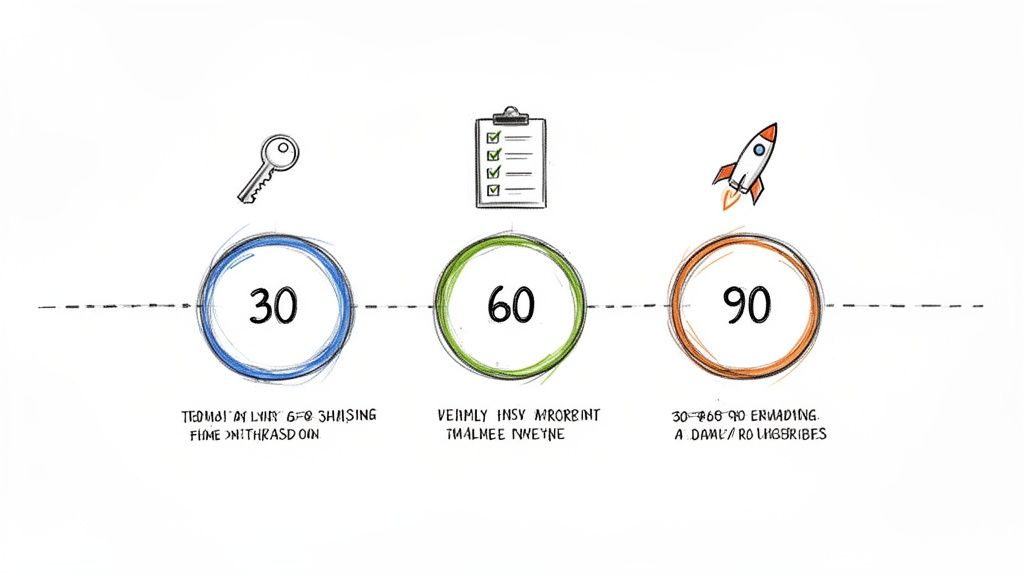
This structured journey, often broken into 30, 60, and 90-day phases, transforms onboarding from a passive experience into an active, goal-oriented process. Each phase should have defined learning objectives, performance goals, and key relationship-building targets, ensuring the new hire is systematically integrated into their role and the company culture.
How to Implement This Practice
Define Phase-Specific Goals: For the first 30 days, focus on learning core systems and meeting the team. The 60-day mark should target initial contributions and deeper process understanding. By 90 days, the goal should be growing autonomy and tackling more complex projects.
Share the Timeline Early: Provide the new hire with their onboarding timeline and milestones before their start date. This transparency helps them feel prepared and understand what is expected from day one.
Schedule Regular Check-ins: Formalize milestone reviews at the end of each period (30, 60, and 90 days) to discuss progress, address challenges, and provide constructive feedback.
Leading companies like Microsoft implement this with structured timelines where Week 1 is for systems access, Month 1 covers role basics, and Month 3 focuses on achieving independence. This phased approach prevents overwhelm and builds momentum. To ensure new hires have a clear roadmap and achieve early success, consider implementing a practical 30-60-90 day plan template.
By creating a clear and predictable journey, you empower new employees to take ownership of their onboarding, reduce manager uncertainty, and create a scalable system for fostering early success.
3. Assign Dedicated Onboarding Champions or Mentors
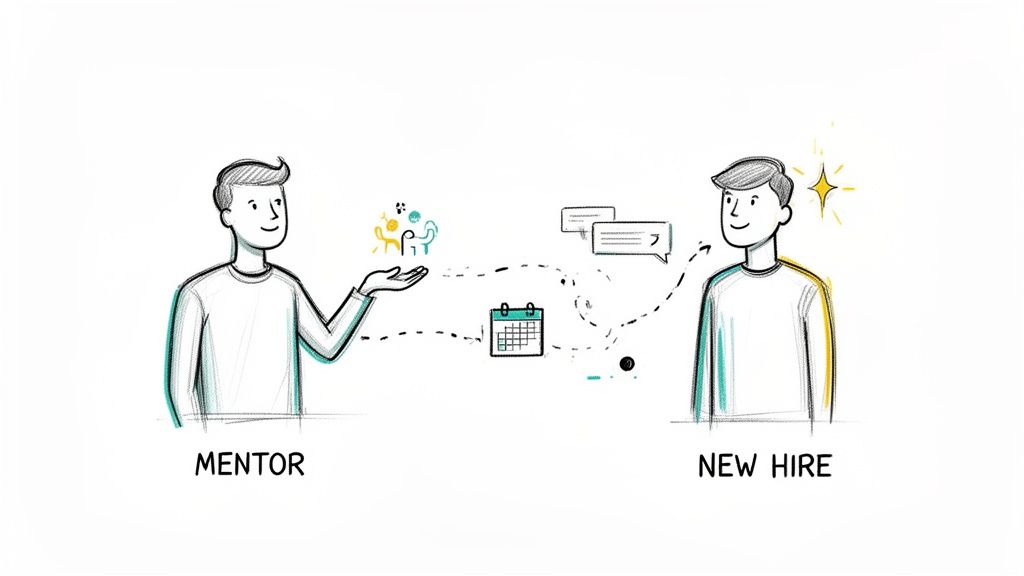
Formal training sessions and documentation are crucial, but they can't replace the value of human connection and personalized guidance. One of the most effective employee onboarding best practices is assigning each new hire a dedicated champion or mentor. This individual acts as a primary point of contact, a cultural guide, and a friendly resource for the informal, ad-hoc questions that new employees are often hesitant to ask their managers.
This human-centric approach transforms onboarding from a checklist of tasks into a supportive, relationship-building experience. An onboarding mentor provides context, shares tribal knowledge, and helps the new hire navigate the social and professional landscape of the organization, significantly accelerating their sense of belonging and integration.
How to Implement This Practice
Create Mentor Playbooks: Don't leave the mentoring process to chance. Develop a clear playbook for champions that outlines their role, responsibilities, suggested conversation topics, and key milestones. Sharing these mentor guides via a platform like Build a Guide ensures consistency across departments.
Schedule Formal Check-ins: Structure the relationship with scheduled weekly or bi-weekly check-ins for the first 90 days. These planned meetings ensure dedicated time for questions and feedback, supplemented by the availability for informal, ad-hoc support.
Train Your Mentors: Equip your champions for success. Provide training on active listening, giving constructive feedback, and how to effectively leverage company resources and onboarding documentation to answer questions.
Recognize and Reward Participation: Acknowledge the effort mentors put in. Incorporate their role into performance reviews, offer small rewards, or create a formal recognition program to incentivize participation and highlight its value to the company.
Companies like Airbnb have famously implemented this with their "Belong buddies" program, which pairs new hires with seasoned employees to facilitate cultural integration. Similarly, LinkedIn’s mentorship program assigns senior engineers to new ones to speed up technical ramp-up. This practice is incredibly powerful for complex roles and essential for fostering connection in distributed teams, ensuring no new hire feels isolated.
4. Implement Role-Specific Learning Paths
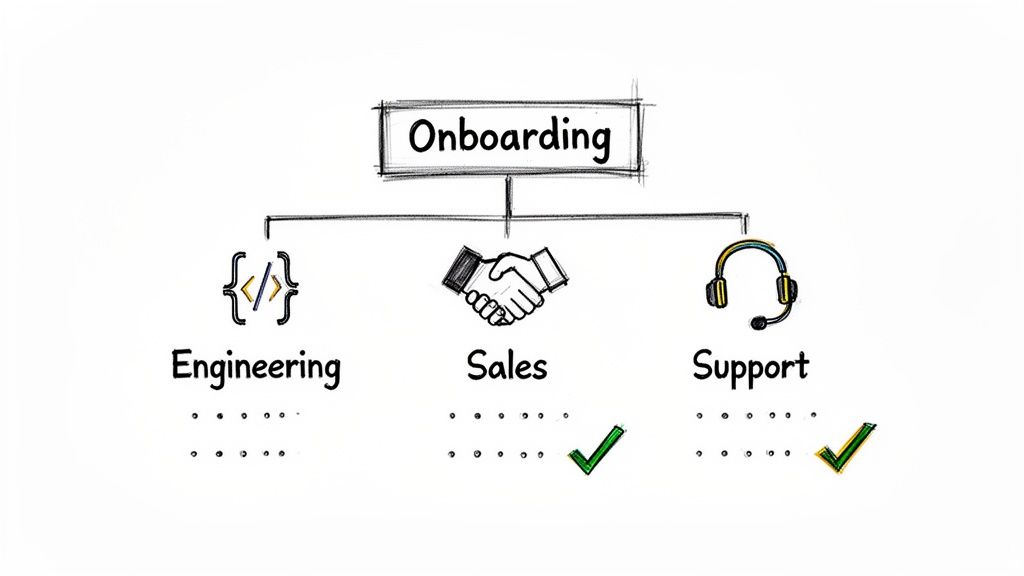
A generic, one-size-fits-all onboarding program fails to address the unique needs of different departments and roles. A crucial employee onboarding best practice is to design and implement tailored learning paths that deliver relevant, role-specific content. This targeted approach acknowledges that the information a new software engineer needs on day one is vastly different from what a customer success manager requires to succeed.
By segmenting your onboarding content, you significantly reduce cognitive load and prevent new hires from feeling overwhelmed by irrelevant information. This focus accelerates their time-to-productivity, as they can immediately start mastering the specific tools, processes, and skills essential for their position. It transforms onboarding from a general orientation into a strategic, performance-focused experience.
How to Implement This Practice
Map Core Competencies: Interview high-performing team members in each role to identify the essential skills, knowledge, and daily tasks. Use this insight to create a skill matrix that maps role requirements to specific learning modules and objectives.
Create Modular Content: Develop your training materials as individual, self-contained guides or modules. This makes it easy to mix and match content to build unique learning paths for different roles without recreating everything from scratch.
Leverage Technology: Use a documentation platform that allows for content tagging and conditional logic. For example, with a tool like Build a Guide, you can create a single source guide and use audience tags to show or hide specific steps based on the new hire's role, ensuring they only see what’s relevant.
Companies like Stripe and Shopify excel at this by providing distinct onboarding tracks for their engineering, sales, and support teams. An engineer at Stripe might dive deep into API documentation and coding standards, while a new sales representative focuses on product positioning and CRM workflows. This customization ensures every new employee receives the most direct and effective path to becoming a valuable contributor.
5. Provide Early Wins and Quick Productivity Goals
Leaving a new hire to passively absorb information for weeks is a recipe for disengagement. One of the most critical employee onboarding best practices is structuring the first week around small, achievable tasks that deliver immediate value and build confidence. These "quick wins" shift the new employee from a passive observer to an active contributor, creating momentum and psychological safety.
This approach counters the common feeling of being overwhelmed by demonstrating tangible competence early on. When a new hire accomplishes a meaningful task, it validates their skills, integrates them into team workflows, and provides a solid foundation for tackling more complex challenges. It proves to them, and the team, that they are a valuable addition from day one.
How to Implement This Practice
Define Role-Specific First Tasks: Work with hiring managers to identify low-risk, high-impact tasks. For a developer, it could be submitting a small pull request; for a marketer, it might be drafting social media copy for a campaign.
Document the Process Clearly: Use a tool like Build a Guide to create a simple, visual step-by-step guide for completing this first task. This removes ambiguity and empowers the new hire to work autonomously.
Provide Necessary Resources: Ensure the employee has everything they need, such as access credentials, project templates, or starter code, to eliminate friction and set them up for success.
Celebrate the Achievement: Acknowledge the completion of the first task publicly. A shout-out in a team Slack channel or a mention in a weekly meeting reinforces the value of their contribution and makes them feel seen.
Companies famous for their engineering culture, like GitHub, often have new developers submit their first pull request by the end of their first week. Similarly, Zapier has new team members build their first internal automation. These aren't just symbolic gestures; they are carefully designed experiences that accelerate integration and productivity, proving that meaningful contribution can start immediately.
6. Establish Real-Time Feedback and Iteration Loops
Static onboarding programs quickly become outdated, leaving new hires with irrelevant information and broken processes. A crucial employee onboarding best practice is to treat your program as a living system by building real-time feedback and iteration loops. This approach transforms onboarding from a one-time event into a dynamic process that continuously improves based on direct input from those experiencing it.
By actively soliciting and acting on feedback, you demonstrate that the company values employee input and is committed to refining their experience. This practice ensures your documentation and workflows remain relevant, effective, and aligned with the evolving needs of your roles and technology stack.
How to Implement This Practice
Deploy Pulse Surveys: Send short, targeted surveys at key milestones (e.g., end of week one, 30 days, 90 days). Keep them brief (3-5 questions) to maximize completion rates and gather timely insights.
Ask Specific, Actionable Questions: Instead of asking, “How was your onboarding?” ask, “What was the most confusing part of your first week?” or “Which training document was least helpful and why?” This yields specific, actionable data.
Analyze Engagement Analytics: Use tools that provide analytics on your onboarding materials. Track which guides or steps cause the most confusion or drop-off to pinpoint areas for immediate improvement.
Create a Feedback Backlog: Centralize all feedback into a shared backlog. Regularly review and prioritize this list with stakeholders to decide which updates to implement next, ensuring a systematic approach to iteration.
Companies like Amazon use this method effectively, deploying post-onboarding surveys to gather data that informs process improvements. Similarly, Intercom analyzes which help articles are most viewed by new hires to identify and clarify confusing aspects of their internal systems.
By establishing these feedback loops, you close the gap between what you think new hires need and what they actually experience. This commitment to continuous improvement not only accelerates their ramp-up time but also strengthens their long-term engagement and success.
7. Standardize and Document All Critical Processes
Relying on "tribal knowledge" where information is passed down verbally is inefficient and risky. One of the most foundational employee onboarding best practices is to convert this tacit knowledge into documented Standard Operating Procedures (SOPs). Standardization ensures every new hire learns the correct, most efficient way to perform tasks, driving consistency and quality across the entire organization.
This practice is the bedrock of a scalable onboarding program. Documented processes reduce dependency on specific individuals, empower new team members to find answers independently, and create a single source of truth that can be updated and improved over time. It’s particularly critical for distributed teams and agencies that must maintain high standards across various projects and client accounts.
How to Implement This Practice
Prioritize Critical Workflows: Don't try to document everything at once. Start by identifying the 10-15 most critical processes that new hires must learn to be effective in their roles.
Involve Subject Matter Experts: The people who perform the tasks daily know the nuances and potential pitfalls. Involve them directly in the documentation process to ensure accuracy and completeness.
Incorporate Decision Logic: Great SOPs don't just list steps; they guide thinking. Include decision criteria, such as "If the client requests X, follow procedure Y; if they mention Z, escalate to a manager."
Companies famous for their operational excellence, like McDonald's, build their entire business model on rigorously standardized procedures that ensure a consistent customer experience worldwide. Similarly, tech companies like Zapier and Buffer have championed transparency by documenting their internal operations, making it easier for new hires to understand how the business runs from day one.
By systematically documenting your core processes, you create a reliable, scalable training asset that accelerates ramp-up time and minimizes preventable errors. To get started on building your own library of processes, you can use a standard operating procedure template to structure your documentation for maximum clarity and impact.
8. Create Accessible, Multi-Format Onboarding Content
Relying on a single format for training materials, such as a text-only PDF, excludes employees with different learning preferences and accessibility needs. A truly effective onboarding program delivers information in multiple formats, a cornerstone of inclusive employee onboarding best practices. This approach ensures that visual learners, auditory learners, and those who prefer reading can all engage with and retain the same crucial information effectively.
By offering content as video tutorials, interactive guides, text documents, and audio clips, you cater to a wider audience. This strategy extends beyond learning styles to include critical accessibility features like mobile responsiveness for on-the-go learning, language options for global teams, and compatibility with assistive technologies. This commitment makes your onboarding process more equitable and impactful for every new hire.
How to Implement This Practice
Start with Core Formats: Begin by creating both a text-based guide and a corresponding video walkthrough for key processes. These two formats cover the most common learning preferences and are relatively easy to produce and scale.
Prioritize Accessibility Features: Add closed captions or transcripts to all videos. Use descriptive alt text for all images and diagrams to assist screen readers. Ensure all digital content is mobile-responsive, as many employees will access materials on their phones.
Test with Assistive Tools: Use screen readers and other assistive technology tools to test your onboarding materials. This helps you identify and fix accessibility barriers you might otherwise miss, ensuring everyone has a smooth experience.
Companies like Duolingo and Asana excel at this by providing a mix of video tutorials, interactive product walkthroughs, and detailed written guides. Similarly, Microsoft Learn offers text-based lessons, video modules, and hands-on labs. This multi-format approach ensures that knowledge is not just available but is also truly accessible, helping new employees build confidence and competence regardless of how they learn best.
9. Foster a Peer Learning and Knowledge-Sharing Culture
Relying solely on managers for training creates a significant bottleneck and can isolate new hires. One of the most effective employee onboarding best practices is to create structures that encourage peer-to-peer learning. This approach decentralizes knowledge, accelerates information transfer, and builds stronger, more collaborative team connections from day one.
A peer-driven culture transforms onboarding from a top-down directive into a collaborative experience. New employees feel more comfortable asking questions to a peer than a manager, and experienced team members reinforce their own knowledge by teaching others. This dynamic environment ensures that tribal knowledge is documented and shared, rather than lost.
How to Implement This Practice
Establish Dedicated Channels: Create specific Slack or Teams channels (e.g.,
#onboarding-engineers,#new-hire-q-and-a) where new employees can ask questions in a low-pressure environment and receive answers from a variety of peers.Encourage Co-Creation: Have new hires co-author or update procedural guides with experienced employees. This gives them immediate ownership and ensures the documentation remains relevant and accurate from a fresh perspective.
Implement a Peer Review System: Before publishing any new SOP or guide, have it reviewed by a peer from the relevant team. This simple step catches errors, clarifies confusing language, and validates the process.
This model has been proven at a massive scale by platforms like Stack Overflow, which built a global knowledge-sharing community on a peer Q&A foundation. Internally, companies can replicate this by fostering a culture of open inquiry and shared ownership. To support a thriving culture, consider implementing strong internal communication best practices that facilitate this kind of open dialogue.
By empowering employees to learn from and teach each other, you create a scalable, self-sustaining system of knowledge transfer. This not only speeds up proficiency but also integrates new hires into the team's social fabric more effectively. To support this, you can learn how to build a knowledge base that serves as a central hub for your team's collective wisdom.
10. Measure Onboarding Success with Key Performance Indicators (KPIs)
An onboarding program without clear metrics is like navigating without a compass; you are moving, but you don't know if it's in the right direction. One of the most critical employee onboarding best practices is to define and track quantifiable KPIs that measure the effectiveness of your program. This data-driven approach moves onboarding from a subjective "feel-good" exercise to an evidence-based business function with a demonstrable return on investment.
Tracking specific metrics allows you to pinpoint weaknesses, validate successful strategies, and continuously iterate your process. By measuring outcomes like productivity, engagement, and retention, you can prove the value of your onboarding investments and make informed decisions to improve the new hire experience.
How to Implement This Practice
Select Core Metrics: Instead of tracking dozens of data points, focus on 3-5 core KPIs that align with your business goals. Common metrics include time-to-productivity, 90-day new hire retention rate, training completion rates, and new hire satisfaction scores (eNPS).
Establish Baselines and Targets: Benchmark your current performance to set a baseline. From there, establish realistic, incremental improvement goals for each KPI to guide your efforts.
Segment Your Data: Analyze metrics by cohort, department, manager, or onboarding buddy. This segmentation helps identify patterns, revealing which teams excel at onboarding and where additional support is needed.
For instance, Google famously tracks new hire productivity and 90-day retention to gauge the success of its onboarding interventions. Similarly, Salesforce uses certification completion rates as a key indicator of a new employee's readiness and knowledge acquisition. This focus on measurement enables them to refine their programs based on concrete results, not assumptions.
By tying your onboarding activities to measurable outcomes, you transform the process from a cost center into a strategic driver of talent development and business performance. This quantitative approach is essential for scaling a consistently effective onboarding experience.
10-Point Employee Onboarding Best Practices Comparison
Practice | 🔄 Implementation Complexity | ⚡ Resource Requirements | ⭐ Expected Outcomes | 📊 Ideal Use Cases | 💡 Key Advantages / Tips |
|---|---|---|---|---|---|
Create Comprehensive, Visual Step-by-Step Guides | Medium — initial design & visual production | Moderate — screen-recording tools, editor, hosting, bandwidth | High ⭐ — better comprehension & fewer support tickets | Software onboarding, distributed teams, self-service support | Reusable self-service assets; tip: use recordings + AI to auto-generate screenshots |
Establish Clear Onboarding Timelines and Milestones | Low–Medium — planning and cadence setup | Low — templates, manager time, tracking docs | Medium–High ⭐ — clear expectations & accountability | New hires, role ramp plans (30/60/90) | Creates structure; tip: share timelines pre-start and include buffers |
Assign Dedicated Onboarding Champions or Mentors | Medium — mentor selection & training | High — mentor time, training materials, coordination | High ⭐ — personalized support, faster cultural integration | Complex roles, remote teams, high-touch onboarding | Human-centered guidance; tip: train mentors and reward effectiveness |
Implement Role-Specific Learning Paths | High — create multiple tailored tracks | High — content per role, tagging/logic, maintenance | High ⭐ — faster time-to-productivity for specialized roles | Organizations with diverse role types or scale | Reduces irrelevant training; tip: build a skill matrix and use conditional content |
Provide Early Wins and Quick Productivity Goals | Low — design first-week tasks and criteria | Low–Moderate — manager input, starter templates | High ⭐ — boosts confidence and immediate contribution | Day-one/week-one onboarding, motivating new hires | Generates momentum; tip: ensure tasks are meaningful, not busywork |
Establish Real-Time Feedback and Iteration Loops | Medium — feedback channels and review process | Moderate — survey/analytics tools, analysis time | High ⭐ — continuous improvement of onboarding | Iterative content improvement, scaling cohorts | Enables rapid iteration; tip: keep surveys short and log hotspots |
Standardize and Document All Critical Processes | High — process audits, SOP creation, versioning | High — contributors, documentation tools, governance | High ⭐ — consistency, reduced single-point dependencies | Agencies, distributed orgs, compliance-focused teams | Foundation for scale; tip: start with top 10–15 critical processes |
Create Accessible, Multi-Format Onboarding Content | High — produce multiple formats and accessibility features | High — video/text/audio tools, captions, testing | High ⭐ — broader accessibility & engagement | Global teams, diverse learning needs, compliance | Inclusive reach; tip: start with video + text and add captions/alt text |
Foster a Peer Learning and Knowledge-Sharing Culture | Medium — establish forums, moderation, governance | Moderate — collaboration platforms, moderators, time | Medium–High ⭐ — faster informal knowledge transfer | Collaborative teams, knowledge-heavy environments | Builds community; tip: use peer review and moderated channels |
Measure Onboarding Success with Key Performance Indicators (KPIs) | Medium — define metrics and reporting pipelines | Moderate — analytics tools, data collection, analysis | High ⭐ — evidence-based decisions & ROI visibility | Organizations needing measurable improvement and benchmarking | Drives data-driven iteration; tip: track 3–5 core KPIs by cohort |
From Best Practices to Daily Reality: Your Next Steps
We've explored a comprehensive roadmap of employee onboarding best practices, moving from the foundational need for visual guides and clear timelines to the nuanced strategies of role-specific paths and continuous feedback loops. The journey from a new hire’s first day to becoming a fully integrated, productive team member is not accidental; it’s the direct result of a well-designed, intentional system. If there is one central theme to take away, it is this: structure creates freedom. A structured onboarding process frees new employees from the anxiety of uncertainty, empowers managers with a clear plan, and allows your entire organization to operate from a shared understanding of success.
The practices detailed here, from assigning mentors to measuring KPIs, are not isolated tactics. They are interconnected components of a holistic strategy. A dedicated onboarding champion is far more effective when equipped with standardized SOPs. Early wins are more achievable when a new hire has a clear, role-specific learning path to follow. This interconnectedness underscores the importance of a centralized, documented approach. Without it, your onboarding becomes a series of well-meaning but disjointed efforts that fail to deliver a cohesive experience.
Turning Insight into Actionable Systems
The transition from understanding these best practices to implementing them can feel daunting. The key is to avoid trying to overhaul everything at once. Instead, adopt an iterative approach focused on building a sustainable system. Your immediate goal should be to transform tribal knowledge into a tangible, accessible asset.
Here are your actionable next steps:
Identify Your Highest-Impact Process: Start small. Pinpoint the one process that causes the most confusion for new hires. Is it setting up their development environment? Navigating your CRM for the first time? Submitting a support ticket? Choose one critical workflow to document first.
Document, Don't Just Write: Move beyond static text documents. The most effective documentation is visual and interactive. Use a tool designed for creating step-by-step guides to capture screenshots, add annotations, and break the process into digestible actions. This creates a living SOP, not a stale manual.
Embed Documentation into Your Workflow: Once created, make this guide a non-negotiable part of the onboarding checklist for that role. Link to it directly from your project management tool, your welcome email, and your internal wiki. Accessibility is crucial for adoption.
Gather Feedback and Iterate: Your first version won't be perfect. Ask your newest hires to go through the guide and point out any confusing steps. This real-time feedback is invaluable for refining your documentation and is a core tenet of effective employee onboarding best practices.
The Lasting Impact of a World-Class Onboarding Program
Mastering employee onboarding is more than just an HR function; it's a powerful lever for organizational growth and cultural health. A superior onboarding experience directly impacts employee retention, accelerates time-to-productivity, and reinforces your company's commitment to setting its people up for success. It builds a foundation of confidence and clarity that pays dividends long after the first 90 days are over.
By systematically implementing these employee onboarding best practices, you are not just creating a better welcome for new team members. You are building a more resilient, scalable, and efficient organization where knowledge is shared, processes are clear, and every employee has the tools they need to thrive from day one. This investment in your people is one of the most significant investments you can make in your company's future.
Ready to transform your onboarding from a collection of documents into a library of interactive, easy-to-follow SOPs? Build a Guide is a browser extension that lets you instantly capture any workflow and turn it into a beautiful, step-by-step guide. Start documenting your processes in minutes and give your new hires the clarity they deserve by visiting Build a Guide today.