
February 11, 2026
How to Reduce Employee Turnover: Practical Retention Strategies
Discover how to reduce employee turnover with proven strategies to diagnose root causes, optimize onboarding, and build a culture that retains top talent.
To get a real handle on employee turnover, you have to start with the money. It's not just an HR headache; it's a massive, often hidden, operational cost. We're talking 30-50% of an entry-level employee's salary and up to a staggering 400% for a senior leader.
This isn't a soft problem. It’s a direct drain on resources, productivity, and morale that ripples across the entire organization.
Understanding the Real Cost of Employee Turnover
Before we jump into retention playbooks, we need to frame the problem correctly. Employee turnover is a hard cost that hits your bottom line, and proving that is the only way to build a real business case for investing in your people.
Too many leaders underestimate the full expense of losing someone. They see the obvious costs, like recruiter fees, but they miss the deeper, more disruptive financial hits. It’s in those hidden costs where the real damage happens, slowly chipping away at profitability and team stability.
The Tangible vs. Hidden Costs
When someone walks out the door, the meter starts running immediately. The tangible costs are the easiest to see, but they're just the tip of the iceberg.
Recruitment Costs: This is everything from job board ads and agency fees to background checks and the hours your hiring team sinks into sourcing, screening, and interviewing.
Onboarding and Training Costs: You’re paying for more than just formal training. Think about the time your managers and senior team members spend getting the new person up to speed—time they aren't spending on their own critical work.
But it's the hidden costs that are far more dangerous. These are the expenses that never show up on a spreadsheet but have a huge impact on your operations. The biggest one? The loss of institutional knowledge—all the undocumented processes, client relationships, and internal know-how that just vanished.
The true cost of turnover isn't measured in dollars spent on hiring. It's measured in lost momentum, evaporated knowledge, and diminished morale. Fixing retention is a direct investment in your company's stability and growth.
Calculating the Financial Hit by Role
The financial gut punch from losing an employee isn't one-size-fits-all. It changes dramatically based on their role, seniority, and unique skills. Losing a junior support agent hurts, but losing a senior engineer with deep knowledge of your product can be absolutely crippling.
The infographic below shows just how quickly these costs escalate as you move up the ladder.
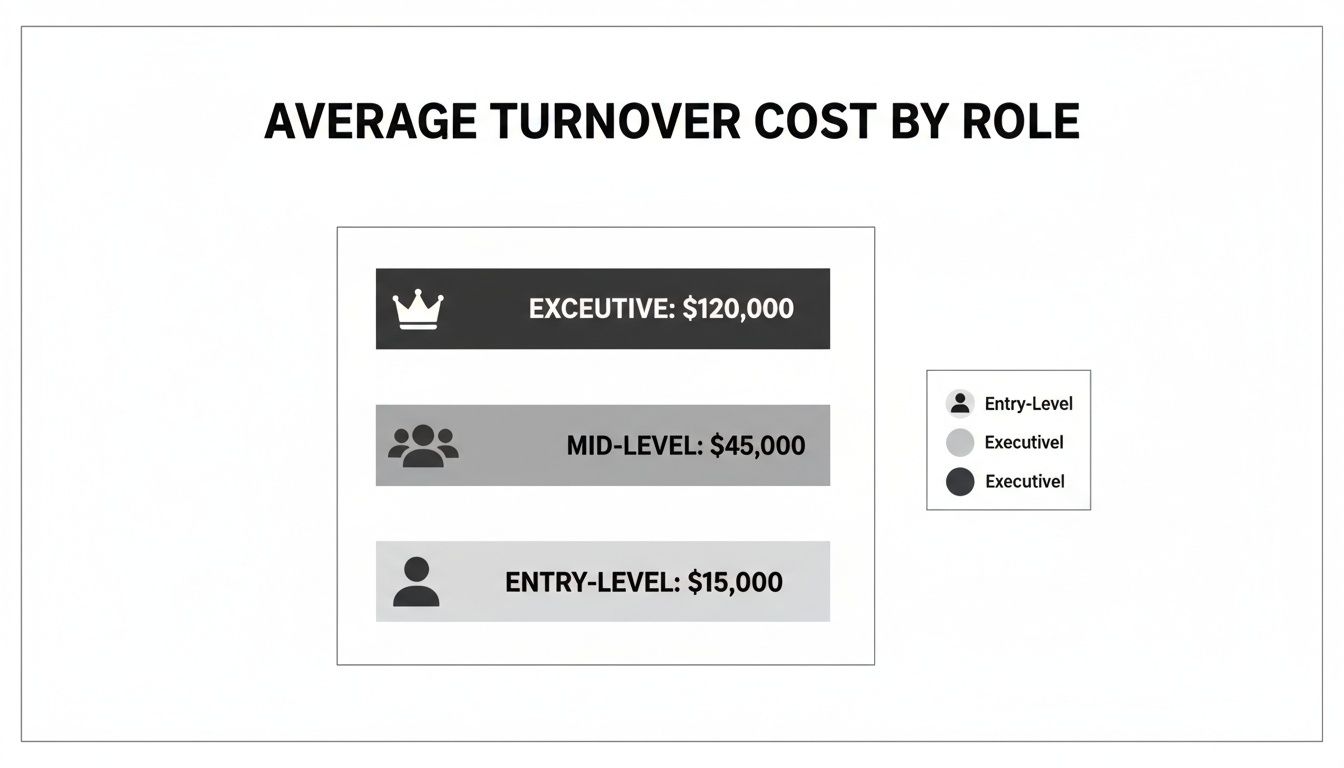
As you can see, the financial burden grows exponentially. This is exactly why holding onto your senior and executive talent is non-negotiable for a healthy business.
To put some real numbers to this, consider how the cost to replace an employee breaks down. It's not just a single line item; it's a compounding expense tied directly to salary and seniority.
Estimated Cost to Replace an Employee by Role
Employee Role | Annual Salary | Estimated Replacement Cost (% of Salary) | Total Estimated Cost |
|---|---|---|---|
Entry-Level (e.g., Support Agent) | $45,000 | 50% | $22,500 |
Mid-Level (e.g., Project Manager) | $80,000 | 150% | $120,000 |
Senior (e.g., Lead Developer) | $150,000 | 200% | $300,000 |
Executive (e.g., VP of Sales) | $220,000 | 400% | $880,000 |
These aren't just abstract percentages; they represent real money walking out the door every time a role is vacated. Understanding this breakdown is the first step in getting leadership to see retention as a strategic priority, not just an HR initiative.
Globally, companies lose an estimated $2.9 trillion a year because of voluntary turnover. That's a mind-boggling number, but the individual impact is what should get your attention. Those percentages—50% for an entry-level hire, 200% for a manager, 400% for an executive—are what make a compelling case for action.
If you're looking for more comprehensive strategies, it's worth exploring a Proactive Approach Reducing Employee Turnover to see how others are tackling this head-on. The numbers don't lie: this is a critical business problem that demands a dedicated strategy.
Finding Out Why Your Best People Are Really Leaving
To solve employee turnover, you have to stop guessing and start diagnosing. Most leaders default to thinking it’s all about compensation, but the real reasons are usually buried much deeper in your team's day-to-day experience. Uncovering these hidden drivers is the only way to build a retention strategy that actually works.
Stopping the revolving door means creating a system to capture honest, unfiltered feedback. This isn't about one-off conversations; it's about building a consistent listening tour through multiple channels. You need to understand not just why people are leaving, but what convinces your best people to stay.

Go Beyond the Standard Exit Interview
The exit interview is your last chance to learn from someone, yet most companies treat it like a box-ticking exercise. The result? Polite, generic feedback that tells you nothing useful. To get real insights, you have to change your approach.
First, who asks the questions—and when—matters. The interview should happen during the employee's final week and be conducted by a neutral party like an HR rep, not their direct manager. This creates a space where people feel safer sharing candid thoughts about management or team dynamics without worrying about burning a bridge.
Second, you have to ask better questions. Move beyond "Why are you leaving?" and dig into the specifics of their experience.
"When did you first start thinking about looking for a new role?"
"Was there a specific event or situation that prompted your job search?"
"What could we have done differently to support your career growth here?"
"How would you describe our team's communication and collaboration style?"
These questions invite stories, not just simple answers. The goal isn’t to change their mind; it’s to gather actionable intelligence you can use to improve things for everyone who stays.
Implement Real-Time Pulse Surveys
While exit interviews give you a rearview mirror perspective, pulse surveys are your forward-looking radar. These are short, frequent check-ins—often just 1-5 questions sent out weekly or bi-weekly—that measure the real-time health of your team's morale and engagement.
Instead of waiting for an annual survey, you can spot dips in engagement right as they happen. For example, a sudden drop in scores related to workload after a major project launch is a clear signal of potential burnout. This lets managers intervene before people start polishing their resumes.
Focus your pulse questions on key retention drivers:
Workload and Balance: Is the current workload manageable?
Recognition: Do you feel your contributions are valued?
Management Support: Does your manager provide the support you need to succeed?
Career Growth: Do you see a path for yourself here in the next two years?
These quick check-ins provide a continuous stream of data, helping you spot trends across departments or roles and address issues proactively.
Discover What Works with Stay Interviews
The most underutilized tool for fighting turnover is the stay interview. This is a structured one-on-one with your current, high-performing employees to understand what keeps them on your team. It’s a proactive strategy focused entirely on retention, not performance.
A stay interview shifts the conversation from "Why are people leaving?" to "What makes our best people stay?" This positive framing uncovers the specific cultural, managerial, and professional elements you need to protect and replicate across the organization.
These aren't performance reviews. They are informal check-ins focused on an employee's satisfaction and future with the company. The manager's only job is to listen and learn.
Sample Stay Interview Questions:
What do you look forward to each day when you come to work?
What are you learning here, and what do you want to learn next?
What part of your job makes you feel energized, and what part feels draining?
If you could change one thing about your role or our team, what would it be?
By consistently gathering feedback through these three distinct channels—exit interviews, pulse surveys, and stay interviews—you create a complete picture of your employee experience. This data-driven approach moves you from reacting to resignations to proactively building an environment where your best people want to build their careers.
Designing an Onboarding Experience That Lasts
The first 90 days are a make-or-break window.
If that sounds dramatic, it’s because it is. A messy, confusing, or lonely onboarding experience is one of the fastest ways to lose a great hire, completely wasting the time and money you just spent on recruiting. Retention doesn't start at the one-year mark; it starts on day one.
This isn’t about just handing over a laptop and a Wi-Fi password. A great onboarding program is a deliberate journey that builds confidence and connection, turning a stressful transition into the first chapter of a long-term career.
The First Week Welcome
The first few days set the tone for everything that follows. The goal here isn't to overwhelm them with tasks—it’s to make them feel prepared, welcomed, and part of the team. Human connection comes first.
A Functional Workspace: This is non-negotiable. Their computer, desk, and all necessary software accounts need to be ready before they walk in the door. Nothing screams "we weren't ready for you" like scrambling to file an IT ticket on their first morning.
The Team Introduction: Schedule a relaxed team lunch or coffee break on day one. This is low-stakes, high-impact. It’s a chance for everyone to put faces to names without the pressure of a formal meeting.
A Meaningful First Task: Give them a small, achievable task they can knock out in the first couple of days. This delivers an early win, builds immediate confidence, and lets them feel like they’re already contributing.
This initial phase is where the retention battle is often won or lost. Early career turnover is notoriously high—a staggering 23.4% of employees leave within their first year, a huge jump from the overall voluntary turnover rate of 13.2%. In industries like hospitality (75.2% total turnover) or retail (59.8%), a supportive, standardized onboarding process is the difference between a new hire who stays and one who’s gone in a few months.
Structuring the 30-60-90 Day Plan
A 30-60-90 day plan is a roadmap. It takes the giant, intimidating goal of "learning the job" and breaks it into clear, manageable milestones. This simple document is one of the most effective tools for reducing new-hire anxiety and setting clear expectations.
Think of it as a collaborative document, not a list of demands. It should outline what they need to learn, who they need to meet, and what they should aim to accomplish at each stage.
An effective 30-60-90 day plan answers the new hire's unspoken question: "How do I succeed here?" It replaces ambiguity with a clear path to becoming a valued, productive member of the team.
The plan should evolve as they grow:
First 30 Days (Learning Focus): This is all about absorption. The goal is to complete foundational training, get comfortable with company systems, and meet key people across different departments.
Next 30 Days (Contribution Focus): Now, they start applying what they've learned. They should begin taking ownership of smaller tasks, contributing to team projects, and participating more actively in meetings.
Final 30 Days (Initiative Focus): By this point, the new hire should be operating with more independence. They're managing their core responsibilities and starting to spot opportunities for improvement on their own.
A great onboarding experience isn't about throwing someone in the deep end; it's about showing them how to swim. A 90-day plan provides the structure they need to feel confident and capable.
Here's a simple template to get you started:
Onboarding Checklist A 90-Day Retention Roadmap
Timeframe | Key Actions & Initiatives | Primary Goal |
|---|---|---|
Days 1-30 | - Complete core company training | Learning & Integration: Absorb information, understand the culture, and build initial relationships. |
Days 31-60 | - Take ownership of recurring tasks | Contribution & Application: Start applying knowledge to real work and gain confidence in core responsibilities. |
Days 61-90 | - Manage core responsibilities with minimal supervision | Initiative & Independence: Operate autonomously, demonstrate proactive problem-solving, and become a fully integrated team member. |
This roadmap turns a vague "get up to speed" directive into a clear, actionable plan that sets everyone up for success.
Creating a Living Library of SOPs
One of the biggest blockers for any new hire is figuring out how things are actually done around here.
When all that critical process knowledge is locked in the heads of a few senior employees, you create a massive bottleneck. New hires are left feeling lost, dependent, and hesitant to ask yet another question.
This is where a clear, accessible library of Standard Operating Procedures (SOPs) becomes a retention superpower. Well-documented processes for key tasks do more than just ensure consistency—they empower new people to find answers for themselves. For a deeper look, check out our guide on how to create training videos that can be embedded directly into your SOPs.
Think of your SOP library as your company’s playbook. It means that when someone leaves, their knowledge doesn't walk out the door with them. It’s all there, ready for the next person, which dramatically cuts down ramp-up time and prevents productivity from dropping. You’re not just training people; you’re building a more resilient, scalable team where new hires can truly thrive.
Building Careers Worth Sticking Around For
If your team can't see a clear future with you, they'll eventually start looking for one somewhere else. Vague promises of "growth opportunities" are no longer enough to keep ambitious, talented people engaged.
To really move the needle on turnover, you have to build tangible career paths that show people exactly how they can advance.
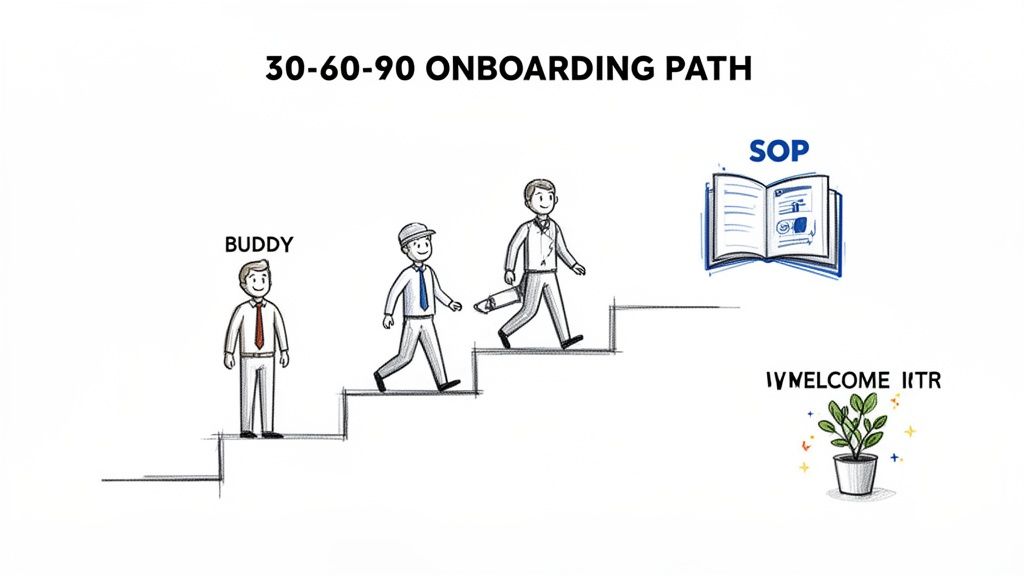
Retention is ultimately about creating a compelling vision for an individual's future inside your organization. When someone understands the specific steps, skills, and milestones needed to move from a junior support agent to a team lead, their job transforms into a career. That clarity is a powerful motivator.
From Vague Promises to Concrete Paths
The first step is moving beyond abstract ideas and mapping out real career ladders. This doesn't have to be some overly complex, bureaucratic process. It's just about defining what "next" actually looks like.
For instance, a customer support team could have a clear, multi-tiered structure:
Tier 1 Support Specialist: Handles frontline inquiries and basic troubleshooting.
Tier 2 Technical Support: Manages escalated, more complex issues.
Senior Support Lead: Mentors junior staff and oversees quality assurance.
Support Operations Manager: Focuses on process improvement and team strategy.
Each level needs clearly defined responsibilities, required skills, and performance metrics. This transparency empowers people to take ownership of their own development because they know exactly what they need to do to get to the next stage. It turns career progression from a mystery into a plan. Our guide on how to create training manuals can help you document the skills for each level.
Launching a Lightweight Mentorship Program
A formal career ladder provides the structure, but a mentorship program provides the human guidance needed to navigate it. Connecting junior staff with senior leaders does more than just transfer skills—it builds a powerful sense of belonging and investment.
Mentorship is one of the most effective retention tools because it sends a clear message: "We see your potential, and we are invested in your success." That personal connection fosters loyalty far more effectively than any generic perk.
A lightweight program is easy to start. You can begin by simply pairing motivated junior employees with experienced leaders for monthly coffee chats. The goal is to create a safe space for asking questions, getting career advice, and understanding the unwritten rules of success. This simple act can be incredibly effective at making people feel seen and valued.
Turning Managers into Career Coaches
Ultimately, your managers are on the front lines of career development. They’re the ones who need to connect the dots between an employee's daily tasks and their long-term aspirations. This requires training them to move beyond project updates and have meaningful, forward-looking conversations.
These development check-ins should be separate from performance reviews and happen regularly. The focus isn't on past performance but on future potential.
Key discussion points for managers:
What parts of your job energize you the most? This helps identify passions that can be nurtured.
What new skills are you interested in developing in the next six months? This creates a collaborative plan for growth.
Where do you see yourself in this company in two years? This opens the door to discussing long-term ambitions.
By equipping managers to have these coaching conversations, you integrate career development into the fabric of your weekly operations. Your company stops being just a place to work and becomes a platform for building a meaningful career. This is how you build a team that sticks around.
How Great Managers Prevent Resignations
You’ve probably heard the old saying: people don't leave bad companies, they leave bad managers. There’s a reason it’s a cliché—it’s true. While things like salary and career growth definitely matter, the single biggest factor in an employee's choice to stay or go is their relationship with their direct leader. If you want to fix your turnover problem, this is where you start.
This isn’t about hiring managers with a certain personality. It's about giving them the right tools and training them to be coaches, not just taskmasters. When you standardize how managers give feedback, recognize good work, and support their teams, you build a foundation of trust and psychological safety that people won't want to leave.

From Boss to Coach
The best managers I've ever seen have all made one critical shift: they stopped acting like a director and started acting like a developer of people. A boss gives orders and checks boxes. A coach, on the other hand, is focused on unlocking an individual’s potential.
This requires a real change in how they run one-on-ones and handle daily check-ins.
Instead of just asking, "What's the status of this project?" a coach asks, "What roadblocks are you facing, and how can I help clear them?" That simple tweak transforms the entire dynamic from one of compliance to one of genuine collaboration. For more on this, check out our guide on team collaboration best practices.
We train our managers to focus on three core coaching behaviors:
Active Listening: Genuinely hearing what their team is saying without immediately jumping in to solve it for them.
Powerful Questioning: Asking open-ended questions that make employees think for themselves and find their own answers.
Consistent Feedback: Giving regular, specific, and helpful guidance as it happens, not saving it all for a dreaded annual review.
The Power of Consistent Feedback and Recognition
Let’s be honest: annual performance reviews are where feedback goes to die. For feedback to actually work, it needs to be timely and consistent. Train your managers to give "in-the-moment" feedback—both positive and constructive—as a normal part of the day.
Recognition is the other side of that coin. People who feel their work is seen and valued are far more likely to stick around. But a generic "good job" in a team meeting has a pretty short shelf life.
Meaningful recognition is specific and public. It connects an individual's action directly to a team or company goal, reinforcing the behaviors you want to see repeated while making the employee feel truly valued for their specific impact.
The cost of poor management is staggering. Leadership quality isn't just a nice-to-have; it's the top driver of retention, beating out pay. In fact, a shocking 50% of employees who look for new jobs do so because of their manager. This disconnect is fueling what's been called 'the great detachment,' where employees are physically present but mentally checked out—costing the global economy $438 billion a year in lost productivity. You can find more on this costly leadership challenge at C-Suite Analytics.
Building Psychological Safety
Psychological safety is the belief that you won't be punished for speaking up with ideas, questions, or mistakes. It’s the bedrock of any high-performing team and a total non-negotiable for retention. Managers are the primary architects of this environment.
They build it through small, repeatable actions. When a team member admits they made a mistake, a manager can react with blame or with curiosity. By asking, "What can we learn from this?" instead of "Why did this happen?" they create a space where it's safe to be vulnerable.
Standardizing workflows with clear SOPs also plays a huge role here. When processes are clearly documented, it cuts down on ambiguity and the fear of "doing it wrong." This creates a more predictable environment where everyone knows the rules of the game, empowering them to focus on great work instead of just avoiding errors.
Got Questions About Reducing Turnover? We’ve Got Answers.
Tackling employee turnover can feel overwhelming, and it's natural to have questions before you dive in. Below are some of the most common ones we hear from leaders, with straight answers you can put to use right away.
What Is the Very First Step I Should Take?
Before you roll out new programs or perks, you have to figure out why people are actually leaving your specific organization. Don't guess. The most powerful first step is simply to start listening.
Your goal is to gather real data. Kick things off with two initiatives:
Revamp Your Exit Interviews: Stop treating them like a box-ticking exercise. Have a neutral third party, like someone from HR, conduct them. Ask probing questions to uncover the root cause of their decision to leave, not just the final trigger. "When did you first start thinking about leaving?" is a great place to start.
Conduct Stay Interviews: This is where the gold is. Sit down with your high-performing, long-term employees and ask them what keeps them here. What do they love about their job? What might tempt them to look elsewhere? Their answers give you a blueprint of what you're doing right and what you need to protect.
These conversations will hand you the raw, honest feedback you need to build a retention strategy that solves your actual problems, not just generic ones.
Is Money Really the Most Important Factor?
It's important, but it's almost never the main reason people quit. Think of compensation as a "threshold factor"—you have to pay competitively just to be in the game. But throwing more money at people won't fix a toxic culture or a dead-end career path.
Time and time again, research and experience show other factors have a much bigger impact on an employee's decision to stay.
A Gallup study found it takes a 20% pay raise to lure most employees away from a manager who truly engages them. But for a disengaged worker? It takes next to nothing to poach them. This shows that a great manager and a supportive environment create a kind of loyalty that money alone can't buy.
Focus on these areas first, and you'll find compensation becomes a much smaller part of the conversation:
Quality of Management: The daily interaction with a direct manager is the single biggest influence on an employee's happiness at work.
Career Development: People need to see a future for themselves at your company. If they don't, they'll find one somewhere else.
Meaningful Work & Recognition: Employees want to know that their work matters and that their contributions are seen and appreciated.
How Can I Keep Remote and Hybrid Teams Engaged?
Keeping a distributed team connected requires more intention. You can't rely on the casual "water cooler" moments to build camaraderie, so you have to create them yourself. The key is to foster genuine connection and ensure everyone has equal access to information and opportunities, no matter where they are.
Here are a few practical strategies that work:
Standardize Your Communication Hub: Use a central project management tool for all key work and document important processes with clear SOPs. This prevents remote employees from feeling left out of the loop because everyone is working from the same playbook.
Facilitate Social Connection: Schedule regular, informal virtual events that have nothing to do with work. Think virtual coffee chats, team-building games, or even just a 15-minute "no work talk" huddle. These help replicate the spontaneous interactions that build real team bonds.
Make Recognition Public: Use a dedicated Slack channel or a similar public forum to celebrate wins and give shout-outs. Public recognition is especially powerful for remote workers because it makes their contributions visible to the entire company.
By being deliberate about communication, social rituals, and visible recognition, you can build a strong, cohesive culture that isn't defined by a physical office. For a more comprehensive look at retention strategies, you might find this guide on How to Reduce Employee Turnover in the UK helpful.
Ready to stop tribal knowledge from walking out the door? Build a Guide helps you create a living library of SOPs that makes onboarding seamless and empowers your team to succeed from day one. Discover how you can build a more resilient team today.