
March 1, 2026
Process and Procedures for Scalable Growth in 2026 - process and procedures
Learn how to implement process and procedures to build reliable, scalable systems that boost efficiency, consistency, and growth. Get practical steps now.
Struggling to tell the difference between a process and a procedure? It’s a common point of confusion, but the distinction is simple and powerful.
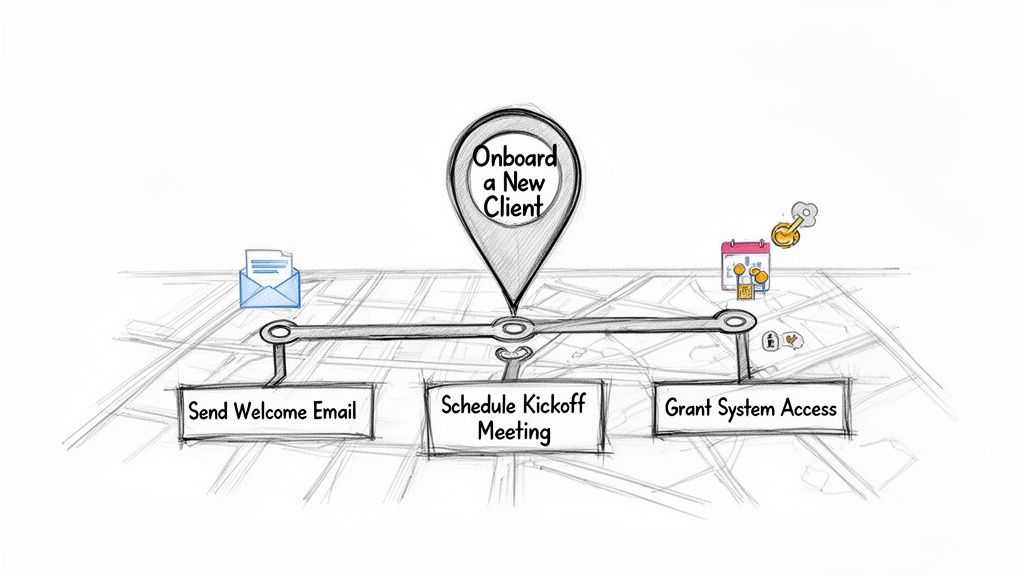
Think of it like this: a process is your destination—say, "Onboard a New Client." It's the big-picture goal. The procedures are the turn-by-turn directions you follow to get there, like "Send Welcome Email" and "Schedule Kickoff Meeting."
Getting this right is the first step toward building a business that runs on clear systems, not just guesswork.
Process Versus Procedure Unpacked
To build an operation that can scale without breaking, you need a clear framework. It all starts with the relationship between a process and a procedure. While people often use the terms interchangeably, they represent two different levels of planning that must work together for you to get consistent results.
A process is the high-level flow of work needed to hit a specific business goal. It answers the question, "What are we trying to accomplish?" It’s a sequence of major stages or milestones, but it avoids getting bogged down in the tiny details of each step.
A procedure, on the other hand, gives you the granular, step-by-step instructions for completing one single stage within that larger process. It answers the question, "How do we actually do this specific task?" Procedures are the checklists and actionable guides your team follows to guarantee quality and consistency every single time.
The Travel Analogy: A Simple Way to Remember
Let's make this more concrete. Imagine your company wants to launch a new product. The entire journey from the initial idea to the final market launch is the process.
That process includes high-level stages like:
Market Research
Product Development
Beta Testing
Marketing Campaign
Official Launch
Each of these stages is a key destination on your journey. The procedure is the detailed itinerary for reaching just one of those destinations.
For the "Marketing Campaign" stage, your procedures would be a list of concrete actions: "Draft press release," "Schedule social media posts," and "Create email announcement." This split is crucial. A process gives your team direction, but it’s the well-defined procedures that ensure they arrive at each milestone without getting lost.
This diagram breaks down the core differences even further.
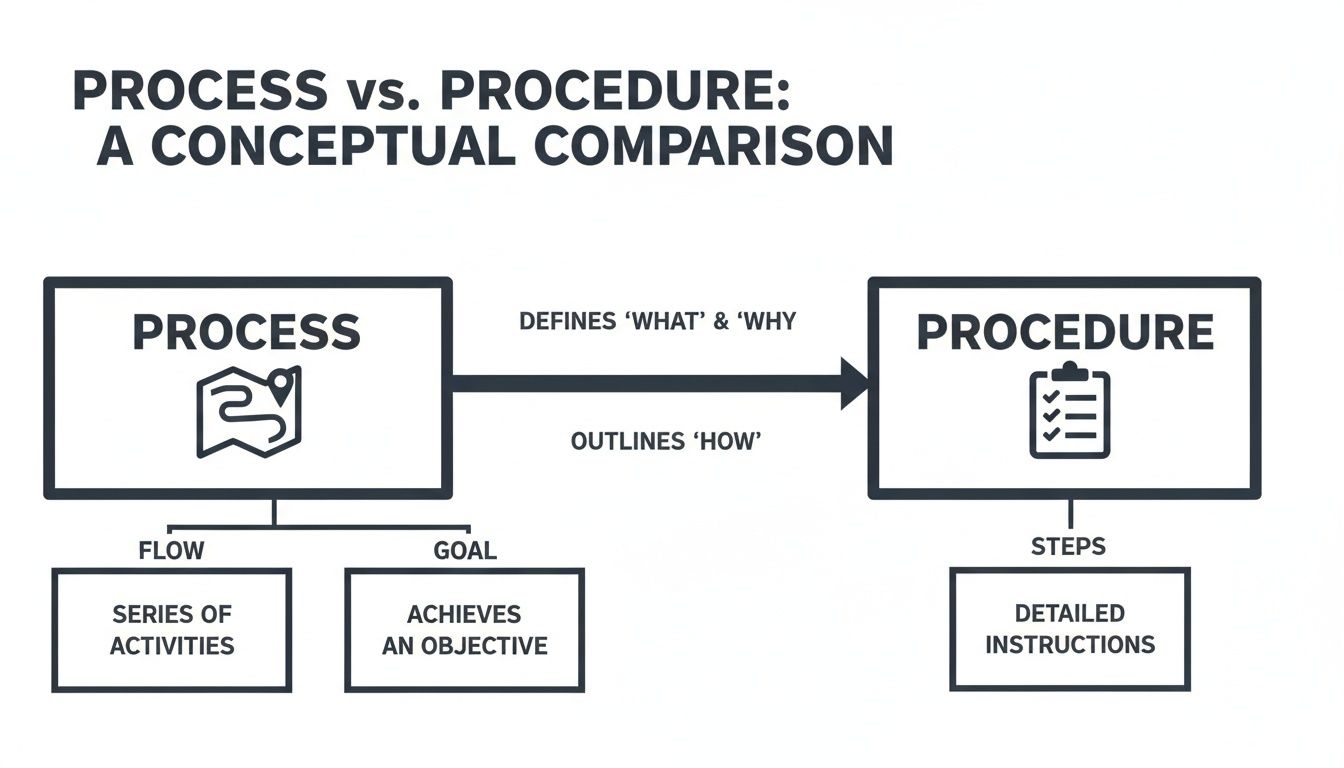
As you can see, the process is the map, while the procedure is the checklist for navigating one part of that map.
Process vs. Procedure At a Glance
Here’s a quick table to make the distinction crystal clear.
Attribute | Process (The 'What') | Procedure (The 'How') |
|---|---|---|
Scope | Broad, high-level, covering major stages. | Narrow, detailed, focused on one task. |
Purpose | To outline the path to a major business goal. | To give explicit, step-by-step instructions. |
Focus | Defines the flow of work and key milestones. | Defines the exact actions, tools, and standards. |
Example | "Hiring a New Employee" | "Post Job on LinkedIn," "Screen Resumes." |
This table shows how these two concepts fit together to create a full operational picture.
This hierarchy is a lot like the one between policies and procedures, where policies set the rules and procedures define the actions. You can read more about that in our guide on the difference between a policy and a procedure.
By separating the "what" from the "how," you give your team both strategic context and tactical clarity. It's a simple but powerful foundation for growth.
Why Great Systems Are Your Competitive Advantage
Knowing the difference between a process and its procedures is the first big step. Now, let’s talk about why turning that knowledge into documented systems is a true game-changer for your business.
This isn’t about creating rigid, soul-crushing bureaucracy. It’s about building a resilient operation that gives you a powerful competitive edge.
Let's imagine two marketing agencies, "Alpha Creative" and "Bravo Systems." Both have ten employees and similar clients.
At Alpha Creative, everything runs on tribal knowledge. The star project manager, Sarah, is a genius at onboarding new clients, but the entire process lives in her head. When she goes on vacation, a new client signs up. The team scrambles—they miss steps, send the wrong documents, and make a terrible first impression.
Now, consider Bravo Systems. They invested time documenting their client onboarding process and procedures in a central guide. When their project manager is out, another team member simply opens the guide. It’s all there: a clear checklist, email templates, and instructions for granting system access. The new client gets a smooth, professional welcome, identical to the one the lead manager would have delivered.
Systems Drive Resilience and Scalability
The story of Alpha and Bravo highlights a fundamental business truth: relying on individual heroes makes your business fragile. A systems-driven business is resilient.
Alpha Creative (Tribal Knowledge): This agency is in a constant state of firefighting. Employee turnover is a full-blown crisis, scaling is chaotic, and consistency is a daily struggle. Every new hire requires a massive time investment from senior staff, pulling them away from high-value work.
Bravo Systems (Documented Procedures): This agency can scale smoothly. New hires become productive much faster by following clear guides. Quality stays high no matter who is doing the task. The team feels empowered to act confidently, which reduces bottlenecks and frees up leadership to focus on growth.
Understanding the difference between the "what" (the process) and the "how" (the procedures) is the foundation for knowing how to streamline business processes. By documenting the "how," you make the "what" repeatable, reliable, and scalable.
The data backs this up. Globally, regulatory mandates drive 70% of SOP adoption, reducing operational risks by an average of 40%. The benefits are concrete: Amazon uses its SOPs to hit 99.9% accuracy in order fulfillment, and hospitals have slashed patient wait times by 25% with standardized triage protocols.
Procedures Empower Autonomy and Innovation
There’s a common myth that procedures kill creativity. In reality, the opposite is true.
When routine and repeatable tasks are standardized, your team's mental energy is freed up. They can stop reinventing the wheel for basic tasks and focus on solving bigger, more creative problems where human ingenuity actually matters.
"When you document a process, you're not locking people into a rigid system. You're giving them a baseline for excellence, a starting point from which they can innovate with confidence."
Clear procedures provide a stable foundation from which real innovation can take off.
This is why building a library of effective process and procedures is more than just an operational task—it’s a strategic investment. It builds a foundation that supports your business through employee turnover, rapid growth, and whatever the market throws at you. It transforms your operations from a source of stress into a true competitive advantage.
How to Document Your First Business System
Now you know the powerful link between a high-level process and its detailed procedures. It's time to put that theory into practice.
The idea of documenting every single thing your business does can feel paralyzing. But you don't have to do it all at once. The secret is to start small, score a quick win, and build momentum from there.
This is a simple, repeatable framework for documenting your very first system. By following these steps, you’ll turn abstract concepts into a real, tangible asset for your team—and create a blueprint you can use again and again.
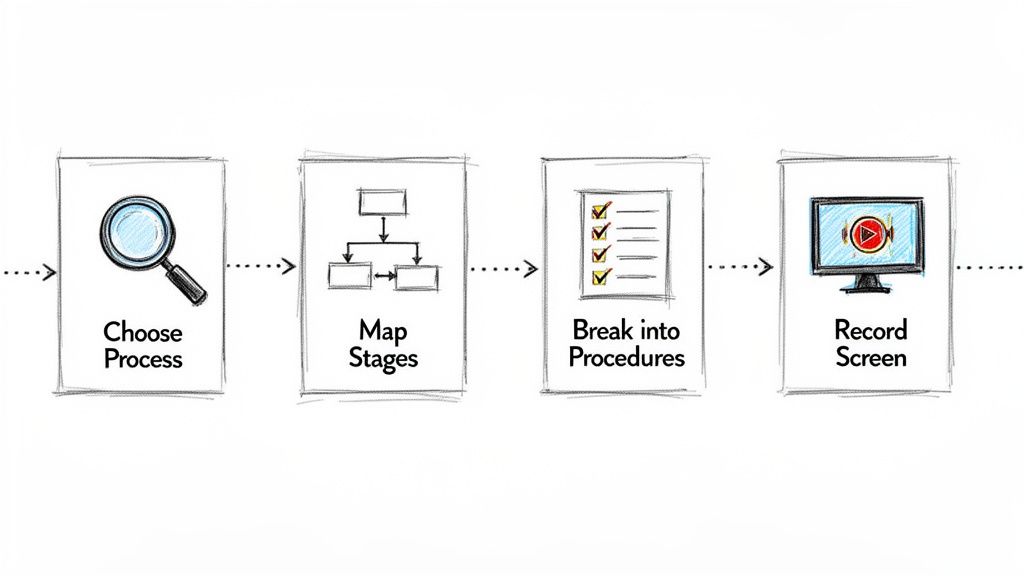
Step 1: Choose Your First Process
Success here comes down to picking the right starting point. You’re looking for the sweet spot: high impact, low complexity. A task that’s done often, involves a few steps, and creates regular confusion is the perfect candidate.
Don't start with a huge, complex project like "overhaul the entire sales cycle." Think smaller. A great first process for many businesses is "creating and publishing a blog post." It’s a regular activity with clear stages, and a solid procedure can save time and prevent mistakes almost immediately.
Think about your day-to-day. What questions do you and your managers have to answer over and over? That's often your first process just waiting to be documented.
Step 2: Map the High-Level Process Stages
Once you've picked your process, the next move is to map out its main stages. Remember, you're defining the "what," not the "how." These are just the major milestones.
For our "Publish a Blog Post" process, the stages might look something like this:
Content Ideation and Research: Deciding what to write about and gathering info.
Drafting and Writing: Creating the first version of the article.
Review and Editing: Checking for clarity, grammar, and accuracy.
Formatting and SEO: Getting the post ready in your content management system (CMS).
Publishing and Promotion: Setting the post live and sharing it with the world.
This high-level map gives everyone a clear overview of the whole workflow. It provides the context for all the detailed procedures that will fit underneath.
Step 3: Break Stages into Actionable Procedures
With your process map complete, it's time to dive into the details. This is where you document the specific "how" for each stage. Go through your map one stage at a time and list out the exact, sequential steps someone needs to follow.
Let's break down the "Formatting and SEO" stage from our example:
Procedure: Formatting the Post in the CMS
Log into the CMS dashboard.
Create a new post and paste the draft text.
Apply H1, H2, and H3 headings based on the outline.
Bold key terms and use bullet points for readability.
Upload and insert images, adding descriptive alt text.
Procedure: On-Page SEO Checklist
Enter the target keyword into your SEO plugin.
Write a compelling meta description under 160 characters.
Check that the URL slug is short and includes the keyword.
Add at least three internal links to other relevant articles.
Each procedure should be a clear, no-nonsense checklist. Someone with little to no experience should be able to follow the steps and get the right result. For more tips on this, check out our deep dive on how to document processes.
Step 4: Choose the Right Format and Tools
How you present your procedures is just as important as what's in them. A dense wall of text in a forgotten shared doc is guaranteed to be ignored.
A procedure that is difficult to use is just as ineffective as having no procedure at all. The goal is not just documentation, but adoption.
Modern formats make information much easier to follow:
Simple Checklists: Perfect for linear, straightforward tasks.
Annotated Screenshots: Excellent for software workflows where seeing the screen is key.
Interactive Guides: The gold standard for complex tasks, letting users click through steps at their own pace.
This is where modern tools completely change the game. Instead of the soul-crushing work of typing out steps and taking endless screenshots, platforms like Build a Guide let you just record your screen. The software automatically captures every click and keystroke, instantly generating a complete step-by-step visual guide with text and screenshots. You can then refine and share it in seconds.
This approach transforms a dreaded documentation day into a quick, efficient workflow, giving you the confidence to finally build out your company's operational playbook.
Building Your Living SOP Library
Documenting your process and procedures feels like a huge win, but it's only half the job. The biggest mistake most companies make is treating documentation as a one-and-done project. A guide created in January is often useless by June.
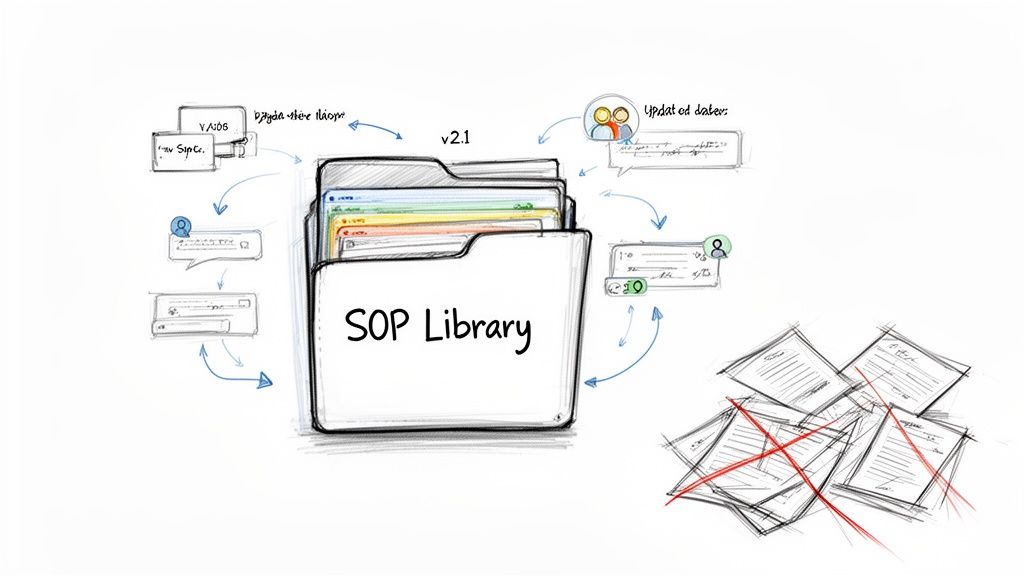
The result is always the same: a digital graveyard of outdated Word docs and PDFs lost on a shared drive. We call this "documentation decay." It kills team trust, creates confusion, and makes all your hard work pointless. The only way to stop it is to ditch static files and build a living SOP library—a single source of truth that grows with your business.
From Static Files to a Single Source of Truth
The old way of managing procedures is broken. When your guides are scattered across different folders and platforms, version control becomes a nightmare. Before you know it, team members are using outdated instructions, leading to inconsistent work and frustrating mistakes.
A modern SOP library fixes this by putting everything in one place. Imagine a single platform where every guide is current, updates are pushed to everyone instantly, and there’s never a question about which version is the "right" one. This isn't just about being organized; it's a strategic move to ensure reliability and empower your team to act with confidence.
To get there, you need a simple system for governance. This sounds formal, but it’s really about answering three basic questions:
Who owns this procedure? Assign one person or team to be responsible for keeping each guide accurate.
When will we review it? Set a realistic review schedule (like quarterly or biannually) to check for necessary updates.
How can people suggest improvements? Create a simple feedback loop so team members on the front lines can easily flag what’s changed.
Fostering a Culture of Continuous Improvement
Your SOP library should be a collaborative tool, not a top-down mandate. The people who actually perform the procedures every day are your best source for keeping them relevant. A good system makes it easy for them to contribute.
This is especially critical for distributed teams. For remote-first SMBs, living SOP libraries drive consistency, with some studies showing 25% faster resolutions and clear ROI. The market for SOP management solutions, valued at USD 4.716 billion in 2024, is expected to surge to USD 10.82 billion by 2035, driven by this exact need for accessible, always-updated documentation.
Building this kind of dynamic system is the heart of what we call a living document. You can explore this concept more in our article about what is a living document.
Key Elements of a Living SOP Library
To keep your library from decaying, you need to build in features that encourage engagement and prevent stale information.
Old Way (Static Docs) | Living Library (Modern Platform) |
|---|---|
Scattered files on a shared drive | Centralized, single source of truth |
Confusing version control (e.g., "final_v3") | Automatic versioning and instant updates |
No way to track usage or effectiveness | Analytics to see which guides are used |
Difficult and manual update process | Simple editing and collaborative feedback |
To ensure your SOP library stays dynamic, understanding best practices in documentation workflow management is key. It gives you a framework for creating, reviewing, and archiving your guides.
The goal of a living SOP library isn't just to store information. It's to create a reliable system that empowers your team with current, accurate, and easily accessible knowledge, eliminating the chaos of outdated instructions.
Ultimately, a living library turns your process and procedures from a dusty binder on a shelf into a powerful operational tool. It stops documentation decay in its tracks and ensures your team always has the right information to do their best work. With a platform like Build a Guide, you can create this central hub, manage versions automatically, and even see which guides your team is actually using.
Writing Procedures Your Team Will Actually Follow
A perfectly documented process is worthless if the procedures are ignored. This is where most documentation efforts quietly fail—by forgetting the human on the other end.
If a guide is confusing, hard to read, or buried in a wall of text, your team will simply find workarounds. All that effort you put into building a system? Wasted.
The goal isn't just to write down steps. It's to create guides that people want to use because they make their work easier. This means shifting your mindset from a technical writer to a teacher, focusing on clarity, speed, and immediate understanding.
Write for Clarity and Action
The best procedures use simple, direct language. No jargon, no corporate-speak, no academic fluff. Write as if you’re speaking directly to a new teammate who needs to get this task done right now.
Use an active voice. It assigns clear responsibility and removes ambiguity. Instead of "The report should be submitted by Friday," write "Submit your report by Friday." That small change makes the instruction direct and unmistakable.
A procedure’s value isn't measured by its detail, but by its usability. If the end user can’t follow it quickly and confidently, the procedure has failed.
This approach turns documentation from a passive record into an active tool for getting work done correctly.
The Power of Visuals and Scannability
Let's be honest: nobody wants to read a novel when they're trying to get work done. Your team is busy and needs answers fast. Dense paragraphs are the enemy.
Humans process images 60,000 times faster than text. So, use that to your advantage. Break down complex tasks with formatting that guides the eye and makes information easy to digest.
Checklists: Turn multi-step tasks into simple, satisfying lists. They provide a clear path from start to finish.
Annotated Screenshots: For any software workflow, show, don't just tell. A screenshot with a red box around the right button is infinitely clearer than three sentences describing its location.
Short Video Clips: For physical tasks or dynamic actions, a quick 15-second video can demonstrate the correct motion far more effectively than paragraphs of text ever could.
These visual aids don't just supplement the text—they often replace it, reducing confusion and speeding up comprehension. This is a core part of building a great process and procedures framework.
Tailor the Detail to the Audience
Not everyone needs the same instructions. A procedure’s depth should match the user's experience and the task's complexity. Over-explaining simple steps to a senior team member is patronizing; under-explaining a complex task to a new hire sets them up for failure.
Consider creating different versions of a procedure for different roles.
For New Hires: A detailed, step-by-step guide with plenty of context, screenshots, and definitions. Think of it as a complete onboarding tool.
For Experienced Staff: A high-level checklist that serves as a quick reminder of the critical steps. They already have the context; they just need a prompt.
This tailoring ensures your documentation feels helpful, not burdensome. By focusing on the end-user experience, you create procedures that become the go-to resource for your team—not the dusty file everyone ignores.
The Future of Smart Process Management
Looking ahead, the way businesses handle their processes and procedures is about to change dramatically. We’re moving away from static documents and manual updates toward systems that are intelligent, automated, and deeply connected to the tools we use every day. This isn't just about being more efficient; it's about building an operational brain for your company—one that learns, adapts, and secures your future growth.
The days of just writing down steps are over. The future is about creating systems that actively improve themselves.
AI as Your Process Optimization Partner
Artificial intelligence is quickly becoming more than just a tool for creating documentation. It's evolving into an active partner that helps you optimize it. Imagine an AI that doesn't just generate a guide but also analyzes how your team actually uses it in real-time.
This new wave of smart platforms will automatically flag steps where people consistently get stuck or slow down. It might suggest that a procedure is unclear or just plain inefficient. By analyzing these usage patterns, AI can find hidden bottlenecks in your workflows you'd otherwise never see, turning your SOP library from a simple archive into a source of continuous improvement.
The Rise of the Connected Operational Ecosystem
For too long, our documentation has lived on an island, completely disconnected from where the work actually gets done. The future is all about integration. Your SOP platform will talk seamlessly with your project management software, your CRM, and all the other tools your business relies on.
This creates a truly connected ecosystem where your processes are part of the action, not an afterthought. For example:
When a new deal is marked "won" in your CRM, it could automatically kick off the right client onboarding procedure for your team.
A task checked off in your project management tool could be automatically marked as complete within the corresponding SOP.
Feedback left on a procedure could instantly generate a task for the process owner, prompting them to review and update the guide.
This level of integration gets rid of manual handoffs, slashes the risk of human error, and weaves your documented processes and procedures directly into your team's daily rhythm.
The next frontier of process management isn't about writing better instructions. It's about building a system so smart and integrated that the right procedure finds the right person at the right moment—without them even having to look for it.
Future-Proofing Your Business for Sustained Growth
Investing in a modern way to manage documentation is really about preparing your business for whatever comes next. This isn't a niche idea anymore. The Standard Operating Procedures (SOP) Software market was valued at USD 1.2 billion in 2023 and is on track to hit USD 2.7 billion by 2032. Businesses adopting these digital solutions are seeing productivity jump by 20-30% as they ditch outdated knowledge for dynamic, living SOPs. You can dig into the numbers in the full market growth analysis.
This trend highlights a massive shift in thinking. A smart process management system gives you a scalable foundation that can adapt to new tech, changing teams, and shifting market demands. It turns your operations from a rigid set of rules into a flexible, resilient, and intelligent engine for growth.
By moving beyond outdated methods, you aren't just tidying up your current workflows. You're building a smarter, more scalable business that's ready to win in the future. With a tool like Build a Guide, you can start laying that intelligent foundation today.
Frequently Asked Questions
Here are a few quick answers to the questions we hear most often about getting your business’s processes and procedures up and running.
How Often Should We Review Our Procedures?
This depends on how stable the process is. For critical or fast-changing workflows, a review every six months is a good rule of thumb. For everything else, an annual check-in usually works just fine.
But here’s the real secret: treat your procedures like living documents. Don't just wait for a calendar reminder. The moment someone on your team notices a step is wrong or could be better, they should be able to flag it. This creates a culture where improvement is constant, not just an annual chore.
What Is the Best Way to Get Team Buy-In?
Getting your team to actually use new systems comes down to two things: including them in the creation and showing them what's in it for them. People don't resist change; they resist being changed.
If you want to build adoption, try this:
Involve them early. The people doing the work are the real experts. Ask them to help you document the procedures. Their insights are invaluable, and their involvement creates ownership.
Explain the "why." Be crystal clear about how these new processes and procedures will make their jobs easier. Will it reduce rework? Eliminate frustrating back-and-forth? Make that benefit obvious.
Start with a real pain point. Don't start by documenting something easy. Pick a process that is a known source of frustration for everyone. When the new procedure actually solves that problem, your team will see the value instantly.
Gaining adoption isn't about enforcing rules; it's about providing a tool so useful that your team can't imagine working without it.
Can a Small Business Benefit From Formal Procedures?
Absolutely. In fact, small businesses often have the most to gain. When you establish clear procedures early, you prevent "operational debt"—the mess of inconsistent habits that gets much harder to fix as you grow.
For a small team, formal procedures make sure quality stays high and crucial knowledge isn't stuck in one person's head. Documenting your core processes and procedures when you're small builds a foundation for scale. It makes it dramatically easier to onboard new hires, delegate work, and grow without the chaos.
Ready to build a living SOP library that your team will actually use? With Build a Guide, you can turn screen recordings into beautiful, interactive step-by-step guides in minutes. Stop the chaos of outdated documents and create a single source of truth that drives consistency and growth. Start building your guide today.