
February 25, 2026
8 Powerful Training Manual Examples to Streamline Your Processes in 2026
Discover 8 expert-level training manual examples and templates. Learn to create SOPs for onboarding, support, and sales that get results.
In today's fast-paced business environment, traditional training manuals often gather dust. They become unread PDFs saved in a forgotten folder or outdated binders on a shelf, failing to serve their purpose. These static documents are difficult to update, impossible to search efficiently, and rarely engage modern teams who expect accessible, on-demand information. This disconnect leads to inconsistent processes, repeated mistakes, and a critical loss of "tribal knowledge" every time an employee leaves. The core problem is that the format itself works against the goal of effective training and process standardization.
What if you could transform these static documents into living, interactive guides that your teams and customers actually use? This article provides a blueprint for that exact transformation. We've gathered 8 powerful training manual examples from various business functions, including software onboarding, client service delivery, and technical implementation. Each example is more than just a template; it's a strategic breakdown of what works and why.
We will dissect the structure, content, and design of each manual, highlighting key sections and actionable takeaways you can apply immediately. You'll learn how to replicate their success and turn any internal process into a polished, step-by-step guide. Forget the dense, ignored handbooks of the past. It’s time to build documentation that actively improves performance, reduces errors, and scales your operations effectively.
1. Software Onboarding Training Manual
A software onboarding training manual is a foundational document designed to guide new users from initial setup to proficient use. Its primary goal is to accelerate the "time-to-value" by making complex features understandable and accessible, which directly impacts user retention and satisfaction. Unlike a simple FAQ page, this type of manual provides a structured, step-by-step learning path that builds a user's confidence and competence.
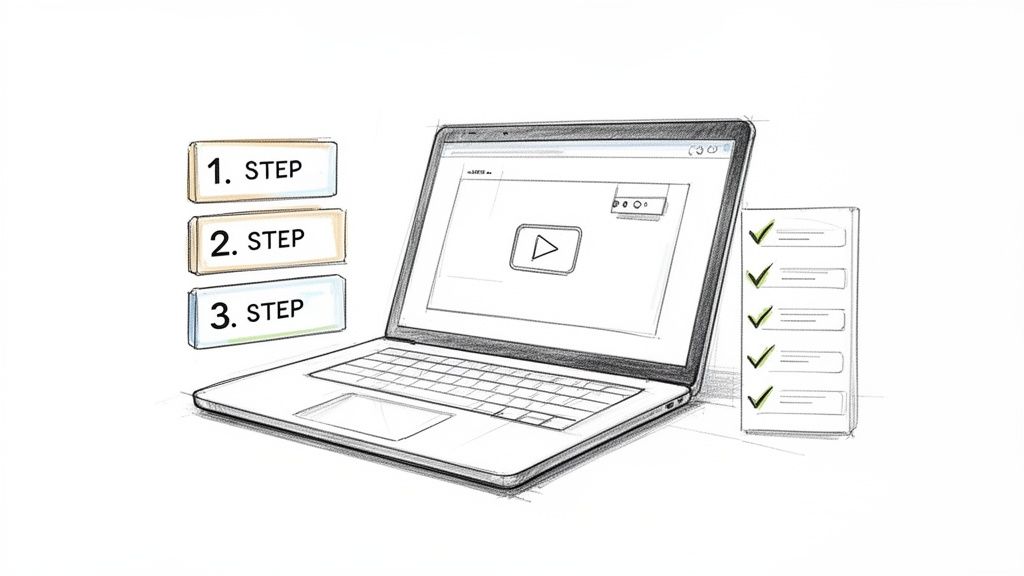
This approach is essential for any SaaS company or product team aiming to reduce the burden on support staff. By proactively answering common questions and demonstrating core workflows, a well-crafted onboarding manual empowers users to solve problems independently. For example, HubSpot’s guides on setting up CRM workflows and Slack’s tutorials for channel management are prime training manual examples that effectively onboard users at scale.
Strategic Breakdown & Key Takeaways
Creating an effective software guide requires a user-centric approach. The structure should mirror the user’s journey, starting with the absolute basics before introducing more advanced functionality.
Progressive Disclosure: Don't overwhelm new users with every feature at once. Start with the "Aha!" moment-the core action that delivers immediate value. Asana does this well by first focusing on creating a single task before explaining complex project timelines.
Role-Specific Paths: Acknowledge that different users have different needs. Create separate onboarding tracks for administrators, standard users, and viewers. This ensures the content is relevant and avoids confusion.
Visual, Dynamic Content: Static screenshots become outdated quickly. Use screen recordings or GIFs to show processes in action. This provides clearer context and is more engaging than text-heavy instructions.
Key Insight: The best software manuals are living documents. They anticipate user friction points by including sections on common errors and their solutions, turning potential support tickets into self-service learning opportunities.
When to Use This Manual
This type of training manual is ideal for:
SaaS Product Launches: Introduce a new product or major feature update to the market.
Customer Success Teams: Standardize the onboarding process to ensure all new clients receive a consistent, high-quality experience.
Reducing Support Volume: Address frequently asked questions in a structured format to lower ticket counts and free up support agents for more complex issues.
By investing in a detailed onboarding manual, you build a scalable foundation for user education. For a deeper look into the creation process, explore our guide on how to create training manuals for more tactical advice.
2. Employee Onboarding and HR Training Manual
An employee onboarding and HR training manual is a structured guide that integrates new hires into an organization. Its purpose is to standardize the initial employee experience, covering everything from company policies and culture to role-specific responsibilities. This document acts as a central source of truth, ensuring every new team member receives consistent, accurate information, which is critical for building a strong foundation from day one.
This manual reduces the administrative load on HR and managers during hiring periods. By clearly outlining expectations, procedures, and company values, it empowers new employees to get up to speed efficiently. For instance, GitLab's public handbook and Zapier’s remote work integration guide are powerful training manual examples that demonstrate how to effectively onboard distributed teams, fostering a sense of belonging and clarity from the start.
Strategic Breakdown & Key Takeaways
A successful onboarding manual is more than just a collection of policies; it’s a culture-building tool. Its structure should guide an employee through their first few months, making the transition feel supported and intentional.
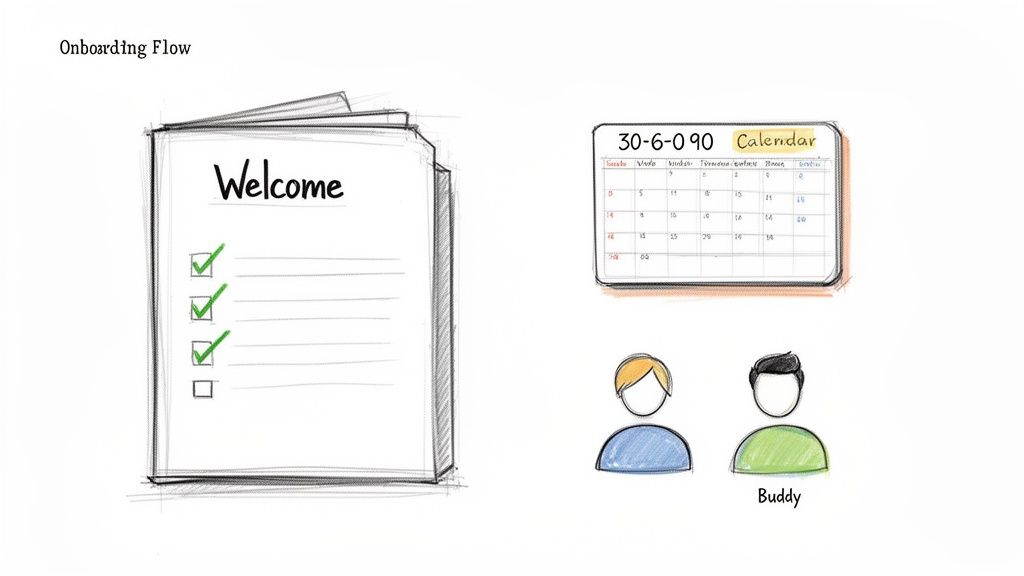
Create a 30-60-90 Day Roadmap: Structure the manual around clear, time-based milestones. This roadmap should outline specific learning goals, tasks, and performance expectations for the first three months, giving new hires a clear path to success.
Incorporate a Buddy System: Formalize peer support by assigning a mentor or "buddy." This section of the manual should introduce the buddy and explain their role in answering informal questions and facilitating social integration.
Use Interactive Checklists: Break down the onboarding process into manageable steps with checklists that new hires can mark as complete. This provides a sense of accomplishment and ensures no critical tasks are missed. For modern teams, consider resources that guide the process of training employees online to make this more engaging.
Key Insight: The most effective onboarding manuals are iterative. They include mechanisms for gathering feedback from recent hires to continuously refine the process, ensuring it remains relevant and addresses real-world pain points.
When to Use This Manual
This type of training manual is essential for:
Scaling Companies: Standardize the onboarding experience to maintain cultural consistency as the team grows rapidly.
Remote or Hybrid Teams: Provide a structured, accessible resource to ensure distributed employees feel connected and well-informed.
High-Turnover Industries: Streamline the training process to reduce the time it takes for new employees to become productive and lower the burden on management.
By building a thorough onboarding manual, you create a scalable system for employee integration and success. To learn more about structuring this experience, review these employee onboarding best practices for additional strategies.
3. Client Service Delivery and Process Documentation Manual
A client service delivery manual is a playbook for agencies and consultants that maps out the entire client engagement process. This document outlines every step, from the initial discovery call and proposal to project execution, delivery, and ongoing support. Its purpose is to standardize service quality, ensuring every client receives the same excellent experience regardless of which team member is leading the project.
Unlike a simple project scope document, this manual provides a repeatable system that improves efficiency and profitability. By documenting proven workflows, it allows teams to collaborate seamlessly and onboard new hires faster. Digital agencies, for instance, use these training manual examples to define their website launch procedures, while marketing consultants map out campaign execution frameworks, making their processes transparent and scalable.
Strategic Breakdown & Key Takeaways
Building an effective service delivery manual requires a balance between structure and flexibility. The documentation should be detailed enough to ensure consistency but adaptable enough to accommodate unique client needs.
Internal vs. Client-Facing Versions: Create two versions of your processes. The internal manual can include sensitive details like profit margins and proprietary tools, while the client-facing version focuses on timelines, deliverables, and approval workflows.
Decision Trees for Common Scenarios: Projects rarely go exactly as planned. Include decision trees that guide your team through common "if-then" scenarios, such as handling scope creep or responding to unexpected feedback.
Document Approval & Sign-Off Points: Clearly define when and how client approval is required. Documenting these sign-off points prevents miscommunication and ensures both parties are aligned at critical project milestones.
Key Insight: The most valuable service manuals are built for both the team and the client. By including service level agreement (SLA) metrics and response time commitments, you set clear expectations and build a foundation of trust from day one.
When to Use This Manual
This type of training manual is essential for:
Service-Based Businesses: Agencies, consultancies, and freelancers looking to scale their operations without sacrificing quality.
Improving Project Profitability: Standardize workflows to reduce project timelines, minimize errors, and improve resource allocation.
Enhancing Client Onboarding: Provide new clients with a clear, professional reference document that explains your process and demonstrates your value.
By documenting your service delivery, you transform your unique process into a tangible asset. For more ideas on structuring process documents, check out our guide on how to create training manuals for practical templates.
4. Product Support and Customer Troubleshooting Manual
A product support and customer troubleshooting manual acts as the central nervous system for a customer service team. It is a detailed knowledge base created to help support agents resolve customer issues quickly and consistently. This manual goes beyond a simple FAQ by providing structured troubleshooting guides, explanations of specific error messages, and clear escalation paths for complex problems. Its purpose is to equip first-line support with the information needed to solve most issues without assistance, leading to faster resolution times and reduced ticket backlogs.
This document is critical for any company aiming to scale its customer support operations efficiently. By standardizing responses and troubleshooting steps, it ensures a consistent customer experience, regardless of which agent handles the ticket. For instance, Zendesk’s help center templates, Stripe’s API troubleshooting guides for developers, and GitHub’s extensive error documentation are all powerful training manual examples that enable self-service and empower support teams to perform at a high level.
Strategic Breakdown & Key Takeaways
Building an effective support manual requires thinking like a frustrated customer. The information must be organized for immediate retrieval under pressure, prioritizing clarity and speed over exhaustive detail.
Organize by Symptom, Not by Feature: Customers describe problems based on what they see ("the button is greyed out"), not the underlying technical cause. Structure your manual to be searchable by these real-world symptoms to get agents to the right solution faster.
Include "What NOT to Do" Warnings: Alongside the correct steps, clearly state actions that could worsen the problem. This prevents agents from making a difficult situation more complex, a common issue for new hires.
Provide Tiered Resolution Paths: Offer multiple solutions for the same problem, ranging from simple fixes for non-technical users to more advanced steps for power users. This allows agents to tailor their support to the customer's comfort level.
Key Insight: The most effective support manuals are dynamic and data-driven. Track which articles are viewed most frequently or are attached to successfully resolved tickets. This data highlights common pain points and shows where to focus your documentation updates.
When to Use This Manual
This type of training manual is essential for:
Scaling Support Teams: Onboard new support agents faster by providing a single source of truth for all known issues and procedures.
Improving First-Contact Resolution: Equip agents with the tools to solve problems on the first try, boosting customer satisfaction and operational efficiency.
Standardizing Service Quality: Ensure every customer receives the same accurate information and troubleshooting steps, regardless of who they speak to.
A well-maintained troubleshooting manual is a cornerstone of a great support system. To see how these principles apply to other operational documents, you can find more standard operating procedure examples that show how to document processes effectively.
5. Compliance and Safety Training Manual
A compliance and safety training manual is a non-negotiable document for organizations in regulated industries. Its purpose is to codify legal requirements, safety protocols, and company policies into a clear, actionable guide that mitigates risk. Unlike general operational guides, this manual is a critical tool for ensuring the organization meets legal standards, passes audits, and protects its employees and customers from harm.
This document translates complex regulations into practical, day-to-day procedures. To effectively address compliance and safety, your training manual should detail the overall framework for an efficient occupational health and safety management system. For instance, a hospital's HIPAA guide for new nurses or a bank’s Anti-Money Laundering (AML) procedures for tellers are indispensable training manual examples that prevent costly legal violations and build a culture of accountability.
Strategic Breakdown & Key Takeaways
Creating an effective compliance manual means balancing legal precision with user accessibility. The content must be legally sound yet simple enough for every employee to understand and apply correctly.
Simplify Complex Jargon: Translate dense legal and regulatory language into plain English. Use real-world scenarios and analogies to illustrate the importance of each rule, such as showing how a specific data handling procedure prevents a major security breach.
Role-Based Content Paths: Not all employees face the same level of risk or responsibility. Create specific training modules for different roles. For example, a senior financial analyst needs deeper AML training than a marketing intern.
Verifiable Completion: Compliance requires proof. Implement a system to track who has completed the training and when. Timestamps and simple quizzes serve as a crucial audit trail, demonstrating the organization's commitment to its regulatory duties.
Key Insight: A compliance manual is not a one-time read. Structure it as a reference tool with checklists, flowcharts for incident response, and quick guides that employees can easily access when faced with a real-world compliance question.
When to Use This Manual
This type of training manual is essential for:
Regulated Industries: A mandatory requirement for sectors like healthcare, finance, manufacturing, and technology to meet legal obligations (e.g., OSHA, HIPAA, GDPR).
High-Risk Operations: Any organization where employee or customer safety is a primary concern, such as construction sites or chemical processing plants.
Audit Preparation: Systematically document all required procedures and employee training records to ensure a smooth and successful audit process.
6. Sales Process and Customer Pitch Training Manual
A sales process and customer pitch training manual is a strategic asset that codifies a company's sales methodology, from initial contact to closing the deal. Its purpose is to create a consistent, high-performing sales motion across the entire team, ensuring every representative delivers the brand's core message effectively. This document goes beyond a simple script, offering frameworks for discovery, objection handling, and competitive positioning.
This type of manual is essential for scaling a sales organization and accelerating the ramp-up time for new hires. By standardizing the approach, leaders can more accurately forecast revenue and identify specific areas for coaching and improvement. Platforms like Gong, which analyze sales conversations, provide invaluable data for building these training manual examples, grounding them in real-world successes rather than abstract theories.
Strategic Breakdown & Key Takeaways
Building a powerful sales manual involves translating successful behaviors into repeatable processes. It should arm the team with the knowledge and confidence to navigate any customer conversation.
Standardize the Pitch, Not the Person: Provide a core pitch framework and value proposition but encourage reps to adapt it to their personality and the prospect's specific context. Rigid scripting can sound robotic and inauthentic.
Create Objection-Specific Playbooks: Don't just list common objections; create mini-guides for each. Include validated responses, re-framing techniques, and customer stories that dismantle the concern. This prepares reps for tough questions.
Include Competitive Battle Cards: Equip your team with concise, factual information about key competitors. Each card should cover their strengths, weaknesses, common claims, and effective counter-points to keep your solution differentiated.
Key Insight: The most effective sales manuals are built on data, not just anecdotes. Analyze closed-won deals and top-performer calls to identify the exact language, questions, and sequences that lead to success.
When to Use This Manual
This type of training manual is ideal for:
Scaling Sales Teams: Onboard new sales development representatives (SDRs) and account executives (AEs) quickly and consistently.
Improving Performance Consistency: Close the gap between top and bottom performers by making winning strategies accessible to everyone.
Launching New Products or Messaging: Ensure the entire sales force is aligned on a new value proposition and can articulate it clearly from day one.
By documenting your sales process, you create a scalable engine for revenue growth. For more details on building structured guides, review our article on how to create training manuals for practical steps.
7. Technical Implementation and Setup Manual
A technical implementation manual is a procedural guide for deploying, configuring, and integrating complex systems. Its main purpose is to ensure that technical teams follow a standardized, error-free process for setting up infrastructure, software, or APIs. This document is far more than a simple command list; it's a critical tool for maintaining consistency across different environments and minimizing downtime during deployments.
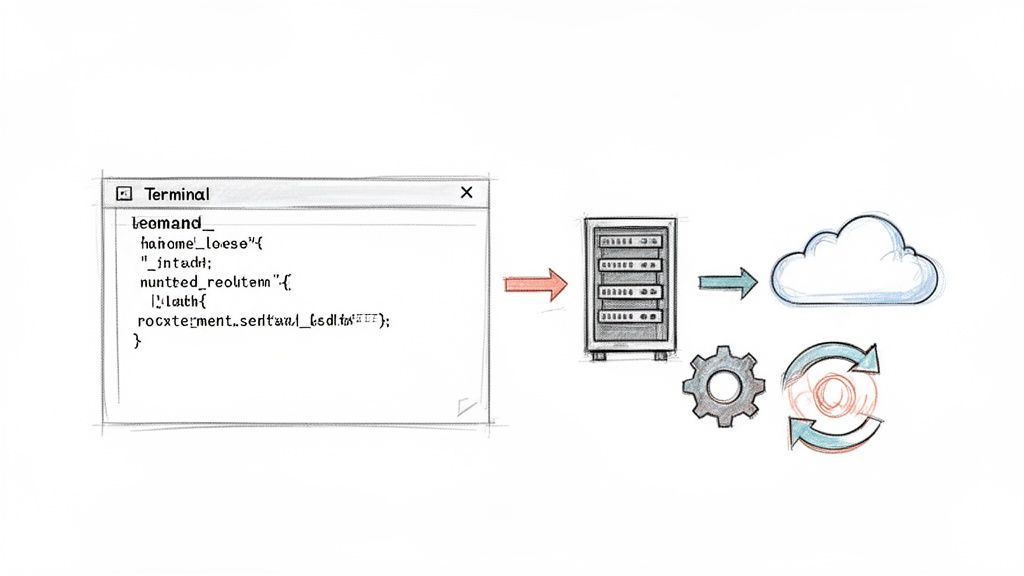
This type of manual is essential for any organization reliant on stable and repeatable technical setups. It empowers developers, IT staff, and support specialists to execute complex procedures with confidence, reducing reliance on the original system architects. For example, AWS deployment guides, Kubernetes cluster setup instructions, and API integration playbooks from companies like Stripe are powerful training manual examples that enable widespread adoption of their technologies.
Strategic Breakdown & Key Takeaways
Creating an effective technical guide requires precision and foresight. The documentation must be clear enough for a new team member to follow but detailed enough to prevent configuration drift.
Version Control and Prerequisites: Always start by clearly stating the required software versions, system specifications, and dependencies. This prevents hours of troubleshooting caused by mismatched environments. HashiCorp’s Terraform documentation excels at this by specifying provider versions upfront.
Actionable Code Snippets and Expected Outputs: Don't just describe a command; provide a copy-and-paste code block. Immediately follow it with the expected terminal output or system response, so the user can verify that each step was completed successfully.
Environment-Specific Variables: Technical setups often differ between development, staging, and production. Use placeholders or distinct sections to outline the specific configurations for each environment, preventing accidental misconfigurations in live systems.
Key Insight: The most robust technical manuals include explicit rollback procedures. Detailing how to safely undo a change before it's made transforms the manual from a set of instructions into a risk-management tool.
When to Use This Manual
This type of training manual is ideal for:
DevOps and IT Operations: Standardize server setups, infrastructure deployment, and CI/CD pipeline configurations.
Software Development Teams: Document the process for setting up local development environments to ensure consistency across the team.
Third-Party Integrations: Provide clear, step-by-step instructions for customers or partners integrating with your API or platform.
By creating a meticulous implementation manual, you build a repeatable and scalable foundation for your technical operations. To learn more about structuring such documents, review our guide on how to create training manuals for practical advice.
8. Quality Assurance and Testing Procedures Manual
A quality assurance (QA) and testing procedures manual is a critical document that standardizes how a product's quality is verified. Its purpose is to establish a unified approach to test strategies, case documentation, and bug reporting, ensuring that every team member follows the same rigorous process. This consistency is vital for reducing the number of defects that reach production, which directly improves product reliability and customer satisfaction.
Unlike informal testing guidelines, a formal QA manual creates a single source of truth for the entire development lifecycle. It defines what "quality" means for a specific product and outlines the exact steps to achieve it. For instance, detailed procedures for mobile app testing on iOS and Android or clear standards for API contract testing are excellent training manual examples that prevent ambiguity. This structured approach helps teams ship better products faster by catching issues early.
Strategic Breakdown & Key Takeaways
Building an effective QA manual involves codifying best practices into repeatable workflows. The document should be clear enough for a new tester to understand and detailed enough to serve as a reference for senior engineers.
Standardized Test Case Templates: Create a uniform structure for all test cases, including fields for a test ID, description, preconditions, steps, expected results, and actual results. This makes tests easy to execute, review, and maintain.
Clear Bug Reporting Protocol: Define the exact information required for a bug report, such as a summary, environment details, reproduction steps, and severity/priority levels. This ensures developers receive actionable information and reduces back-and-forth communication.
Integrate Automation Wisely: Specify which types of tests should be automated, like regression suites that run frequently. Document the tools (e.g., Selenium) and processes for creating, running, and analyzing automated test results to maximize efficiency.
Key Insight: A great QA manual isn't just a list of rules; it's a playbook for risk management. It should categorize tests by priority and link testing activities directly to business requirements, ensuring that the most critical functions receive the most attention.
When to Use This Manual
This type of training manual is essential for:
Growing Engineering Teams: Standardize testing practices as new developers and QA specialists join the team.
Complex Product Development: Ensure comprehensive test coverage for products with multiple platforms, integrations, or user workflows.
Improving Release Quality: Establish a formal process to minimize bugs in production and build a reputation for reliability.
By creating a detailed QA and testing manual, you establish a culture of quality that scales with your organization. For more guidance on building structured documentation, check out our article on how to create training manuals for practical advice.
8-Point Training Manual Comparison
Template | 🔄 Implementation Complexity | ⚡ Resource & Speed | ⭐📊 Expected Outcomes | Ideal Use Cases | 💡 Key Advantages |
|---|---|---|---|---|---|
Software Onboarding Training Manual | Moderate–High 🔄 multimedia, role variants; ongoing updates | High ⚡ recording tools, designers, analytics; slow initial build | High ⭐📊 reduces support tickets; accelerates time-to-value; measurable engagement | SaaS product teams, customer success, feature launches | Scalable interactive guidance; real-time updates; role-specific paths |
Employee Onboarding and HR Training Manual | Moderate 🔄 cross-department coordination; policy updates required | Medium ⚡ HR time, videos, mentors; quick to scale once built | High ⭐📊 standardizes onboarding; improves retention; ensures compliance | HR managers, distributed teams, growing organizations | Consistent processes; compliance coverage; onboarding efficiency |
Client Service Delivery & Process Documentation Manual | Moderate 🔄 process mapping + client customization; versioning needed | Medium ⚡ templates + customization; speeds handoffs post-setup | High ⭐📊 consistent service quality; shorter project timelines; client confidence | Agencies, consultancies, service teams | Service consistency; smoother handoffs; client-facing deliverables |
Product Support & Customer Troubleshooting Manual | Moderate 🔄 knowledge capture, decision trees, escalation flows | Medium ⚡ support tools, writers; requires continuous upkeep | Very High ⭐📊 lowers resolution time; reduces ticket volume; enables self-service | Support teams, SaaS companies, help centers | Faster resolutions; consistent answers; analytics-driven prioritization |
Compliance and Safety Training Manual | High 🔄 specialized legal/regulatory input; role-specific tracks | High ⚡ compliance experts, tracking systems; slower to implement | High ⭐📊 legal protection; audit readiness; reduced operational risk | Regulated industries (healthcare, finance, manufacturing) | Audit trails; measurable completion; role-based compliance |
Sales Process & Customer Pitch Training Manual | Moderate 🔄 framework alignment + live-call examples; needs buy-in | Low–Medium ⚡ templates, recordings; quick to deploy and iterate | High ⭐📊 shorter ramp time; improved conversion; consistent messaging | Sales teams, enablement, revenue ops | Repeatable pitches; objection scripts; measurable performance |
Technical Implementation & Setup Manual | High 🔄 deep technical detail; environment-specific variants | High ⚡ engineers, testing environments; upfront cost, faster deployments later | High ⭐📊 consistent deployments; fewer errors; clear rollback/recovery | DevOps, IT teams, integrations | Reliable deployments; disaster recovery; audit documentation |
Quality Assurance & Testing Procedures Manual | High 🔄 extensive test plans, automation, continuous updates | High ⚡ QA tools, automation engineers; initial heavy lift, speeds releases | High ⭐📊 fewer defects; reliable releases; improved QA metrics | QA teams, development orgs, product engineering | Standardized testing; regression coverage; traceable results |
From Manuals to Momentum: Building Your SOP Library
We've explored a wide spectrum of training manual examples, from the detailed precision of a technical implementation guide to the empathetic structure of a customer support playbook. Across all these documents, a clear pattern emerges: the most effective training manuals are not static, dusty binders on a shelf. They are living, breathing resources designed for action, clarity, and continuous improvement. The days of creating a dense document, emailing it once, and hoping for the best are over. Success now depends on building a dynamic library of standard operating procedures (SOPs) that empowers your team from day one.
The core lesson from analyzing these varied examples is that the medium is just as important as the message. A brilliant sales process documented in a 50-page PDF will be ignored. The same process, broken down into an interactive, step-by-step guide with checklists and visuals, becomes an indispensable tool that drives consistent performance. This shift from passive information to active engagement is the single most critical factor in creating documentation that people actually use.
Synthesizing the Core Principles of Effective Manuals
Reflecting on the best practices seen in the examples, several key principles stand out. Adopting these will fundamentally change how you approach process documentation and training.
Clarity Over Complexity: Every successful manual prioritizes simplicity. It uses plain language, avoids jargon where possible, and presents information in a logical, sequential flow. The goal is to eliminate ambiguity, ensuring any team member can follow the process and achieve the same outcome.
Visuals as a Primary Tool: From annotated screenshots in a software onboarding guide to flowcharts in a quality assurance manual, visual aids are not decorative. They are essential for conveying complex information quickly and reducing cognitive load. As we saw, a single well-placed image or short video can replace paragraphs of text.
Action-Oriented Structure: The best manuals are built around tasks and outcomes. Instead of long narrative sections, they use checklists, numbered steps, and clear headings that guide the user through a specific action. This makes the information immediately applicable and easy to scan for specific needs.
Accessibility and Centralization: A manual is only useful if it can be found and accessed in the moment of need. The most effective systems, as highlighted, store all SOPs in a centralized, searchable knowledge base. This prevents fragmented or outdated information from causing confusion and errors.
The Strategic Value of a Modern SOP Library
Moving beyond individual documents to build a comprehensive SOP library creates a powerful competitive advantage. It's an investment that pays dividends in operational efficiency, team alignment, and scalability. When your processes are clearly documented and easily accessible, you unlock several key benefits. You reduce the time it takes to onboard new employees, enabling them to become productive faster. You create consistency in service delivery, ensuring every client and customer receives the same high-quality experience.
Furthermore, a well-maintained SOP library turns institutional knowledge into a tangible asset. Critical "how-to" information no longer resides only in the minds of a few key employees, which protects your business from knowledge loss during personnel changes. It also provides a foundation for systematic improvement. When a process is documented, it can be analyzed, tested, and refined over time, leading to lasting gains in productivity and quality. The training manual examples we've reviewed are more than just templates; they are blueprints for building a more resilient, efficient, and scalable organization.
Ready to move from static documents to a dynamic SOP library? The examples here show what’s possible, but creating them manually is time-consuming. Build a Guide automatically converts any screen-recorded workflow into a beautiful, interactive step-by-step guide in seconds. Stop writing manuals and start building your operational playbook today at Build a Guide.